
Hot-Dip Galvanized Steel Pipe (Round), DN15 to DN300
Hot-dip galvanized round steel pipe from DN15 to DN300 with a zinc coating of 30 to 700 g/m², produced to GB/T 3091 for water, gas, fire-protection, heating and structural duty. Supplied in 6 m lengths, threaded and coupled or plain end, with mill certificate and coating report.
Product Overview
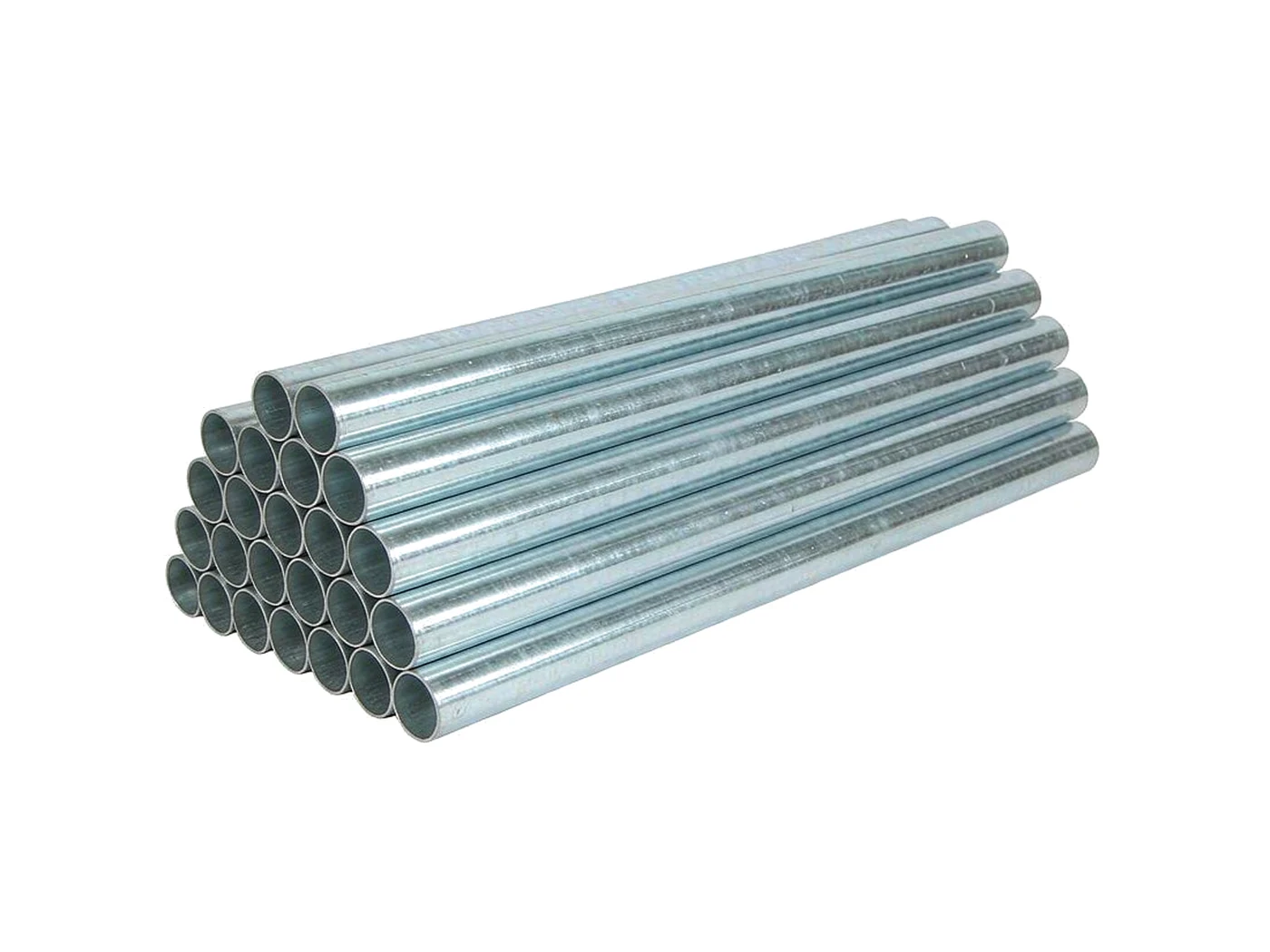
Galvanized round pipe is ERW welded steel pipe that has been pickled, fluxed and dipped in molten zinc, so a zinc-iron alloy layer forms on the outside surface and on the bore. Inside a tube the coating matters even more than outside, because the bore is where the water sits and where no paint can ever reach; the zinc protects the inside of the pipe by sacrificial action, which is why a galvanized water line outlasts a black one by a wide margin.
Pipe is produced to GB/T 3091 in Q195, Q215 and Q235, with the size designated by nominal bore from DN15 up to DN300. DN15 is 21.3 mm outside diameter and DN20 is 26.9 mm, and the run continues through the familiar sizes to DN100 at 114.3 mm and DN300 at 325 mm. Wall thicknesses typically run from 1.8 mm to about 9.75 mm depending on the size and the pressure class.
For water, gas and fire-protection work the pipe is hydrostatically tested to the standard with the test pressure recorded, and can be delivered plain end or threaded with couplings and caps. Internally plastic-lined galvanized pipe is available in the same size range where the line carries aggressive water.
Specifications & Size Range
Nominal bore, outside diameter, common wall thickness and the duty each size group is normally ordered for. Coating weight is selected per order and stated on the acknowledgement. Threading, grooving and internal plastic lining are available on request.
| Nominal bore | Outside diameter (mm) | Wall thickness (mm) | Coating (g/m²) | Typical use |
|---|---|---|---|---|
| DN15 – DN25 | 21.3 / 26.9 / 33.7 | 1.8 – 3.25 | 30 – 275 | Branch lines, instrument piping, conduits, small sprinkler drops |
| DN32 – DN50 | 42.4 / 48.3 / 60.3 | 2.0 – 4.0 | 180 – 400 | Water distribution, gas risers, sprinkler branches, heating circuits |
| DN65 – DN100 | 76.1 / 88.9 / 114.3 | 2.5 – 5.0 | 180 – 500 | Fire mains, sprinkler mains, risers, plant water lines |
| DN125 – DN200 | 139.7 / 168.3 / 219.1 | 3.5 – 7.75 | 275 – 500 | Water trunk mains, hydrant lines, industrial pipework, piling sleeves |
| DN250 – DN300 | 273 / 323.9 | 4.5 – 9.75 | 275 – 500 | Municipal mains, outfalls, gantry and structural tubular members |
Tolerances
Dimensions, wall thickness and technical delivery follow GB/T 3091 for welded steel pipe for liquid service. Coating is applied and tested to GB/T 13912, ISO 1461, ASTM A123 and JIS H8641, and is quoted as coating mass in g/m² total on both surfaces, with roughly 7 µm of coating per 100 g/m². Hydrostatic test pressure is applied to the standard and the record is supplied with the pipe.
Available Sizes — Detailed Specification Pages
Every size below has its own page with the full theoretical weight table, tolerances, grade data, applications and delivery options.
| Size | Wall thickness (mm) | Specification page |
|---|---|---|
| OD 21.3 mm | 2.0 – 2.8 | Weight & specification |
| OD 33.7 mm | 2.0 – 3.2 | Weight & specification |
| OD 48.3 mm | 2.5 – 3.5 | Weight & specification |
| OD 60.3 mm | 2.0 – 3.5 | Weight & specification |
| OD 76.1 mm | 2.5 – 4.0 | Weight & specification |
| OD 88.9 mm | 3.0 – 4.5 | Weight & specification |
| OD 114.3 mm | 3.0 – 5.0 | Weight & specification |
Steel Grades & International Equivalents
All grades below are supplied with a mill test certificate. The right-hand column shows the material type and the Chinese standard the grade is produced to; the middle columns give the nearest recognised equivalent in other national standards. Exact equivalence for a specific project should be confirmed on the enquiry.
| GB (China) | ASTM / AISI (US) | EN (Europe) | JIS (Japan) | DIN (Germany) | Type / Standard |
|---|---|---|---|---|---|
| Q235B + hot-dip galvanized | A123 / A153 (ASTM) | EN ISO 1461 | JIS H8641 | DIN 50976 | Hot-dip galvanized structural steel (GB/T 13912) |
| Q235B welded pipe | A53 Gr.B / A500 Gr.B | EN 10219 S235JRH | STK400 (JIS G3444) | St37-2 | Welded steel pipe (ERW / LSAW) (GB/T 3091) |
| Q195 welded pipe | A53 Gr.A / A500 | EN 10255 (S195T) | SGP (JIS G3452) | St33 | Welded steel pipe (ERW) (GB/T 3091) |
Grade Notes
- Q235B + hot-dip galvanized — Zinc coating of 30–700 g/m² gives 5–30+ years of atmospheric corrosion protection depending on thickness and environment.
- Q235B welded pipe — Structural welded pipe for scaffolding, piling, water mains and building frames.
- Q195 welded pipe — General-purpose welded pipe for water, gas, heating and structural framing.
Chemical Composition (%, ladle analysis)
Typical specification limits. Actual heat values are reported on the mill test certificate supplied with every shipment.
| Grade | C | Si | Mn | P max | S max | Other elements |
|---|---|---|---|---|---|---|
| Q235B welded pipe | ≤0.20 | ≤0.35 | ≤1.40 | ≤0.045 | ≤0.045 | — |
| Q195 welded pipe | ≤0.12 | ≤0.30 | 0.25–0.50 | ≤0.035 | ≤0.040 | — |
Mechanical Properties
Minimum values at room temperature unless stated. ReL = yield strength; Rp0.2 = 0.2% proof stress; Rm = tensile strength; A = elongation after fracture.
| Grade | Yield (ReL) | Proof (Rp0.2) | Tensile (Rm) | Elongation A | Impact / others | |
|---|---|---|---|---|---|---|
| Q235B + hot-dip galvanized | — | — | — | — | — | Coating 30–700 g/m² (both sides), made to order Adhesion per GB/T 13912 bend test |
| Q235B welded pipe | ≥235 MPa | — | 370–500 MPa | ≥26% | — | Test Pressure hydro-tested per spec |
| Q195 welded pipe | ≥195 MPa | — | 315–430 MPa | ≥33% | — | Test Pressure hydro-tested per spec |
Standards & Documents
- GB/T 3091 — welded steel pipes for liquid service, dimensions and technical delivery
- GB/T 13912 — hot-dip galvanized coatings on fabricated iron and steel articles
- ISO 1461 / EN ISO 1461 — hot-dip galvanized coatings, international equivalent
- ASTM A123 — zinc (hot-dip galvanized) coatings on iron and steel products
- JIS H8641 — hot-dip zinc coatings, Japanese equivalent
- Testing: hydrostatic pressure test to standard, coating mass test, EN 10204 3.1 mill test certificate
Typical Applications
| Industry / Application | Typical use |
|---|---|
| Building water supply | Riser and branch pipework in residential, commercial and industrial buildings, where the internal coating keeps service water clean of corrosion product. |
| Gas distribution | Town gas and LPG distribution mains, building gas risers and service pipes, supplied threaded and coupled or plain end for site welding. |
| Fire protection systems | Fire mains, hydrant pipework, sprinkler mains and standpipe risers, hydrostatically tested and supplied to the design pressure class. |
| Heating & HVAC | Heating circuits, chilled water mains, condenser lines and general HVAC pipework in plant rooms and distribution routes. |
| Structural & general fabrication | Scaffolding, handrails, fence posts, gantry members and general tubular steelwork that has to stand outdoors. |
| Irrigation & agriculture | Irrigation mains, sprinkler lines, livestock watering systems and greenhouse pipework. |
| Municipal & industrial pipework | Water mains, plant cooling and process lines, and pipework exposed to weather or a corrosive atmosphere. |
Common Problems Buyers Face — and How We Prevent Them
These are the issues that most often cause claims on steel imports. Each one is controlled in our process before shipment.
Zinc coating looks dull, mottled or uneven after dipping
Why it happens: Coating appearance depends on the base steel chemistry, the coating weight and the cooling rate, so a heavier coating is naturally duller than a light one, and mottling is not a coating defect.
Our control: We explain the expected appearance for the coating weight you have ordered, and where a uniform bright finish matters for exposed architectural work we advise on the coating weight and finish that can deliver it. Coating mass, not appearance, is what is measured against the standard.
The internal coating is thin or missing in places
Why it happens: Zinc has to flow into and drain out of the pipe bore, and if the pipe is dipped at the wrong angle or drained too quickly the internal coating is uneven.
Our control: Pipe is dipped at an angle that lets the zinc flow through the bore and drain fully, and internal coating is checked on cut samples per lot. Where a defined internal coating is specified, we confirm the dipping method and the coating mass we can guarantee inside.
Threads cut after galvanizing leave bare steel
Why it happens: Any threading or grooving done after dipping removes the coating exactly where the joint will be wettest, so the threads rust first even though the rest of the pipe is protected.
Our control: We supply threaded and coupled pipe with the threads cut before dipping, or with threaded ends protected by couplings and caps, so no bare steel is left at the joint. Site-cut threads should be repaired with zinc-rich paint, which we can supply with the order.
Hydrostatic test certificate does not state the pressure the authority is asking for
Why it happens: The test is normally performed to the standard rather than to the project figure, and a receiving inspector working from a project specification can reject a certificate that does not quote the same number.
Our control: Tell us the required test pressure and duration when you order. The pipe is tested to that figure and the report states it explicitly, so the document matches the specification being enforced rather than the default standard test.
Pipe delivered with the coating scuffed at the ends and along the length
Why it happens: Galvanized pipe is heavy, rolled and handled with chains, and the coating is soft compared with the steel, so handling marks are almost impossible to avoid without protection.
Our control: Ends are protected with caps or wrapping, bundles are lifted with slings rather than hooks where the order allows, and touch-up material is supplied for minor marks. Where appearance is critical, we discuss the handling and packing method with the customer before shipment.
Our Supply & Manufacturing Advantages
- Coating inside and outside — The bore, the outer surface and the cut ends are all coated, which is what makes galvanized pipe suitable for water and gas service.
- Hydrostatic testing before shipment — Every pipe can be pressure tested to the standard or to your project figure, with the test pressure and duration stated on the report.
- Ready to install — Supplied plain end, or threaded and coupled with caps, grooved, or cut to length, so the pipe arrives in the condition your site procedure expects.
- Coating weight to your specification — 30 to 700 g/m² quoted on the enquiry and tested per lot, matched to the atmosphere the line will run in.
- Plastic-lined option — Internally plastic-lined galvanized pipe in the same nominal bore range for aggressive water and chemical service.
- Documented and traceable — EN 10204 3.1 mill test certificate, hydrostatic test report and coating mass report with every shipment.
Packaging, Delivery & Payment
- Packing: loose in bulk vessel, or bundled and containerised to your requirement. Galvanized and coated products get VCI paper, waterproof wrapping and edge protection. See our export packaging methods.
- Availability: both stock and custom production. Tell us the specification and we will confirm the route.
- MOQ: no strict minimum — one ton can ship.
- Lead time: stock dispatched to port within 3 days; orders needing export packaging about 1 week; custom production quoted per product.
- Payment: stock — 10% deposit, balance before shipment; custom production — 50% deposit, balance before shipment.
- Documents: EN 10204 3.1 mill test certificate with every shipment; third-party inspection (SGS / BV) on request.
Frequently Asked Questions
What is the equivalent of DN15 and DN20 galvanized pipe in inches?
DN15 is nominally a half-inch pipe with an outside diameter of 21.3 mm, and DN20 is nominally three-quarter inch with a 26.9 mm outside diameter. The nominal bore is a size designation rather than the actual inside diameter, so always work from the outside diameter and the wall thickness. DN25 is 33.7 mm, DN50 is 60.3 mm and DN100 is 114.3 mm.
Can galvanized pipe be used for gas lines?
Yes. Galvanized steel pipe is a standard material for town gas and LPG distribution, building gas risers and service pipes, and is normally supplied threaded and coupled. The internal and external coating protects the pipe against condensate and ground moisture. Check the local gas code for the jointing method and any restriction on the pipe used downstream of the meter.
What coating weight should I specify for a fire main or outdoor pipe?
For internal fire mains in a dry building, 180 to 275 g/m² is normally adequate. For pipework exposed to weather, or installed in a coastal or industrial atmosphere, we recommend 350 to 500 g/m². For buried or permanently wet service, 500 g/m² and above. Tell us the installation conditions and the design life and we will nominate the figure.
What pressure is the pipe tested to?
The pipe is hydrostatically tested to the applicable GB/T 3091 requirement for its size and wall thickness, and the test pressure and duration are recorded on the test report. If your project specifies a different test pressure, state it on the enquiry and the pipe will be tested and reported to that figure instead.
Does the zinc coating affect water quality?
Zinc is a permitted material in contact with water in most jurisdictions, and galvanized steel pipe has been used for potable water for well over a century. New pipe does release a small amount of zinc into standing water for a short period, which is why freshly installed lines are flushed before use. Where the water is aggressive or the local code restricts galvanized pipe, specify internally plastic-lined pipe.
Who supplies hot-dip galvanized steel pipe from China for export?
We do. Dayang supplies galvanized pipe to distributors, plumbing and fire-protection contractors and stockists worldwide in DN15 to DN300, plain or threaded and coupled, with hydrostatic test records and coating reports issued with each shipment. Send the size list and the coating specification for a quotation.
Do you have a minimum order quantity?
No strict minimum and one ton can ship, though galvanized pipe is normally most economical in container quantities and we will tell you where the freight break points are. Mixed sizes in one container are welcome and are packed so that each size is separately identified.
What documents come with a galvanized pipe shipment?
An EN 10204 3.1 mill test certificate showing heat number, chemical composition and mechanical properties, a hydrostatic test report and a coating mass test report, plus the commercial invoice, packing list and certificate of origin. Pre-shipment inspection by SGS or BV can be arranged.
How is galvanized pipe packed for sea freight?
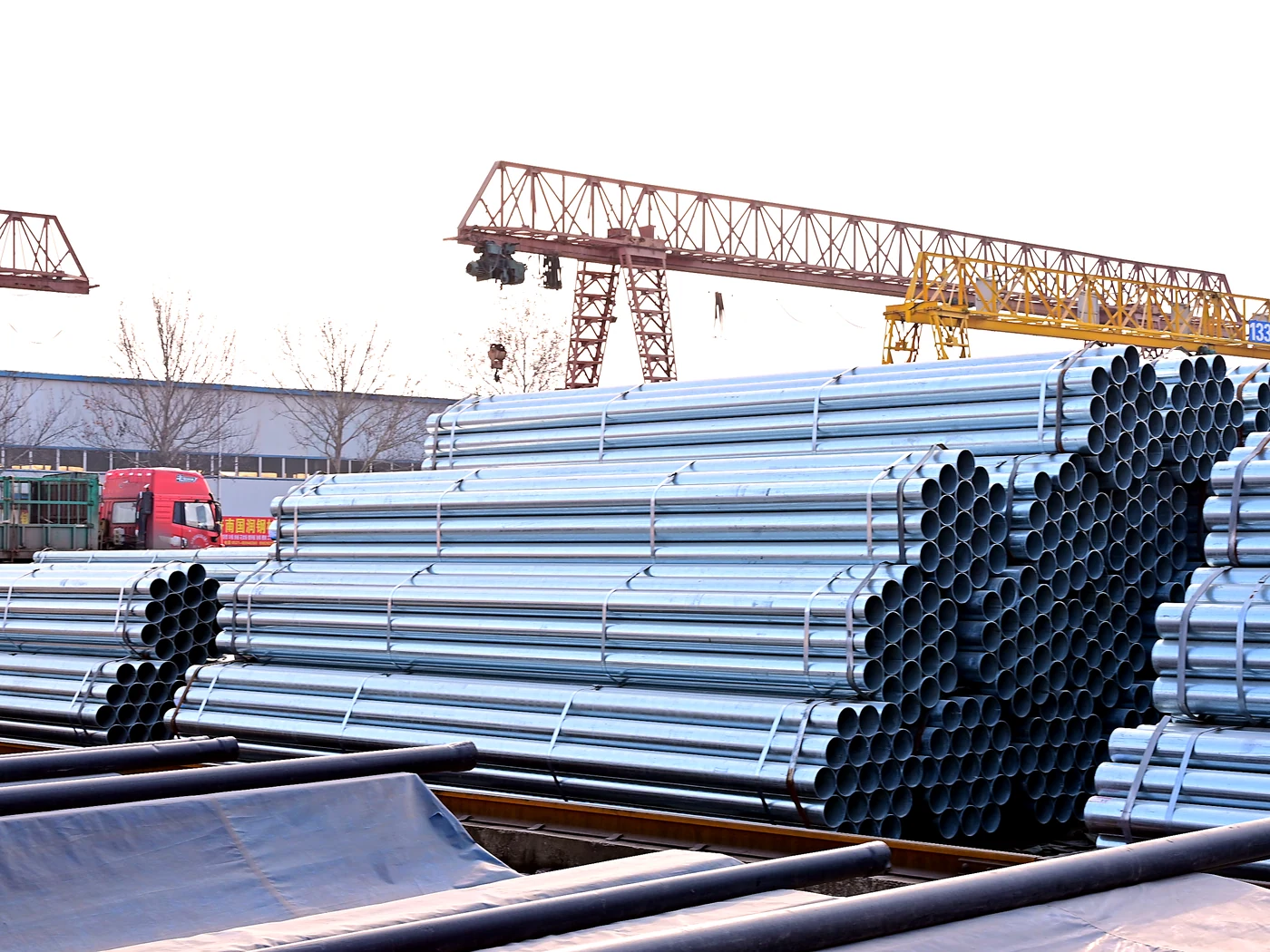
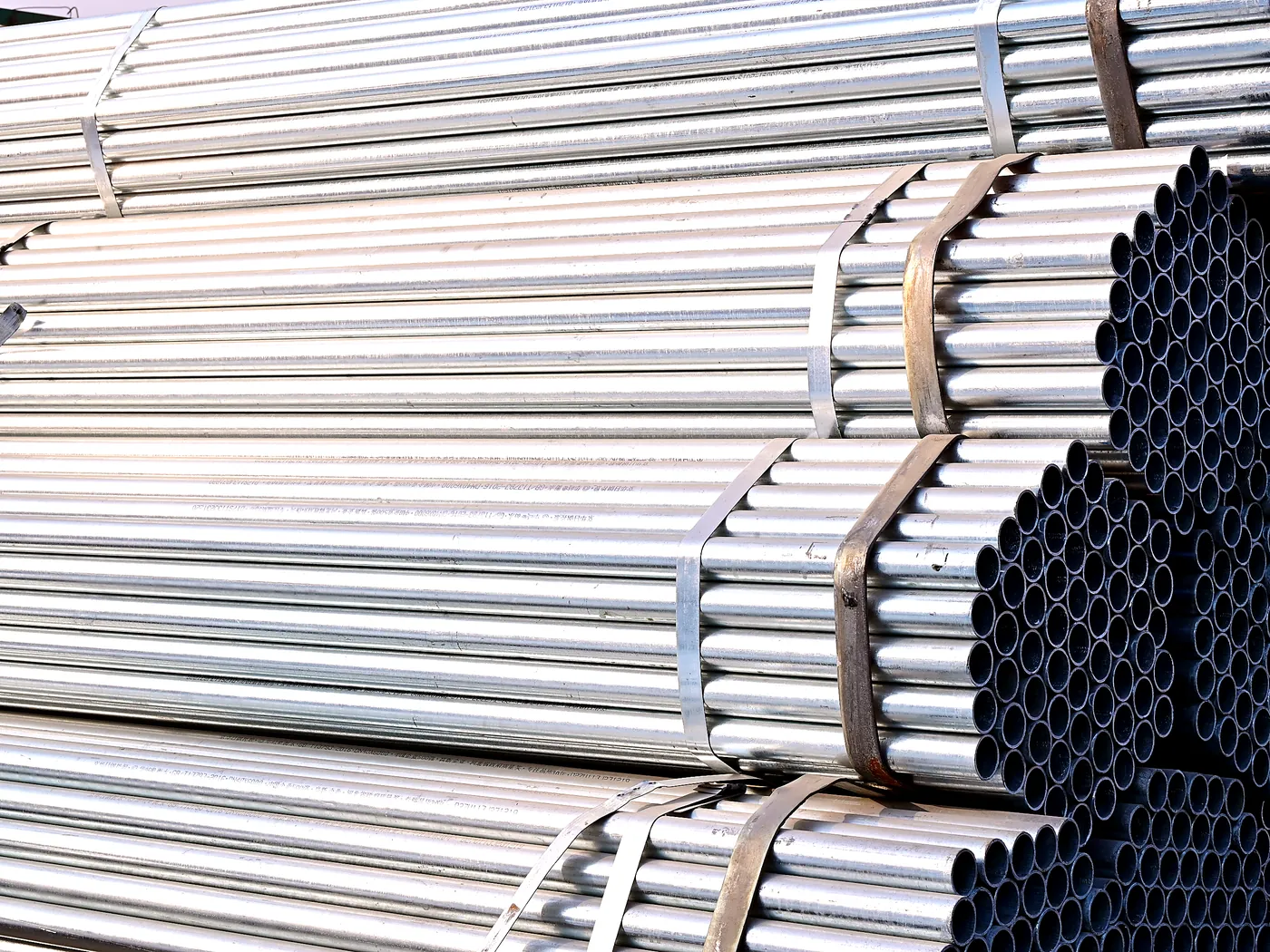
Pipe is bundled with steel straps in hexagonal or square bundles for container loading, with end caps or wrapping to protect the coating and the threads. Larger sizes are shipped break-bulk or in flat racks, nested and lashed. Bundle labels show the nominal bore, wall thickness and coating weight.
Request a Quotation Export Packaging