
Alloy Steel Round Bar (20Cr, 40Cr, 20CrMnTi, 42CrMo, GCr15, 65Mn)
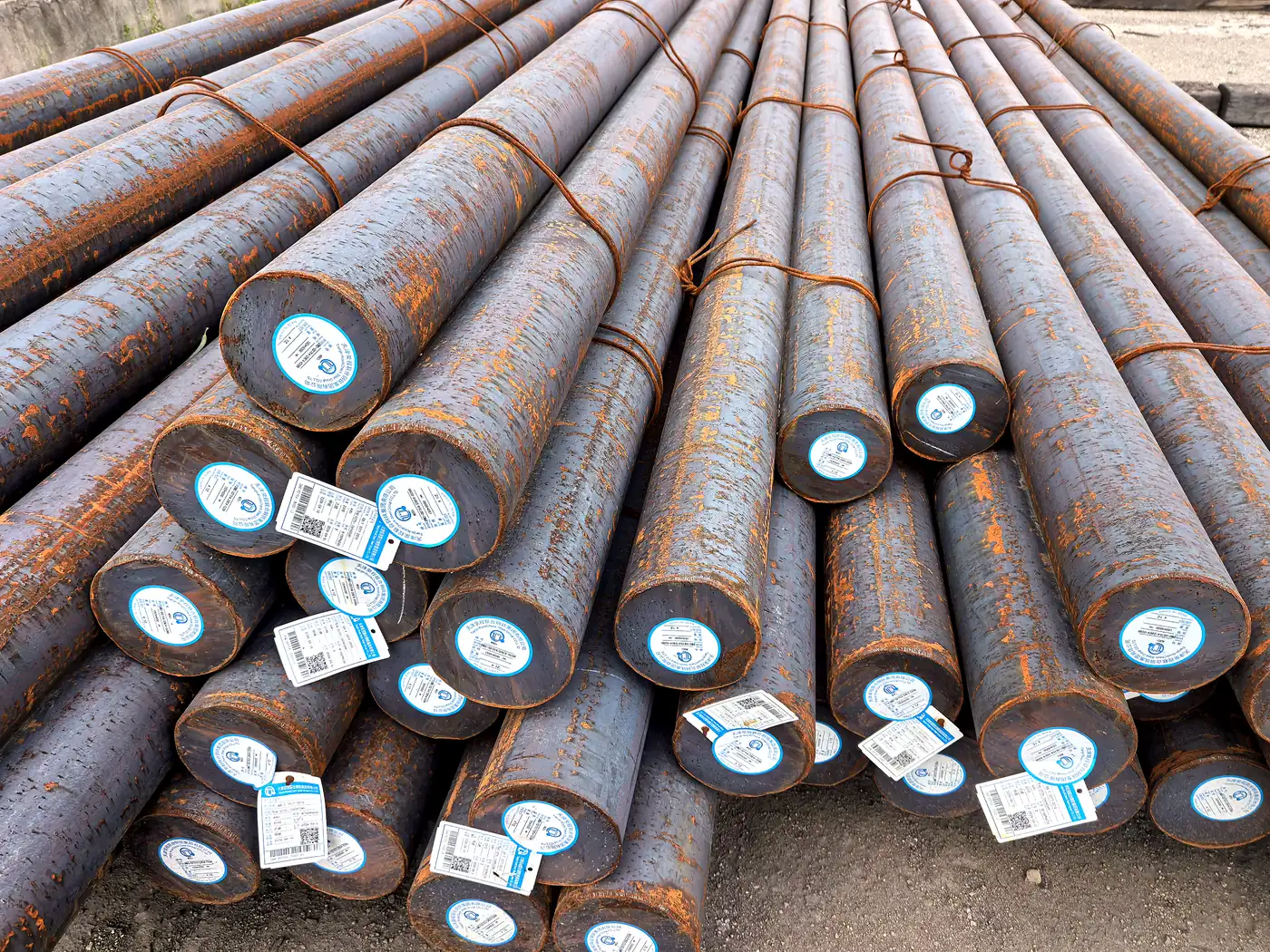
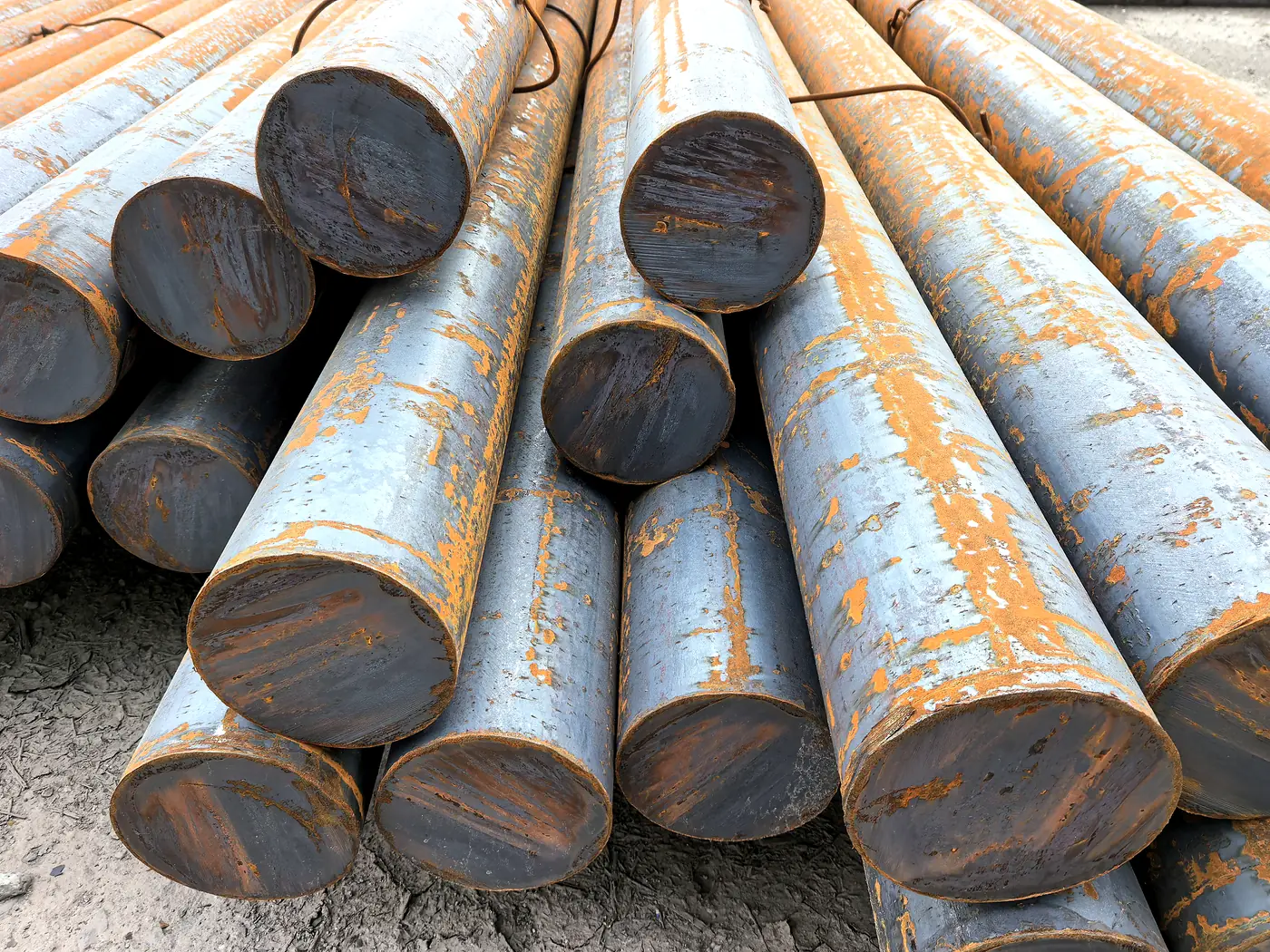
Alloy steel round bar in carburizing, quench-and-temper, bearing and spring grades, in diameters from 16 mm to 800 mm as hot-rolled or forged bar. Supplied black, forged, rough-turned or peeled and ground, in the as-rolled, annealed or quenched-and-tempered condition, with ultrasonic testing available for forged material.
Product Overview
Alloy steel round bar is carbon steel with chromium, molybdenum, manganese, nickel or titanium added to change how it hardens and how it behaves under load. The practical consequences are higher strength at a given section size, better hardenability so that a large section hardens through rather than only at the surface, and improved fatigue and wear resistance. That is why gears, shafts, bearings, springs and moulds are made from alloy bar rather than from plain carbon bar: the part is not just stronger, it holds its properties through the section and through the heat treatment.
Four families cover the majority of enquiries. Carburizing grades — 20Cr and 20CrMnTi — give a hard, wear-resistant case with a tough core, and are used for gears, pins and camshafts. Quench-and-temper grades — 40Cr and 42CrMo — give high strength and fatigue resistance through the section and are the standard shaft and axle materials. GCr15 is a through-hardening bearing steel used for rings, balls, rollers and precision spindles. 65Mn is a manganese spring steel used for springs, washers, plough discs and wear parts.
Delivery condition matters as much as grade, because an alloy bar that is too hard cannot be machined and a bar that is too soft cannot be used without a full heat treatment. We supply bar as-rolled, annealed for machining, or quenched and tempered, in black hot-rolled or forged finish, rough-turned, or peeled and ground for tight dimensional control. Forged bar can be supplied with ultrasonic testing where the part will carry a heavy or safety-critical load.
Specifications & Size Range
Diameter groups, production routes, delivery conditions and typical uses. Small and medium sizes are produced by hot rolling, larger sizes by forging, and the delivery condition is chosen to suit the machining and heat treatment you plan. Non-standard diameters and cut lengths are produced to order.
| Size group | Diameter range (mm) | Production route | Delivery condition | Typical use |
|---|---|---|---|---|
| Small bar | 16 – 60 | Hot-rolled | Black, annealed or quenched and tempered | Gears, pins, small shafts, fasteners, springs |
| Medium bar | 65 – 150 | Hot-rolled or forged | Black or annealed, peeled on request | Shafts, axles, hydraulic rods, gear blanks |
| Large bar | 160 – 400 | Forged | Forged black, rough-turned, annealed | Heavy shafts, press columns, ring and disc blanks |
| Heavy bar | 420 – 800 | Forged | Forged black or rough-machined, ultrasonic testing on request | Moulds, large rings, mill and crusher parts |
| Bright / precision | 16 – 150 | Peeled or cold-finished | Bright, h9 / h11 on request | Precision shafts, spindles, machine parts |
Tolerances
Dimensions and tolerance of hot-rolled bar follow GB/T 702, with the permitted limits for the ordered size stated on the mill certificate. Forged bar is supplied to an agreed dimensional tolerance and machining allowance rather than to a rolled tolerance. Where peeled or ground bar is ordered, the diameter tolerance is quoted in ISO 286 bands and confirmed on the order acknowledgement, and ultrasonic testing of forged bar is carried out to the standard agreed on the enquiry.
Steel Grades & International Equivalents
All grades below are supplied with a mill test certificate. The right-hand column shows the material type and the Chinese standard the grade is produced to; the middle columns give the nearest recognised equivalent in other national standards. Exact equivalence for a specific project should be confirmed on the enquiry.
| GB (China) | ASTM / AISI (US) | EN (Europe) | JIS (Japan) | DIN (Germany) | Type / Standard |
|---|---|---|---|---|---|
| 40Cr | AISI 5140 | 41Cr4 (EN 10083) | SCr440 | 41Cr4 | Alloy structural steel (quench & temper) (GB/T 3077) |
| 20CrMnTi | AISI 8620 (approx.) | 20MnCr5 (EN 10084) | SCr420 (JIS G4104) | 20MnCr5 | Alloy carburizing steel (GB/T 3077) |
| 42CrMo | AISI 4140 | 42CrMo4 (EN 10083) | SCM440 | 42CrMo4 | Alloy structural steel (Q&T) (GB/T 3077) |
| GCr15 | AISI 52100 / ASTM A295 | 100Cr6 (EN ISO 683-17) | SUJ2 | 100Cr6 | Bearing steel (through-hardening) (GB/T 18254) |
| 65Mn | AISI 1566 | 1.1231 / C67S | SUP9 (approx.) | CK67 | Spring steel (GB/T 1222) |
Grade Notes
- 40Cr — The classic Chinese shaft steel: high strength and fatigue resistance after quenching and tempering.
- 20CrMnTi — Case-hardening alloy steel: tough core with hard wear-resistant surface. Used for gears, shafts and transmission parts.
- 42CrMo — The most widely used high-strength alloy steel in China, equivalent to AISI 4140 / EN 42CrMo4.
- GCr15 — Standard bearing steel for rings, balls and rollers; also used for precision spindles and gauges.
- 65Mn — Manganese spring steel for springs, washers, plough discs, saw blades and wear parts.
Chemical Composition (%, ladle analysis)
Typical specification limits. Actual heat values are reported on the mill test certificate supplied with every shipment.
| Grade | C | Si | Mn | P max | S max | Other elements |
|---|---|---|---|---|---|---|
| 40Cr | 0.37–0.44 | 0.17–0.37 | 0.50–0.80 | ≤0.035 | ≤0.035 | Cr 0.80–1.10 |
| 20CrMnTi | 0.17–0.23 | 0.17–0.37 | 0.80–1.10 | ≤0.035 | ≤0.035 | Cr 1.00–1.30 Ti 0.04–0.10 |
| 42CrMo | 0.38–0.45 | 0.17–0.37 | 0.50–0.80 | ≤0.035 | ≤0.035 | Cr 0.90–1.20 Mo 0.15–0.25 |
| GCr15 | 0.95–1.05 | 0.15–0.35 | 0.25–0.45 | ≤0.025 | ≤0.025 | Cr 1.40–1.65 |
| 65Mn | 0.62–0.70 | 0.17–0.37 | 0.90–1.20 | ≤0.035 | ≤0.035 | — |
Mechanical Properties
Minimum values at room temperature unless stated. ReL = yield strength; Rp0.2 = 0.2% proof stress; Rm = tensile strength; A = elongation after fracture.
| Grade | Yield (ReL) | Proof (Rp0.2) | Tensile (Rm) | Elongation A | Impact / others | |
|---|---|---|---|---|---|---|
| 40Cr | ≥785 MPa (Q&T) | — | ≥980 MPa | ≥9% | — | — |
| 20CrMnTi | ≥835 MPa (quenched & tempered) | — | ≥1080 MPa | ≥10% | — | — |
| 42CrMo | ≥930 MPa (Q&T) | — | ≥1080 MPa | ≥12% | — | — |
| GCr15 | — | — | ≥1700 MPa (hardened) | — | — | — |
| 65Mn | ≥785 MPa | — | ≥980 MPa | ≥8% | — | — |
Standards & Documents
- GB/T 3077 — alloy structural steels (20Cr, 40Cr, 20CrMnTi, 42CrMo)
- GB/T 18254 — high-carbon chromium bearing steel (GCr15)
- GB/T 1222 — spring steels (65Mn)
- GB/T 702 — hot-rolled steel bar: dimensions, shape and tolerance
- GB/T 6402 — ultrasonic testing of forged steel, where ultrasonic inspection is specified
- EN 10204 3.1 mill test certificate with chemical composition and mechanical properties; SGS or BV third-party inspection on request
Typical Applications
| Industry / Application | Typical use |
|---|---|
| Gears & transmission parts | Gear blanks, transmission shafts, synchroniser parts and camshafts. 20Cr and 20CrMnTi are carburized to give a hard case with a tough core; 40Cr and 42CrMo are used quenched and tempered where a through-hardened part is required. |
| Shafts & axles | Drive shafts, axle shafts, crankshafts, connecting rods and hydraulic rods. 40Cr and 42CrMo are the standard choices, with 42CrMo used where the section is large or the load is heavy and fatigue life matters. |
| Bearings & wear parts | Bearing rings, balls, rollers, wear bushes and precision spindles in GCr15, hardened to give the hardness and dimensional stability a rolling contact demands. |
| Springs, washers & discs | Coil and leaf springs, spring washers, plough discs, saw blades and other parts that must deflect and recover, using 65Mn spring steel. |
| Moulds & tooling | Mould bases, ejector plates, die holders and tooling components, where a quench-and-temper alloy bar gives the strength and toughness the tool has to hold through a production run. |
| Mining & construction machinery | Crusher shafts, breaker parts, excavator pins and heavy linkage components in 42CrMo and 40Cr, often in the larger forged sizes with ultrasonic testing. |
| Fasteners & high-strength bolts | High-strength bolt, stud and nut stock, where 40Cr and 42CrMo quenched and tempered give the strength grade the fastener specification requires. |
Common Problems Buyers Face — and How We Prevent Them
These are the issues that most often cause claims on steel imports. Each one is controlled in our process before shipment.
Bar will not machine cleanly, or tool life is short
Why it happens: An alloy bar supplied as-rolled or incompletely annealed can arrive hard, and the problem only appears at the lathe or the mill after the material has been cut.
Our control: State the machining process on the enquiry and we will supply the bar annealed for machining with a hardness limit stated on the certificate — for example 229 HBW or below for 45#, 207 HBW for 40Cr, 217 HBW for 42CrMo and 20CrMnTi. That way the tool life and cycle time you planned are achievable.
Internal defects found after machining or in service
Why it happens: Large forged bar can contain shrinkage, porosity or inclusions that are invisible on the surface and only show up when the part is machined or when it fails under load.
Our control: Forged bar can be supplied with ultrasonic testing to the agreed standard, and the material is sourced from mills using vacuum degassing and refining. Where a part is safety-critical, specify ultrasonic testing on the enquiry so that it is carried out before shipment rather than discovered at your machine.
Surface decarburisation affecting the heat-treated case
Why it happens: A decarburised layer at the surface of an annealed or rolled bar will not reach the specified hardness after hardening, leaving a soft skin on a part that was supposed to be wear-resistant.
Our control: The machining allowance in the delivery condition is set so that the decarburised layer is removed during machining, and where the part is critical we can supply peeled or ground bar that has the surface condition controlled rather than rolled.
Grade substitution against an international specification
Why it happens: A drawing that calls out AISI 4140, AISI 52100 or AISI 8620 cannot be satisfied by a Chinese grade that is merely close without checking the chemistry and the hardenability.
Our control: We nominate the Chinese grade that corresponds to your drawing — 42CrMo for AISI 4140, GCr15 for AISI 52100, 40Cr for AISI 5140, 20CrMnTi for AISI 8620 — and put the chemistry and mechanical property comparison in writing so that you can check it against your own specification before the order is placed.
Hardness or properties vary between bars of the same heat
Why it happens: Inconsistent heat treatment at the mill, or a mix of delivery conditions in one shipment, produces bars that behave differently at the machine and after heat treatment.
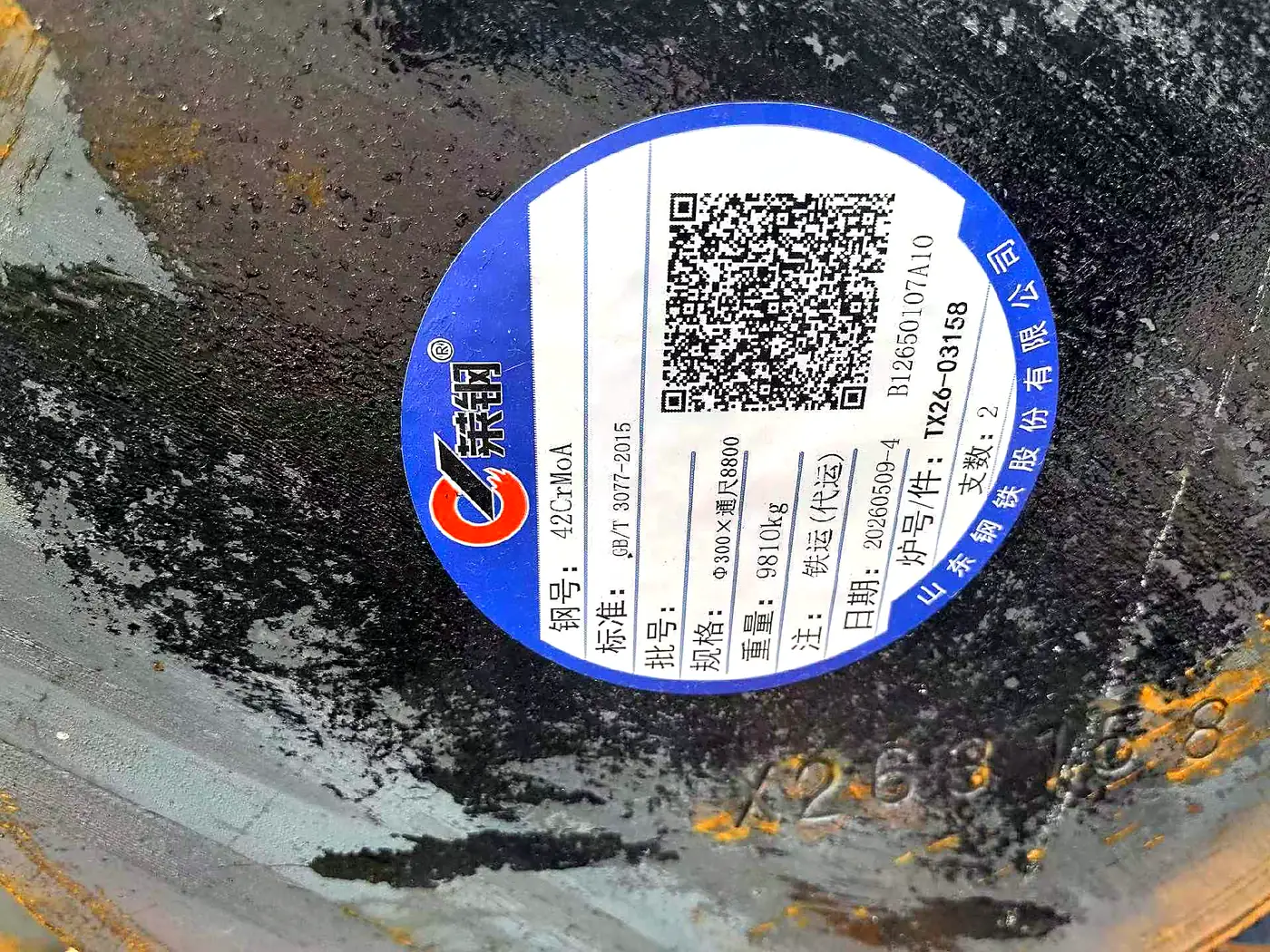
Our control: One delivery condition per item, stated on the order acknowledgement and on the mill certificate, with the bars bundled and tagged by heat number. Where a batch has to be uniform, we can supply the material in a single heat rather than as a mixed consignment.
Our Supply & Manufacturing Advantages
- Four alloy families from one supplier — Carburizing, quench-and-temper, bearing and spring grades in one order, so gear steel, shaft steel, bearing steel and spring steel arrive with one certificate set.
- Diameters from 16 mm to 800 mm — Small and medium sizes hot rolled, large sizes forged, so a single enquiry can cover both a small machined part and a heavy forged blank without a second supplier.
- Delivery condition to suit your process — As-rolled, annealed for machining, or quenched and tempered, in black, rough-turned or peeled and ground finish, with the hardness condition stated on the certificate.
- Inspection where it matters — Ultrasonic testing of forged bar, chemical analysis and mechanical testing on request, with SGS or BV third-party inspection available before loading.
- Grade equivalence support — We map your drawing specification (AISI 4140, 4340, 5140, 52100, 8620, EN 42CrMo4, 100Cr6, JIS SCM440, SUJ2) to the Chinese grade and confirm it in writing before the order.
- Export packaging built in — Bundled and strapped for container loading, or loose in bulk vessel for large tonnage, with end protection and rust protection where the route demands it.
Packaging, Delivery & Payment
- Packing: loose in bulk vessel, or bundled and containerised to your requirement. Galvanized and coated products get VCI paper, waterproof wrapping and edge protection. See our export packaging methods.
- Availability: both stock and custom production. Tell us the specification and we will confirm the route.
- MOQ: no strict minimum — one ton can ship.
- Lead time: stock dispatched to port within 3 days; orders needing export packaging about 1 week; custom production quoted per product.
- Payment: stock — 10% deposit, balance before shipment; custom production — 50% deposit, balance before shipment.
- Documents: EN 10204 3.1 mill test certificate with every shipment; third-party inspection (SGS / BV) on request.
Frequently Asked Questions
What is the Chinese equivalent of AISI 4140 alloy steel?
42CrMo to GB/T 3077 is the standard Chinese equivalent of AISI 4140, and the two are close in carbon, chromium and molybdenum content and in quenched-and-tempered strength. 42CrMo is the most widely used high-strength alloy steel we supply and is available from 16 mm to 800 mm. Send us the drawing with the required hardness and section size and we will confirm that the 42CrMo we ship will meet it.
What is the Chinese equivalent of AISI 52100 bearing steel?
GCr15 to GB/T 18254 is the Chinese equivalent of AISI 52100 and of EN 100Cr6. It is a through-hardening high-carbon chromium bearing steel supplied in the annealed condition for machining and then hardened to the 60 to 66 HRC range for bearing rings, balls and rollers. It is also used for precision spindles and gauges where high hardness and dimensional stability are needed.
What is the Chinese equivalent of AISI 8620 for carburized gears?
20CrMnTi to GB/T 3077 is the closest widely available Chinese equivalent, and 20CrMo is also used for the same duty. Both give a hard carburized case over a tough core. Because the alloying elements differ from 8620, we recommend confirming the required case depth and core hardness on the enquiry rather than relying on the grade name alone.
Which grade should I choose for a gear, a shaft and a spring?
For gears, use 20Cr or 20CrMnTi and carburize to give a hard wear-resistant case over a tough core. For shafts and axles, use 40Cr for medium sections and moderate loads, and 42CrMo where the section is large or the load is heavy. For springs, washers and parts that must deflect and recover, use 65Mn spring steel. For bearing rings and rollers, use GCr15.
In what condition is the bar supplied, and can it be annealed for machining?
Bar is supplied as-rolled, annealed for machining, or quenched and tempered, depending on the grade and the process you plan. Where heavy machining is involved we normally supply the bar annealed with a hardness limit stated on the certificate, so that tool life and cycle time are predictable. Tell us the machining and heat treatment sequence on the enquiry and we will nominate the delivery condition.
Do you supply ultrasonic testing and material certificates for forged bar?
Yes. Forged bar can be supplied with ultrasonic testing to the standard agreed on the enquiry, which is the usual requirement for heavy shafts, press columns and safety-critical forged parts. Every heat is supplied with an EN 10204 3.1 mill test certificate showing chemical composition and mechanical properties, and SGS or BV third-party inspection and sampling can be arranged before loading.
What is your minimum order quantity and lead time?
There is no strict minimum order quantity and a trial shipment of one ton is possible, which makes a trial machining run practical. Stock diameters of the common grades reach the port within about 3 days. Bar that has to be produced in a non-standard diameter, forged, peeled and ground, annealed to a hardness limit or supplied with ultrasonic testing takes longer, and the lead time is quoted per item.
What documents come with an alloy steel bar shipment?
An EN 10204 3.1 mill test certificate showing heat number, chemical composition and mechanical properties, plus the commercial invoice, packing list and certificate of origin. Where ultrasonic testing is specified, the test report is supplied with the certificate. SGS or BV inspection and sampling can be arranged before loading if the project or the letter of credit requires it.
Who supplies 42CrMo alloy round bar from China?
We supply 42CrMo and the other standard alloy grades — 20Cr, 40Cr, 20CrMnTi, GCr15 and 65Mn — in diameters from 16 mm to 800 mm, hot rolled or forged, in the as-rolled, annealed or quenched-and-tempered condition. Forged bar can be supplied with ultrasonic testing. Send the drawing, the grade, the section size and the tonnage and we will confirm the delivery condition, the price and the delivery schedule.
Request a Quotation Export Packaging