
Hot-Rolled Steel Plate & Sheet (Q235B, Q355B, SS400)
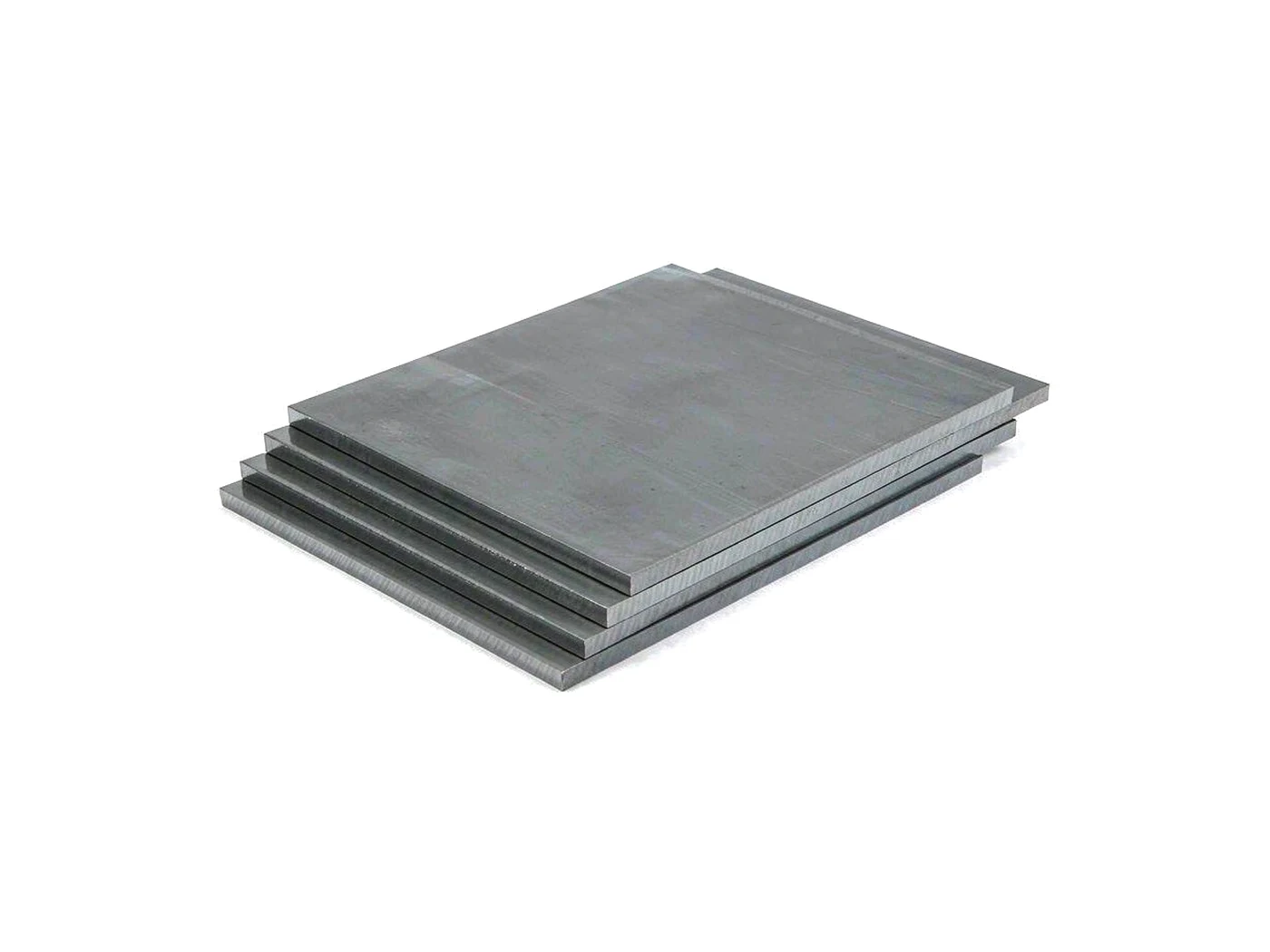
Hot-rolled steel plate and uncoiled sheet (sheet levelled and cut from hot-rolled coil) in Q235B, Q355B and SS400, from 1.5 mm to 200 mm nominal thickness. Widths run 1000 mm to 2500 mm and lengths to 12 m, with cut-to-size, edge bevelling and drilling done before shipment. Nominal thickness is quoted the way the Chinese market quotes it: a nominal 6 mm plate typically measures 5.75 mm. Full-thickness plate is also available on request.
Product Overview
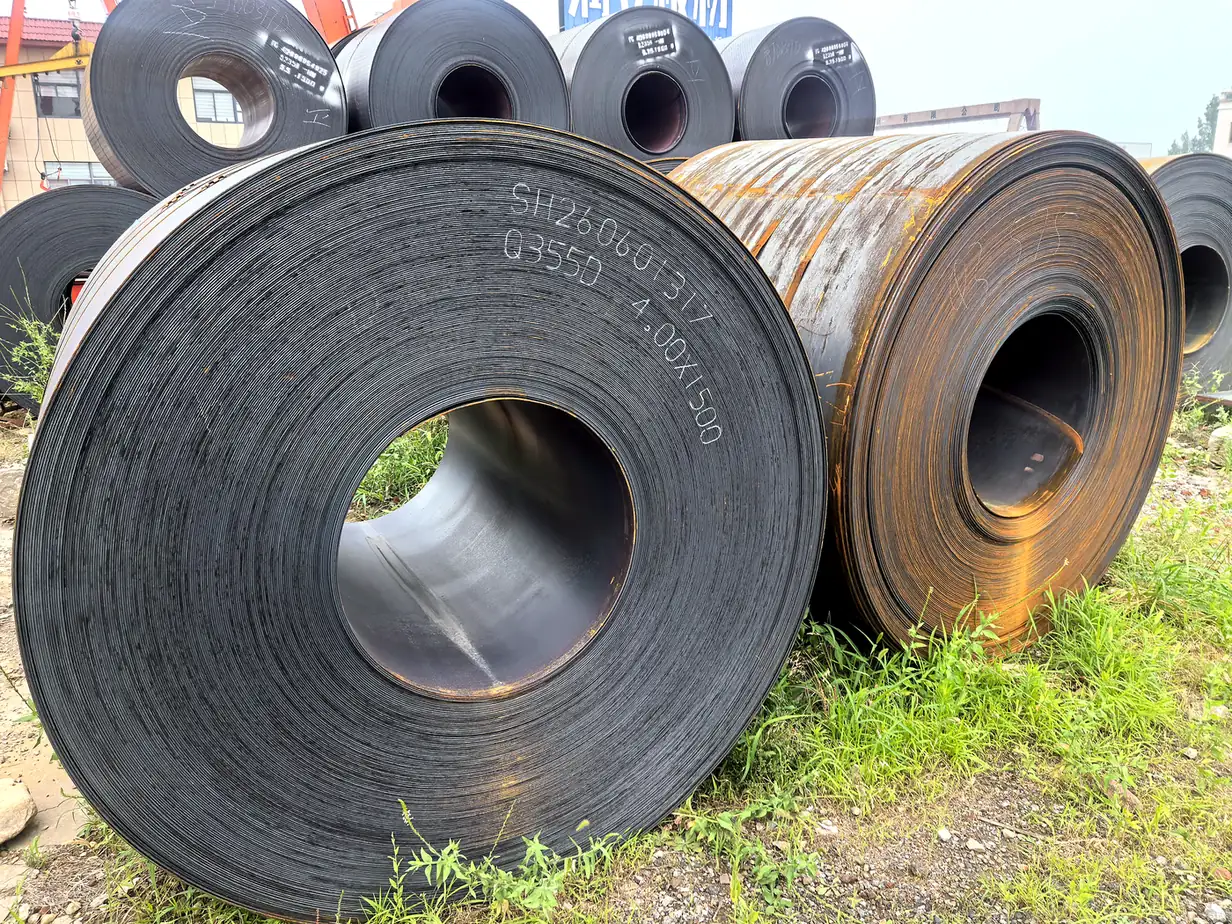
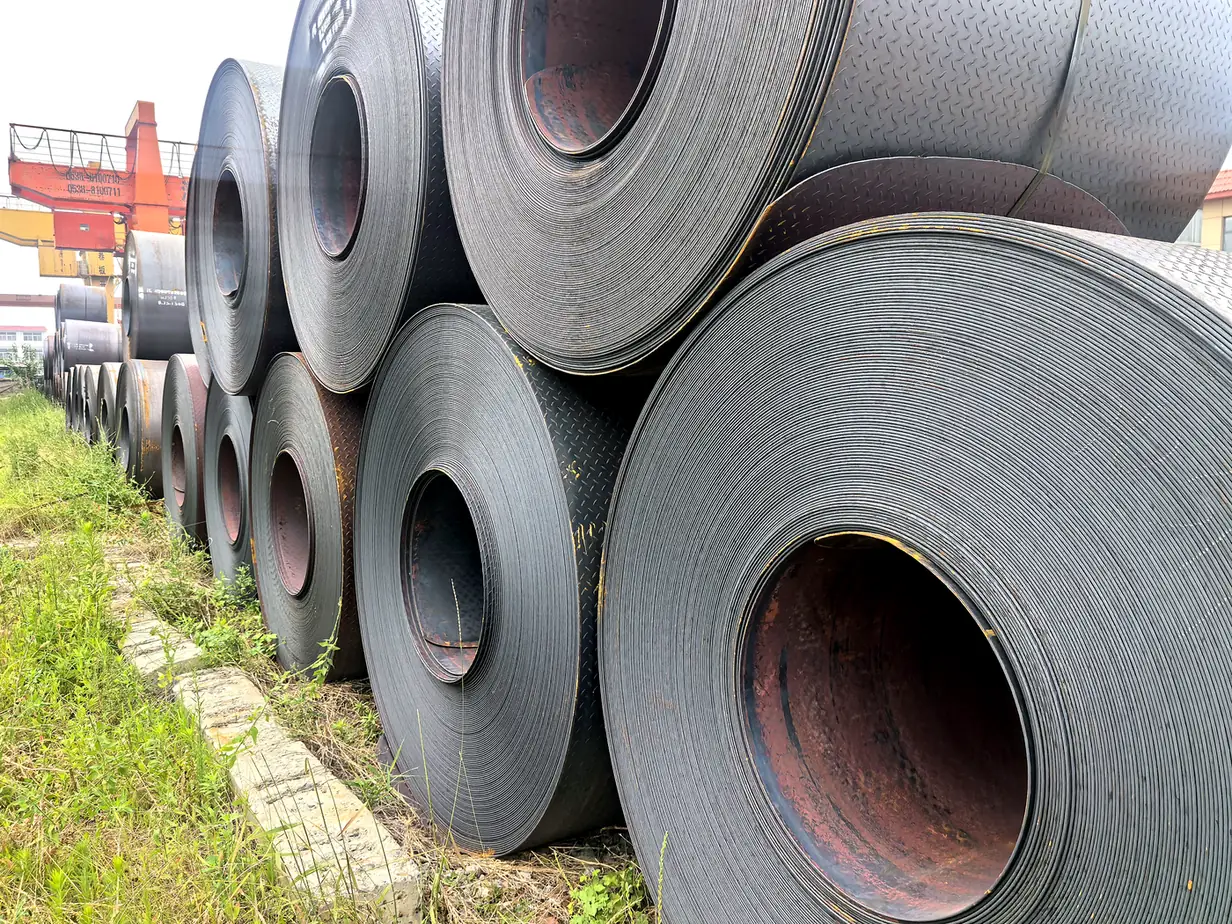
Hot-rolled plate is rolled from a steel slab at high temperature. The process leaves a dark mill-scale surface and produces the lowest cost per kilogram of any flat steel product, with good weldability and predictable mechanical properties. Two supply routes are used. Mill-rolled plate is rolled directly to a fixed length and width at the mill. Uncoiled sheet — the form known commercially as cut-to-length sheet — is made by levelling hot-rolled coil and shearing it to length. Uncoiled sheet is the cheaper route for gauges up to about 20 mm and is how 2 mm to 12 mm material is normally bought; mill-rolled plate takes over from about 20 mm upward, where the coil route is no longer practical. Because both routes start from the same hot-rolled steel, the grade, chemistry and mill certificate are equivalent.
Thickness is the single most common misunderstanding when plate is bought from China, so we state the rule plainly. Nominal thickness is a label, not a measured value. Under normal Chinese mill practice a nominal 4 mm plate measures 3.75 mm, 5 mm measures 4.75 mm, 6 mm measures 5.75 mm, 8 mm measures 7.75 mm and 10 mm measures 9.75 mm — about 0.25 mm under nominal across the thin and medium gauges. This is why the market lists uncoiled stock as 3.75, 4.75, 5.75, 7.75, 9.75, 11.75 and so on: the label is the measured thickness. Above 10 mm the under-tolerance widens to roughly 0.5 mm to 1.0 mm depending on thickness, width and mill. This is standard commercial plate and is priced as such. If a weight calculation, a design check or your receiving inspection requires measured thickness to equal nominal, ask for full-thickness (no under-tolerance) plate and we will quote it separately, because it is a different mill order and carries a price premium.
Plate is supplied with an EN 10204 3.1 mill test certificate showing heat number, chemical composition and mechanical properties for each heat. Cutting to size, edge bevelling, drilling and bending can all be carried out before packing, so plate arrives as a part rather than as a raw sheet. Export packing is planned around container loading with edge protection, and rust protection is added where the route is long or humid. One ton can ship, which keeps trial orders and maintenance quantities practical.
Specifications & Size Range
Standard thicknesses, widths and lengths. The common mill widths are 1000, 1250, 1500, 1800, 2000 and 2200 mm. Uncoiled sheet is supplied in 2.4 m to 6 m lengths, mill plate in 6 m, 8 m and 12 m. Intermediate thicknesses, non-standard widths and cut-to-size blanks are produced to order, and cut-to-length blanks reduce both offcut waste and freight weight.
| Product form | Common thicknesses (mm) | Width (mm) | Standard length | Typical use |
|---|---|---|---|---|
| Uncoiled sheet, thin | 2.0, 2.3, 2.5, 2.75, 3.0, 3.5, 3.75, 4.0, 4.5, 4.75, 5.0, 5.75, 6.0 | 1000 / 1250 / 1500 | 2.4-3 m, cut to order | Tanks, machine guards, ducting, panels, light fabrication |
| Uncoiled sheet, medium | 7.75, 9.75, 11.75, 13.75, 15.75, 17.75, 19.75 (nominal 8 to 20) | 1250 / 1500 / 1800 / 2000 | up to 6 m, cut to order | Gusset and connection plates, base plates, frames, hoppers |
| Mill plate, medium | 4.0, 5.0, 6.0, 8.0, 10.0, 12.0, 14.0, 16.0, 18.0, 20.0 | 1500 / 1800 / 2000 / 2200 | 6 m / 8 m / 12 m | Structural nodes, brackets, welded frames, machine parts |
| Mill plate, heavy | 22.0, 25.0, 28.0, 30.0, 36.0, 40.0, 50.0 | 1800 / 2000 / 2200 / 2500 | 6 m / 8 m / 12 m | Plant columns, crusher bodies, mould bases, heavy brackets |
| Mill plate, extra-heavy | 60, 70, 80, 100, 120, 150, 180, 200 | 1800 / 2000 / 2500 | cut to size | Press and die bases, heavy machine frames, large weldments |
| Cut-to-size blanks | any thickness above | as required | to drawing | Profiled parts, gaskets, flanges, ready-to-weld components |
Tolerances
Thickness to GB/T 709 for hot-rolled plate and strip and GB/T 3274 for structural plate. In commercial terms: nominal 4 / 5 / 6 / 8 / 10 mm material is commonly measured at 3.75 / 4.75 / 5.75 / 7.75 / 9.75 mm, about 0.25 mm under nominal, and plate above 10 mm carries a wider under-tolerance of roughly 0.5-1.0 mm. Full-thickness plate with no minus tolerance is quoted on request and confirmed on the order acknowledgement. Width, length, camber and flatness follow the same standards; uncoiled sheet is supplied levelled with bow and edge-wave limits agreed at the enquiry stage.
Available Sizes — Detailed Specification
Every size below has its own page with the full theoretical weight table, tolerances, grade data, applications and delivery options. Theoretical weights are the published values from GB/T 709-2019.
| Thickness | Weight (kg/m²) | Weight per 1500 × 6000 sheet | Specification page |
|---|---|---|---|
| 3 mm | 23.55 | 212 kg | Weight & specification |
| 4 mm | 31.4 | 283 kg | Weight & specification |
| 5 mm | 39.25 | 353 kg | Weight & specification |
| 6 mm | 47.1 | 424 kg | Weight & specification |
| 8 mm | 62.8 | 565 kg | Weight & specification |
| 10 mm | 78.5 | 706 kg | Weight & specification |
| 12 mm | 94.2 | 848 kg | Weight & specification |
| 14 mm | 109.9 | 989 kg | Weight & specification |
| 16 mm | 125.6 | 1130 kg | Weight & specification |
| 18 mm | 141.3 | 1272 kg | Weight & specification |
| 20 mm | 157 | 1413 kg | Weight & specification |
| 22 mm | 172.7 | 1554 kg | Weight & specification |
| 25 mm | 196.25 | 1766 kg | Weight & specification |
| 28 mm | 219.8 | 1978 kg | Weight & specification |
| 30 mm | 235.5 | 2120 kg | Weight & specification |
| 32 mm | 251.2 | 2261 kg | Weight & specification |
| 36 mm | 282.6 | 2543 kg | Weight & specification |
| 40 mm | 314 | 2826 kg | Weight & specification |
| 45 mm | 353.25 | 3179 kg | Weight & specification |
| 50 mm | 392.5 | 3532 kg | Weight & specification |
| 60 mm | 471 | 4239 kg | Weight & specification |
Steel Grades & International Equivalents
All grades below are supplied with a mill test certificate. The right-hand column shows the material type and the Chinese standard the grade is produced to; the middle columns give the nearest recognised equivalent in other national standards. Exact equivalence for a specific project should be confirmed on the enquiry.
| GB (China) | ASTM / AISI (US) | EN (Europe) | JIS (Japan) | DIN (Germany) | Type / Standard |
|---|---|---|---|---|---|
| Q235B plate | A36 / A283 Gr.C | S235JR+N (EN 10025-2) | SS400 | St37-2 | Hot-rolled structural plate (GB/T 3274) |
| Q355B plate | A572 Gr.50 | S355JR (EN 10025-2) | SM490 | St52-3 | High-strength hot-rolled plate (GB/T 1591) |
| SS400 (JIS) | A36 | S235JR | SS400 | St37-2 | Carbon structural steel (JIS G3101) |
Grade Notes
- Q235B plate — General structural plate for fabrication, welding and machining. Thickness tolerance to GB/T 709.
- Q355B plate — High-strength plate for bridges, heavy machinery, pressure structures and offshore fabrication.
- SS400 (JIS) — Japanese standard grade widely accepted in Asia. Interchangeable with Q235B / A36 for general structures.
Chemical Composition (%, ladle analysis)
Typical specification limits. Actual heat values are reported on the mill test certificate supplied with every shipment.
| Grade | C | Si | Mn | P max | S max | Other elements |
|---|---|---|---|---|---|---|
| Q235B plate | ≤0.20 | ≤0.35 | ≤1.40 | ≤0.045 | ≤0.045 | — |
| Q355B plate | ≤0.24 | ≤0.55 | ≤1.60 | ≤0.035 | ≤0.035 | Ceq ≤0.45 |
| SS400 (JIS) | — | — | — | ≤0.050 | ≤0.050 | — |
Mechanical Properties
Minimum values at room temperature unless stated. ReL = yield strength; Rp0.2 = 0.2% proof stress; Rm = tensile strength; A = elongation after fracture.
| Grade | Yield (ReL) | Proof (Rp0.2) | Tensile (Rm) | Elongation A | Impact / others | |
|---|---|---|---|---|---|---|
| Q235B plate | ≥235 MPa | — | 370–500 MPa | ≥26% | +20 °C, ≥27 J | — |
| Q355B plate | ≥355 MPa (≤16 mm) | — | 470–630 MPa | ≥22% | +20 °C, ≥27 J | — |
| SS400 (JIS) | ≥245 MPa | — | 400–510 MPa | ≥21% | — | — |
Standards & Documents
- GB/T 709 — hot-rolled steel plate and strip: dimensions, shape, weight and permissible tolerances
- GB/T 3274 — hot-rolled structural steel plate and strip: technical delivery conditions
- GB/T 700 — carbon structural steels (Q235B); GB/T 1591 — high-strength structural steels (Q355B)
- JIS G3101 — rolled steels for general structure (SS400)
- Grade equivalence: Q235B to ASTM A36 / A283 Gr.C and EN S235JR; Q355B to ASTM A572 Gr.50 and EN S355JR
- EN 10204 3.1 mill test certificate with every heat; SGS or BV third-party inspection on request
Typical Applications
| Industry / Application | Typical use |
|---|---|
| Structural steel fabrication | Gusset plates, connection plates, base plates, stiffeners and node plates for steel frames, workshops and heavy structures. Q235B covers most connections, Q355B where the design calls for higher strength or a thinner section. |
| Machine building & equipment frames | Machine bases, press frames, bed plates, guards and enclosures. Plate is the standard starting point for any welded machine structure because it is easy to cut, drill and weld. |
| Tanks, silos & hoppers | Shell and division plate for storage tanks, silos, hoppers, chutes and ducting in non-pressure service. Grade and thickness are nominated against the stored medium and the support arrangement. |
| Shipbuilding & marine fabrication | Hull, deck and bulkhead plate, plus deck machinery beds and barge structures. Where a classification society applies, tell us the class requirement and we will nominate the grade that satisfies it. |
| Bridges & heavy civil works | Main girder plate, diaphragms, splice plates and stiffeners for road and rail bridges, where Q355B and a documented certificate are usually specified. |
| Mining, quarry & bulk handling | Crusher bodies, screen frames, chute liners and conveyor structure, in thicknesses that survive abrasion and impact loading. |
| General engineering & job shops | General stock for cutting, drilling, bending and welding work, where a clean mill certificate and a quick, mixed-thickness shipment matter more than absolute flatness. |
Common Problems Buyers Face — and How We Prevent Them
These are the issues that most often cause claims on steel imports. Each one is controlled in our process before shipment.
Plate arrives thinner than the nominal thickness on the order
Why it happens: Chinese commercial plate is normally rolled to the minus side of the standard, so a nominal 6 mm plate measures about 5.75 mm. A buyer who expects nominal to mean measured finds the weight and the fit-up short.
Our control: We state the measured thickness on the quotation and on the packing list before the order is placed, so there is no surprise at the receiving bay. If your design or your weight calculation needs full thickness, order full-thickness plate and we will quote it as a separate line item.
Mill scale flaking and surface rust before the plate is used
Why it happens: Hot-rolled plate carries an oxide scale and has no protective coating, and scale traps moisture. Sea transit in a humid route will show surface oxidation within weeks.
Our control: Plate for sea freight is shipped dry with edge protection, and VCI paper plus desiccant is added on request. Where scale must be removed for painting, we can supply pickled or blasted plate, or cut and bevel the parts first so they arrive ready for the coating line.
Uncoiled sheet springs or bows after cutting
Why it happens: Uncoiled sheet is levelled from coil and retains some internal stress, so long narrow strips can bow after they are cut. This is inherent to the process, not a material defect.
Our control: Tell us if the parts are long and narrow, or if flatness is critical. We increase the levelling pass, stack and store the sheets flat, and where the part is flatness-sensitive we supply mill plate instead of uncoiled sheet.
Cut sizes do not match the drawing, or the plate is cambered
Why it happens: Cut-to-size work done without an agreed tolerance and a written cut list drifts, especially on thick plate or where a plasma cut edge is used as a finished edge.
Our control: We confirm the cut list, the cutting process and the dimensional tolerance in writing before production. Cutting accuracy is held to about plus or minus 1 mm on a CNC cut, and camber is checked against the standard before the parts are packed.
Mixed heats in one bundle with no traceability
Why it happens: Q235B and Q355B plate look identical once the mill marking is rubbed off in handling, and a bundle without heat tags cannot be identified at the receiving inspection.
Our control: Every bundle is tagged by heat number, grade and size, and the matching EN 10204 3.1 mill certificate travels with the shipment. Heat numbers are recorded through loading so an identification check takes minutes rather than days.
Our Supply & Manufacturing Advantages
- Thickness declared before you buy — The measured thickness, and the under-tolerance that applies to it, is written on the quotation. If you need full-thickness plate, it is quoted as a separate, clearly priced option.
- One order, coil route and plate route — Thin and medium gauges come as uncoiled sheet and heavy gauges as mill plate, so a single order can cover a whole fabrication package with matching certificates.
- Cut, bevelled and drilled before shipping — Parts arrive ready to weld. Processing before packing removes offcut weight, reduces freight cost and eliminates the yield loss of cutting in your own yard.
- Documented material — EN 10204 3.1 mill test certificate for every heat, with composition and mechanical properties, plus dimensional records and third-party inspection on request.
- Grade-matching support — Tell us the grade you normally buy — ASTM A36, A572 Gr.50, EN S235JR or S355JR, JIS SS400 — and we will nominate the Chinese grade and confirm the equivalence in writing.
- Export packaging built in — Bundled and strapped for container loading, or loose in a bulk vessel for large tonnage, with edge protection and rust protection matched to the voyage.
Packaging, Delivery & Payment
- Packing: loose in bulk vessel, or bundled and containerised to your requirement. Galvanized and coated products get VCI paper, waterproof wrapping and edge protection. See our export packaging methods.
- Availability: both stock and custom production. Tell us the specification and we will confirm the route.
- MOQ: no strict minimum — one ton can ship.
- Lead time: stock dispatched to port within 3 days; orders needing export packaging about 1 week; custom production quoted per product.
- Payment: stock — 10% deposit, balance before shipment; custom production — 50% deposit, balance before shipment.
- Documents: EN 10204 3.1 mill test certificate with every shipment; third-party inspection (SGS / BV) on request.
Frequently Asked Questions
What is the Chinese equivalent of ASTM A36 steel plate?
Q235B to GB/T 700 is the closest Chinese equivalent to ASTM A36 and is the grade most often shipped in its place. The two are close in yield strength, tensile range and weldability. If your drawing requires A36 specifically, Q235B plate to GB/T 3274 is normally accepted, and we can supply SS400 to JIS G3101 as well, which is also treated as an A36 equivalent in most markets.
Why does my 6 mm plate measure 5.75 mm?
Because Chinese commercial plate is rolled to the minus side of the tolerance and the market quotes the measured figure. A nominal 6 mm plate is delivered at about 5.75 mm, a nominal 5 mm at 4.75 mm and a nominal 8 mm at 7.75 mm, roughly 0.25 mm under nominal. This is standard commercial plate, not a defect, and it is priced accordingly. Full-thickness plate with no under-tolerance is available on request.
What is the difference between mill plate and uncoiled sheet?
Mill plate is rolled directly to a fixed length and width at the mill, so it is dimensionally regular and carries lower internal stress. Uncoiled sheet is levelled and sheared from hot-rolled coil, which costs less, is available in thinner gauges and may show slight bow after long strips are cut. Both come from the same hot-rolled steel and carry the same grade and certificate.
Which grade should I choose, Q235B or Q355B?
Use Q235B for general fabrication, connections, tanks and machine parts where yield strength around 235 MPa is sufficient and cost is the priority. Use Q355B where the design needs higher strength, better strength-to-weight ratio, or a thinner plate for the same load. Q355B is the usual choice for bridge girders, heavy structures and transport equipment.
Who supplies hot-rolled steel plate from China for export?
We do — the plate is produced by major Chinese mills and shipped worldwide with a mill test certificate. Tell us the grade, thickness, width, length and quantity, and we will confirm availability, measured thickness and the port-to-port lead time. Trial quantities from one ton are accepted.
What is the difference between hot-rolled and cold-rolled sheet?
Hot-rolled sheet is rolled at high temperature and has a dark, scaled surface, a thickness range from about 1.5 mm upward and the lower price per ton. Cold-rolled sheet is rolled at room temperature from hot-rolled coil, giving a smooth bright finish, tighter thickness control in the 0.3 to 3 mm range and much better formability for stamping. Hot-rolled for structure and welding, cold-rolled for appearance and pressing.
What documents come with a plate shipment?
An EN 10204 3.1 mill test certificate showing heat number, chemical composition and mechanical properties for each heat, plus the commercial invoice, packing list and certificate of origin. Dimensional records and third-party inspection by SGS or BV can be arranged before loading.
What is the minimum order quantity and the lead time?
There is no strict minimum order quantity and one ton can ship, which suits trial orders and maintenance work. Common sizes are dispatched to the port within about 3 days; orders requiring cutting, bevelling, export packaging or full-thickness material take about a week to reach the port. Custom sizes are quoted item by item.
Can you cut, bevel and drill plate to my drawing?
Yes, and we recommend it. Cutting, edge bevelling, drilling and bending are carried out before packing, and the cut list and tolerance are confirmed in writing first. Processing before shipment reduces freight weight and means the plate arrives as a component rather than a raw sheet.
Request a Quotation Export Packaging