
Cast Iron Drainage Pipe & Fittings, DN50 to DN300
Flexible-joint cast iron drainage pipe and fittings in HT200 grey iron, DN50 to DN300, to ISO 6594, EN 877 and ASTM A888. Supplied in 1.5 m and 3 m lengths with push-on or mechanical couplings, for building drainage, soil and vent stacks, rainwater and municipal sewer work.
Product Overview
Cast iron drainage pipe is produced by centrifugal casting grey iron to HT200, which gives a dense, fine-grained wall with graphite flakes that damp vibration rather than transmit it. That is the property architects specify it for: a cast iron soil stack is dramatically quieter than a plastic one, because the mass of the wall and the damping effect of the graphite absorb the noise of flowing water instead of radiating it into the building.
Beyond noise, cast iron has three further advantages in drainage service. It is dimensionally stable and does not soften at high temperature, so it will take hot discharge from commercial kitchens and plant rooms that would deform a thermoplastic pipe. It is strong enough to be self-supporting across a long bracket spacing and to resist impact in service. And in a drainage environment it corrodes extremely slowly, which is why cast iron drainage systems installed a century ago are still in use and why a service life of 50 years and beyond is a normal expectation rather than a claim.
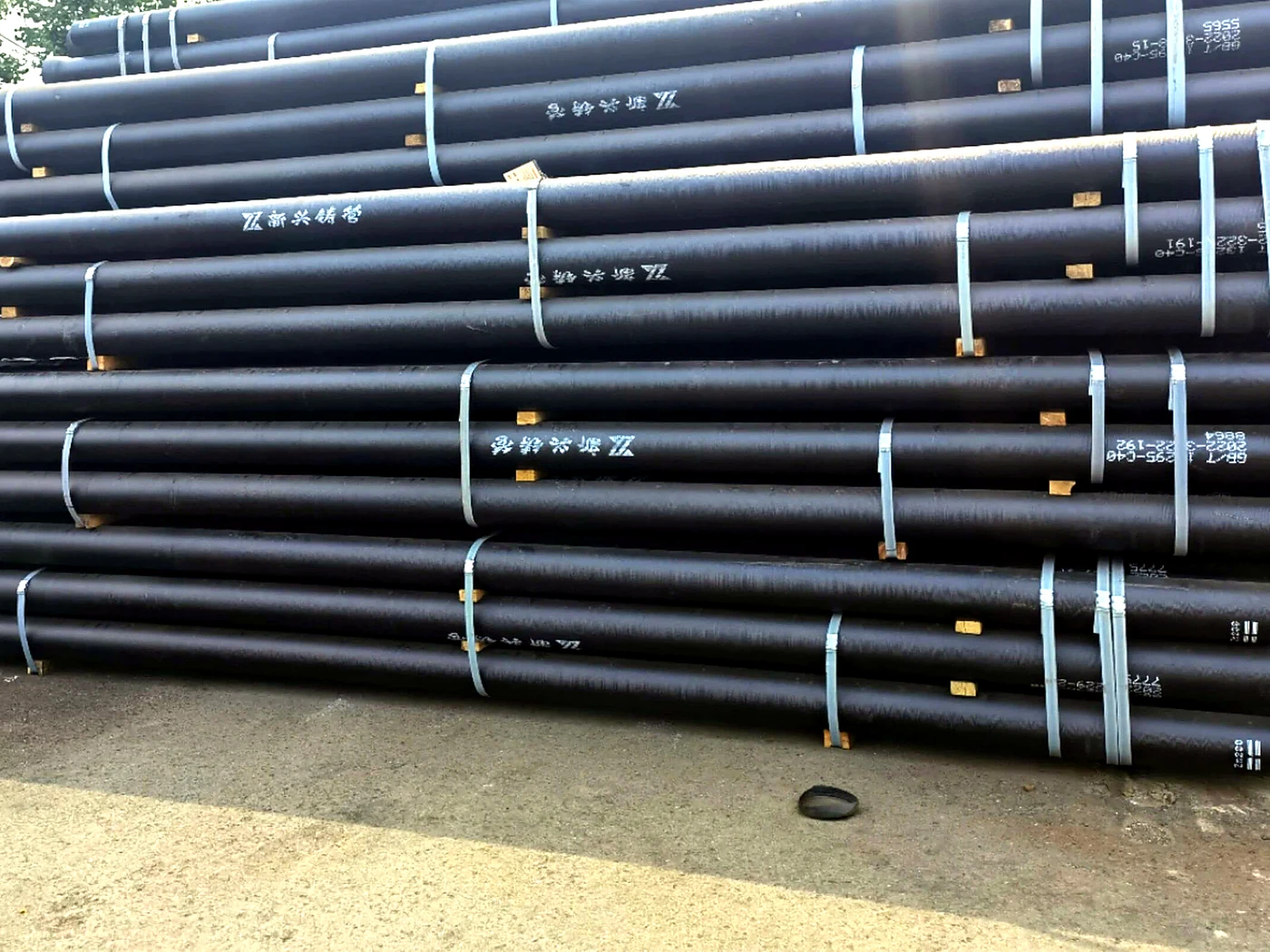
We supply pipe and a matching range of fittings in DN50, DN75, DN100, DN150, DN200, DN250 and DN300, in 1.5 m and 3 m lengths, with flexible joints. Both the push-on socket type and the clamp-coupling type are available, and the flexible joint accommodates thermal movement and slight ground settlement without cracking the pipe or opening a joint.
Specifications & Size Range
Standard nominal diameters with the connection type and the duty each size is normally used for. Both push-on socket and clamp-coupling joint systems are available, together with the corresponding bends, branches, junctions, offsets and access fittings. State the joint type on the enquiry so pipe and fittings are matched.
| Nominal diameter | Common application | Length (m) | Joint type | Fittings available |
|---|---|---|---|---|
| DN50 – DN75 | Basin, bath and sink waste, small branch drains, condensate lines | 1.5 / 3 | Push-on socket or clamp coupling | Bends, tees, traps, reducers, access caps |
| DN100 | Soil and waste stacks, WC connections, main building drainage, vent stacks | 1.5 / 3 | Push-on socket or clamp coupling | Bends, branches, junctions, offsets, access doors |
| DN150 | Building drainage mains, rainwater downpipes, kitchen and plant room discharge | 1.5 / 3 | Push-on socket or clamp coupling | Bends, double branches, swept junctions, expansion joints |
| DN200 – DN250 | External drainage, municipal sewer connections, car park and yard drainage | 1.5 / 3 | Push-on socket or clamp coupling | Bends, junctions, gullies, inspection fittings |
| DN300 | Sewer mains, large rainwater runs, industrial and process drainage | 1.5 / 3 | Push-on socket or clamp coupling | Bends, junctions, adaptors, inspection chambers |
Tolerances
Pipe and fittings are produced to the applicable drainage standard with wall thickness, socket dimensions and joint tolerances as set out there. The flexible joint is designed to accept angular deflection and longitudinal movement at each connection, so the installed system tolerates thermal expansion and minor ground settlement. Dimensions and joint performance are verified by the manufacturer and reported per batch, and third-party inspection can be arranged.
Steel Grades & International Equivalents
All grades below are supplied with a mill test certificate. The right-hand column shows the material type and the Chinese standard the grade is produced to; the middle columns give the nearest recognised equivalent in other national standards. Exact equivalence for a specific project should be confirmed on the enquiry.
| GB (China) | ASTM / AISI (US) | EN (Europe) | JIS (Japan) | DIN (Germany) | Type / Standard |
|---|---|---|---|---|---|
| HT200 / grey iron | A48 Class 30 / A888 | EN 877 (approx.) | FC200 (JIS G5501) | GG20 | Grey cast iron (cast iron pipe) (GB/T 9439) |
Grade Notes
- HT200 / grey iron — Grey cast iron for drainage pipes and fittings: excellent noise damping, corrosion resistance and long service life.
Chemical Composition (%, ladle analysis)
Typical specification limits. Actual heat values are reported on the mill test certificate supplied with every shipment.
| Grade | C | Si | Mn | P max | S max | Other elements |
|---|---|---|---|---|---|---|
| HT200 / grey iron | 3.0–3.6 | 1.4–2.2 | 0.5–0.9 | ≤0.30 | ≤0.12 | — |
Mechanical Properties
Minimum values at room temperature unless stated. ReL = yield strength; Rp0.2 = 0.2% proof stress; Rm = tensile strength; A = elongation after fracture.
| Grade | Yield (ReL) | Proof (Rp0.2) | Tensile (Rm) | Elongation A | Impact / others | |
|---|---|---|---|---|---|---|
| HT200 / grey iron | — | — | ≥200 MPa | — | — | — |
Standards & Documents
- ISO 6594 — cast iron drainage pipes and fittings for building construction
- EN 877 — cast iron pipes and fittings, their joints and accessories for the evacuation of water from buildings
- ASTM A888 — hubless cast iron soil pipe and fittings for sanitary and storm drain, waste and vent applications
- ISO 185 / GB/T 9439 — grey cast iron, covering the HT200 pipe material
- ASTM A48 Class 30 — grey iron castings, equivalent material specification
- Batch dimensional and joint inspection report; third-party inspection by SGS or BV on request
Typical Applications
| Industry / Application | Typical use |
|---|---|
| Building soil & vent stacks | High-rise residential, hotel, hospital and office drainage stacks where low noise transmission into habitable rooms is a design requirement. |
| Sanitary & waste drainage | WC, basin, bath, shower, sink and appliance connections and branch drains within the building envelope. |
| Rainwater & storm drainage | Roof and podium rainwater downpipes, yard and car park drainage and connections to the external sewer. |
| Municipal sewer connections | Sewer laterals and mains, manhole connections and inspection chamber pipework where strength and impact resistance matter. |
| Industrial & process drainage | Factory, workshop and plant room drainage, chemical and food processing waste lines and boiler blow-down discharge. |
| Commercial kitchen & hot discharge | Kitchen and restaurant waste lines and any drainage run carrying hot discharge that would deform a thermoplastic pipe. |
| Fire-rated & acoustic shafts | Drainage risers in acoustic shafts and penetration-controlled compartments where a non-combustible, dimensionally stable pipe is specified. |
Common Problems Buyers Face — and How We Prevent Them
These are the issues that most often cause claims on steel imports. Each one is controlled in our process before shipment.
Joint leaks after installation
Why it happens: A flexible joint leaks if the coupling is not located correctly, if the pipe end is not cut square, or if the pipe is forced into alignment rather than allowing the joint to take up the deflection.
Our control: Pipe ends are supplied square cut with the socket dimensions to the standard, and each joint should be assembled with the pipe aligned and the coupling positioned to the manufacturer’s mark. Installation instructions and the batch joint inspection report are provided with the shipment.
Pipe cracked or chipped in transit
Why it happens: Cast iron is strong in compression but brittle in impact, and a heavy pipe dropped on a hard surface or struck by a forklift can chip a socket, which only shows up when the joint will not seal.
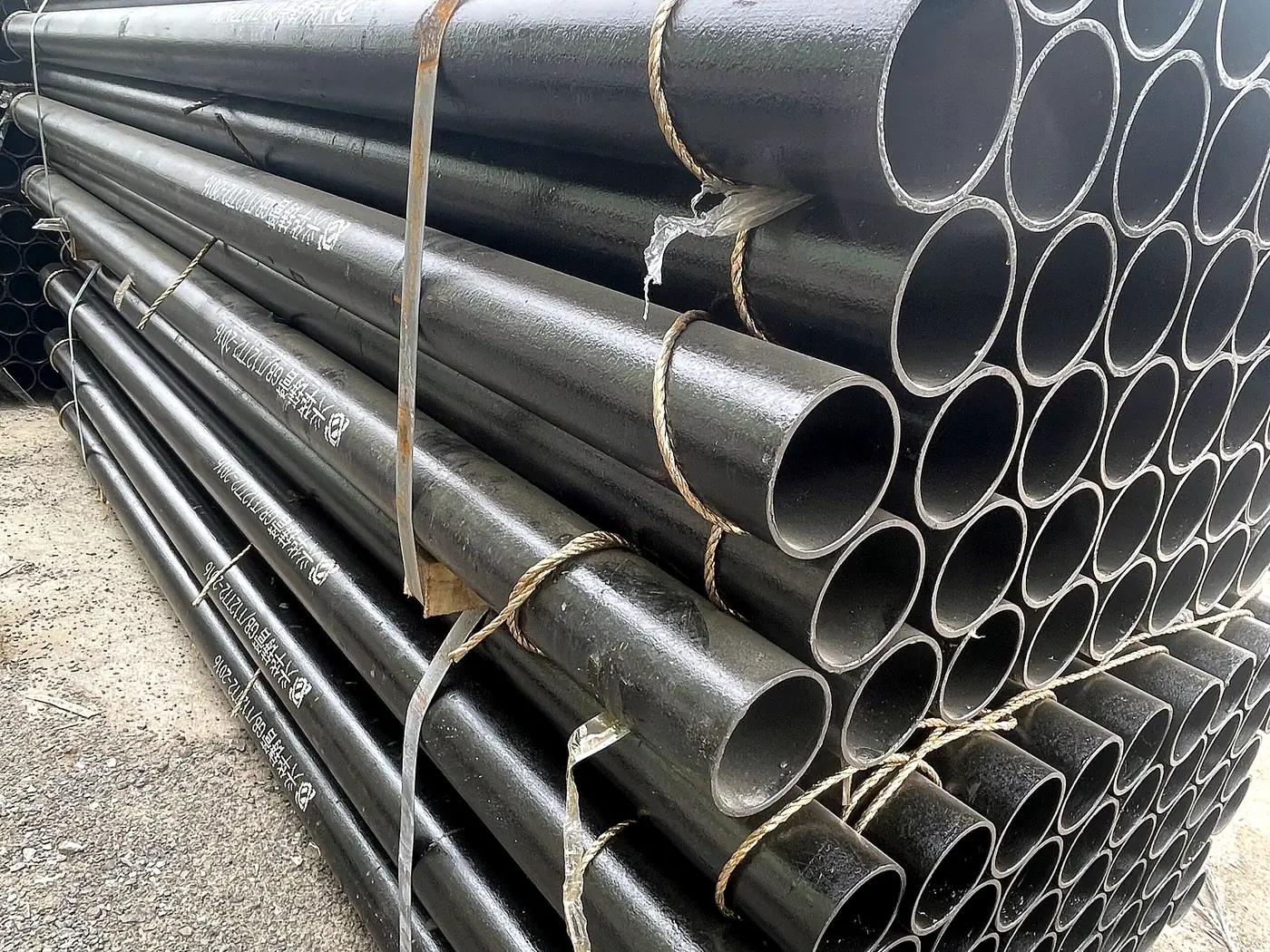
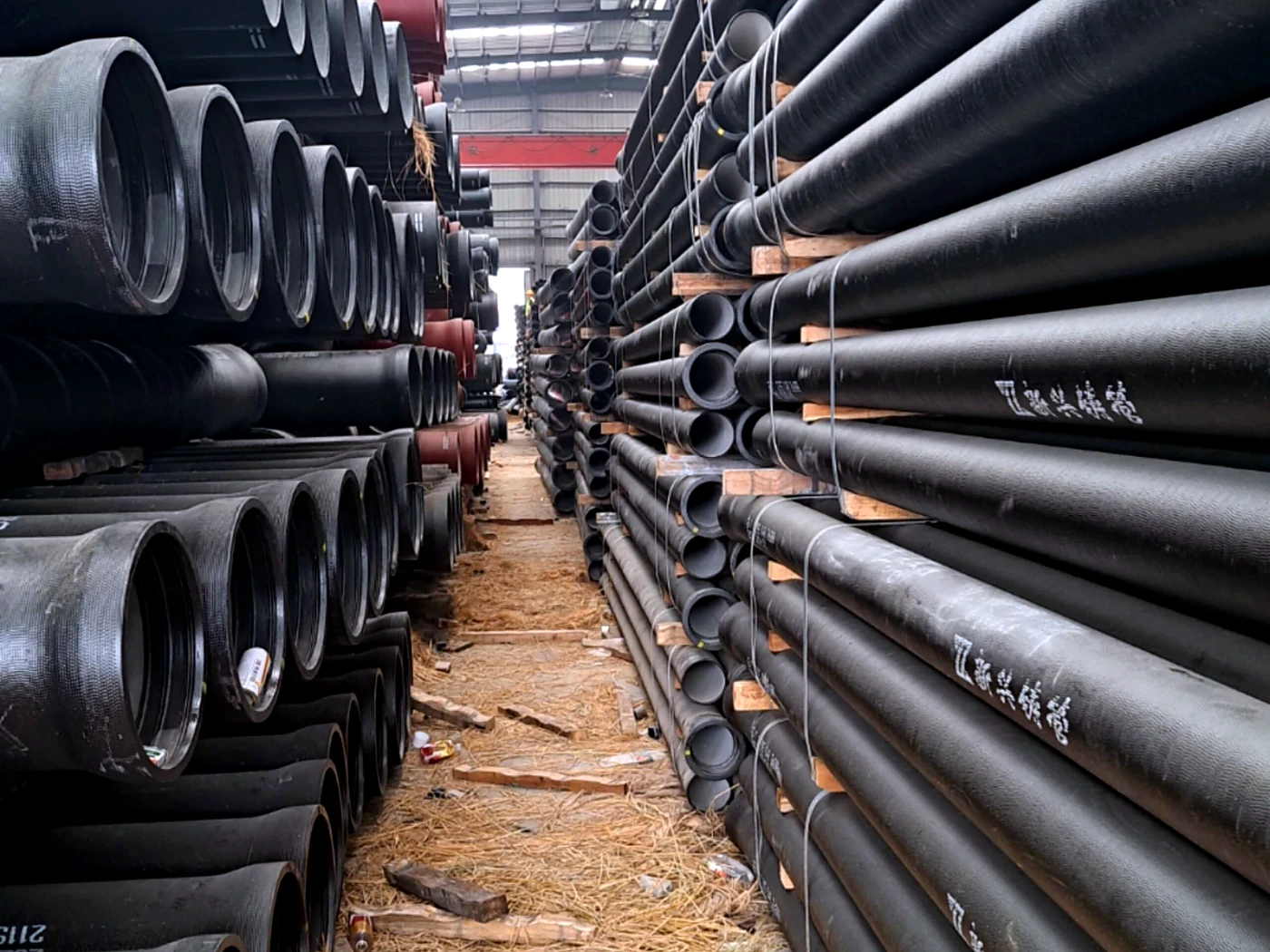
Our control: Pipe is packed with timber dunnage and separators between layers, and bundles are strapped and lifted with slings at the marked points. Socket ends are protected with wrapping, and units damaged in transit can be identified on arrival and claimed against the inspection record.
Condensation forming on cold drainage pipes in service
Why it happens: A cold drain carrying chilled or rainwater will attract condensation, particularly in a humid plant room or a kitchen, and the moisture causes staining and drip damage.
Our control: The pipe can be supplied with an external coating or be insulated on site. If condensation is expected, tell us at the enquiry and we will advise on the coating and on the insulation system the drainage design should include.
Support spacing too wide, so the pipe sags or the joint opens
Why it happens: Cast iron is heavy, and brackets spaced as if the pipe were plastic will allow deflection, joint movement and noise.
Our control: Bracket spacing and the number of rigid anchors are set by the pipe standard and by the drainage design, and are normally given in the installation instructions supplied with the order. Each flexible joint should be close to a support and each change of direction anchored.
Customer expects a smooth plastic-like bore and finds the internal surface different
Why it happens: A centrifugal cast iron bore has a different internal texture from a plastic pipe, and some designers mistakenly expect equivalent hydraulic performance from a much smaller diameter.
Our control: We confirm the nominal diameters and wall construction on the enquiry so the hydraulic design is carried out on the correct internal diameter. If the drainage capacity is critical, size the pipe from the actual internal bore rather than from a nominal figure.
Our Supply & Manufacturing Advantages
- Excellent noise damping — High density and a thick wall absorb the sound of flowing water, which is why cast iron is specified for stacks serving habitable rooms.
- Long service life — Grey iron corrodes extremely slowly in drainage service, and systems in use for over half a century are the normal evidence for a 50-year-plus expectation.
- Flexible joints — Push-on and clamp-coupling joints accept angular deflection and longitudinal movement, absorbing thermal expansion and minor settlement.
- Dimensionally stable at temperature — Cast iron does not soften at the temperature of hot kitchen or plant room discharge, unlike thermoplastic drainage pipe.
- Strong and impact resistant — The wall is thick and rigid, so the pipe is self-supporting over longer bracket spacings and resists impact and external load.
- Complete pipe and fittings range — Pipe, bends, branches, junctions, offsets and access fittings in DN50 to DN300 from one source, so the whole system comes from the same batch and standard.
Packaging, Delivery & Payment
- Packing: loose in bulk vessel, or bundled and containerised to your requirement. Galvanized and coated products get VCI paper, waterproof wrapping and edge protection. See our export packaging methods.
- Availability: both stock and custom production. Tell us the specification and we will confirm the route.
- MOQ: no strict minimum — one ton can ship.
- Lead time: stock dispatched to port within 3 days; orders needing export packaging about 1 week; custom production quoted per product.
- Payment: stock — 10% deposit, balance before shipment; custom production — 50% deposit, balance before shipment.
- Documents: EN 10204 3.1 mill test certificate with every shipment; third-party inspection (SGS / BV) on request.
Frequently Asked Questions
What is the difference between push-on socket and clamp-coupling cast iron pipe?
Push-on pipe has a socket at one end and a spigot at the other, with a rubber ring seated in the socket so the spigot pushes straight in; the joint is quick to assemble and allows controlled deflection. Clamp-coupling pipe is plain ended and joined by a separate stainless steel coupling with a rubber sleeve, which is faster to install and allows the pipe to be cut on site. Both are flexible and both perform well; the choice is normally decided by the contractor’s preferred method.
Why is cast iron pipe quieter than plastic drainage pipe?
Cast iron has a high density and a thick wall, and the graphite flakes in the grey iron structure damp vibration, so the pipe absorbs the energy of flowing water instead of radiating it as airborne noise. A plastic pipe is light and transmits noise readily through its thin wall. This is the reason many building codes and acoustic specifications require a cast iron stack for soil and vent pipes in hospitals, hotels and residential buildings.
How long does a cast iron drainage system last?
In normal drainage service grey cast iron corrodes extremely slowly, and a service life of 50 years or more is a reasonable expectation supported by systems that have been in continuous use for longer than that. Corrosion rate depends on the discharge chemistry and the external environment, so where aggressive effluent or soil conditions apply we recommend confirming the internal and external coating with us at the enquiry stage.
Is cast iron pipe suitable for high-temperature discharge?
Yes. Cast iron does not soften within the temperature range of commercial kitchen waste, boiler blow-down or plant room discharge, whereas thermoplastic drainage pipe can deform above its rated service temperature. If your system carries hot discharge, cast iron removes the need for cooling or dilution, provided the joint components are also suitable for the temperature.
What is the equivalent of EN 877 or ASTM A888 in cast iron drainage pipe?
EN 877 covers cast iron pipes and fittings for the evacuation of water from buildings and is the standard normally used in Europe and the Middle East, while ASTM A888 covers hubless cast iron soil pipe and fittings and is the standard used in North America. Our pipe is produced with both specifications available, and ISO 6594 covers the equivalent international basis. State which standard governs the project.
Who supplies cast iron drainage pipe and fittings from China for export?
We do. Dayang supplies cast iron pipe and fittings to plumbing distributors, mechanical contractors and drainage stockists worldwide in DN50 to DN300, with the matching range of bends, branches and access fittings, and with dimensional and joint inspection records issued per batch.
Do you have a minimum order quantity?
No strict minimum, though cast iron is heavy and freight cost per ton rises quickly for small quantities. Pipe and fittings are normally shipped as a consolidated set for a project or as a stockist order, and we will advise on the most economical load for your destination.
What documents come with a cast iron pipe shipment?
A batch inspection record covering dimensions and joint detail, a material certificate for the grey iron to ISO 185 or GB/T 9439, and the commercial invoice, packing list and certificate of origin. Where the project specifies EN 877, ASTM A888 or ISO 6594 conformance, the documents are issued against that standard on request.
How is cast iron pipe packed for sea freight?
Pipe is packed in bundles with timber dunnage and separators between layers, strapped securely for container loading, with socket ends protected by wrapping or caps so the joints are not chipped. Fittings are crated separately and labelled by size. Lifting points are marked on the bundle so the pipe is handled with slings rather than forks.
Request a Quotation Export Packaging