
Cold-Drawn Bright Flat Bar (Q235B, 20#, 45#)
Cold-drawn flat bar with a bright, scale-free surface and a thickness tolerance of 0.02 to 0.05 mm, produced from Q235B, 20# and 45# base material. Supplied 10 mm to 100 mm wide and 3 mm to 20 mm thick for keys, guide rails and precision components.
Product Overview
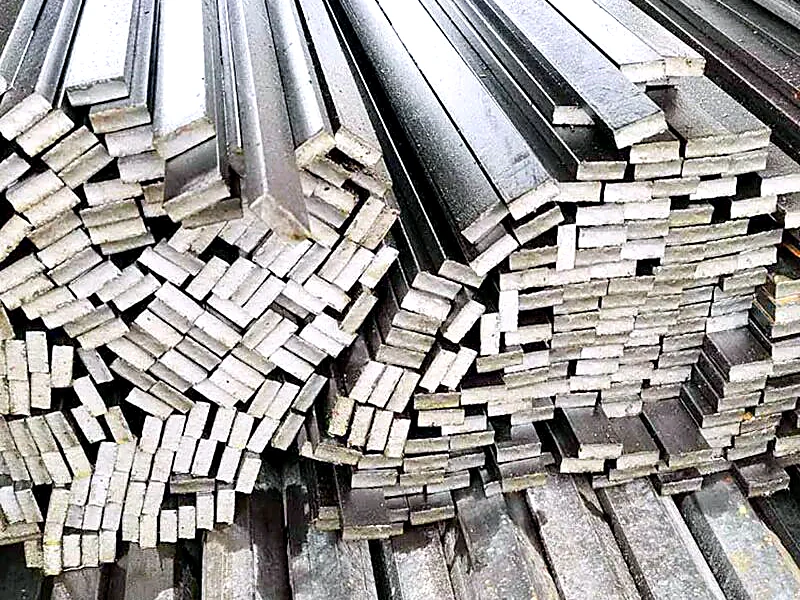
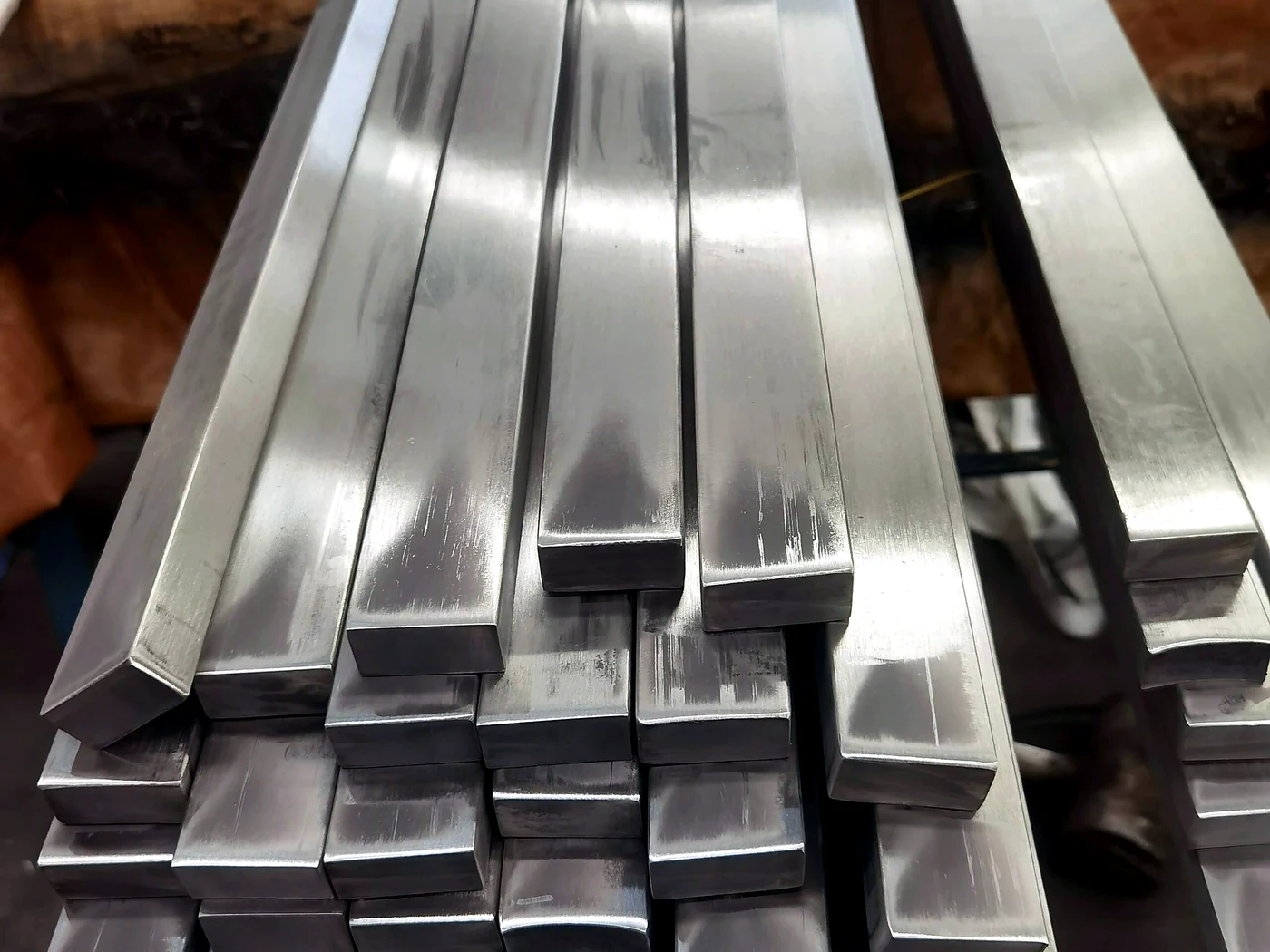
Cold-drawn flat bar is made by pulling hot-rolled flat bar through a die at room temperature, which reduces the section slightly and leaves a smooth, bright, scale-free surface. The process also cold-works the steel, raising its strength by roughly 10 to 20 percent compared with the same grade in the hot-rolled condition, and it produces a section that can go straight to the machine without a cleaning or roughing operation.
The commercial point of cold-drawn bar is tolerance. Thickness is held to about plus or minus 0.02 to 0.05 mm and width to about plus or minus 0.1 to 0.2 mm, against the much wider band of a hot-rolled section, and the bar is straight and consistent enough to be fed into automatic machines. That accuracy is what allows you to reduce machining allowance on a precision part instead of paying to remove metal that was only there to cover mill tolerance.
We supply it in Q235B for general bright parts, 20# where a low-carbon quality steel with reliable machinability is wanted, and 45# for keys, guide rails and other parts that will be quenched and tempered. Widths run from 10 mm to 100 mm and thicknesses from 3 mm to 20 mm, in 2 m to 6 m lengths.
Specifications & Size Range
Common cold-drawn width and thickness combinations. The section range is narrower than for hot-rolled bar because the material must pass through a die, but the tolerance and surface finish are far better. Special widths and small-quantity trial orders are quoted on request.
| Size group | Common width × thickness (mm) | Tolerance (mm) | Standard length | Typical use |
|---|---|---|---|---|
| Thin bright strip | 10×3, 12×3, 15×3, 20×3, 20×4 | thickness ±0.02 – 0.05 | 2 m – 6 m | Shims, spacers, instrument frames, decorative trim, keys |
| Small machined bar | 25×5, 25×6, 30×5, 30×6, 30×8 | thickness ±0.02 – 0.05 | 2 m – 6 m | Guide rails, sliders, tool holders, positioning blocks |
| Standard machined bar | 40×6, 40×8, 40×10, 50×8, 50×10 | width ±0.1 – 0.2 | 2 m – 6 m | Machine ways, clamps, valve and pump components, jigs |
| Heavy bright bar | 60×10, 60×12, 80×12, 80×16, 100×20 | width ±0.1 – 0.2 | 2 m – 6 m, cut to order | Heavy slides, press tooling, die backing plates, wear strips |
| Cut-to-length bright bar | Any size above | as above | to cutting list | Blanks cut to finished length for automatic machining lines |
Tolerances
Thickness tolerance is typically plus or minus 0.02 mm to 0.05 mm and width tolerance plus or minus 0.1 mm to 0.2 mm, appreciably tighter than hot-rolled flat bar. The bar is supplied straight, free of scale and with square or slightly rounded corners. The cold-working pass raises tensile strength by about 10 to 20 percent over the hot-rolled condition, and hardness and mechanical properties are reported on the mill certificate.
Steel Grades & International Equivalents
All grades below are supplied with a mill test certificate. The right-hand column shows the material type and the Chinese standard the grade is produced to; the middle columns give the nearest recognised equivalent in other national standards. Exact equivalence for a specific project should be confirmed on the enquiry.
| GB (China) | ASTM / AISI (US) | EN (Europe) | JIS (Japan) | DIN (Germany) | Type / Standard |
|---|---|---|---|---|---|
| Q235B | A36 / A283 Gr.C | S235JR (EN 10025-2) | SS400 (JIS G3101) | St37-2 | Carbon structural steel (GB/T 700) |
| 20# (20 carbon steel) | AISI 1020 / ASTM A29 1020 | C22 (EN 10083) | S20C (JIS G4051) | CK22 | Quality carbon structural steel (GB/T 699) |
| 45# (45 carbon steel) | AISI 1045 / ASTM A29 1045 | C45 (EN 10083) | S45C (JIS G4051) | CK45 | Quality carbon structural steel (GB/T 699) |
Grade Notes
- Q235B — The workhorse structural grade in China. Fully weldable, excellent cost-performance, the closest Chinese equivalent to ASTM A36 / EN S235JR.
- 20# (20 carbon steel) — Low-carbon quality steel with good weldability and cold formability. Standard material for seamless pipes, boilers and machined parts.
- 45# (45 carbon steel) — Medium-carbon steel for shafts, gears and axles. Responds well to quenching and tempering.
Chemical Composition (%, ladle analysis)
Typical specification limits. Actual heat values are reported on the mill test certificate supplied with every shipment.
| Grade | C | Si | Mn | P max | S max | Other elements |
|---|---|---|---|---|---|---|
| Q235B | ≤0.20 | ≤0.35 | ≤1.40 | ≤0.045 | ≤0.045 | — |
| 20# (20 carbon steel) | 0.17–0.24 | 0.17–0.37 | 0.35–0.65 | ≤0.035 | ≤0.035 | — |
| 45# (45 carbon steel) | 0.42–0.50 | 0.17–0.37 | 0.50–0.80 | ≤0.035 | ≤0.035 | — |
Mechanical Properties
Minimum values at room temperature unless stated. ReL = yield strength; Rp0.2 = 0.2% proof stress; Rm = tensile strength; A = elongation after fracture.
| Grade | Yield (ReL) | Proof (Rp0.2) | Tensile (Rm) | Elongation A | Impact / others | |
|---|---|---|---|---|---|---|
| Q235B | ≥235 MPa | — | 370–500 MPa | ≥26% | +20 °C, ≥27 J | — |
| 20# (20 carbon steel) | ≥245 MPa | — | ≥410 MPa | ≥25% | — | — |
| 45# (45 carbon steel) | ≥355 MPa | — | ≥600 MPa | ≥16% | — | — |
Standards & Documents
- GB/T 702 — hot-rolled steel bars, dimensions and tolerance of the base section
- GB/T 700 — carbon structural steels, covering Q235B
- GB/T 699 — quality carbon structural steels, covering 20# and 45#
- EN 10204 3.1 mill test certificate with composition, mechanical properties and hardness for every heat
- Dimensional inspection report for thickness and width on request, verified against the ordered tolerance band
- AISI 1020 / AISI 1045 and EN C22 / C45 equivalences documented in writing on request
Typical Applications
| Industry / Application | Typical use |
|---|---|
| Keys, gibs & machine fittings | Parallel and taper keys, gib strips, retainers and adjustment shims, usually in 45# for wear resistance after heat treatment. |
| Guide rails & sliding ways | Machine guide strips, slideways and wear plates where dimensional accuracy and a smooth, clean surface are essential to the fit. |
| Tooling, jigs & fixtures | Tool holders, clamps, locating blocks, die backing plates and fixture components machined directly from the bright bar. |
| Automotive & pump components | Piston rings, valve plates, spring plates, pump bodies and clips, in 20# and 45# for subsequent machining and heat treatment. |
| Instrument & equipment frames | Instrument frames, chassis members, casing frames and brackets where a consistent bright finish is left exposed. |
| Lock, hinge & hardware bodies | Lock bodies, hinges, latch strips, decorative strips and hardware blanks machined without a pickling or cleaning step. |
| Precision structural parts | Any small load-bearing component where a machined fit is needed but a fully machined bar would be an unnecessary expense. |
Common Problems Buyers Face — and How We Prevent Them
These are the issues that most often cause claims on steel imports. Each one is controlled in our process before shipment.
Bar is not straight enough for automatic feeding
Why it happens: Cold drawing leaves some residual stress, and bar that is stacked or bundled carelessly can take a set, which stops it feeding or causes runout on the finished part.
Our control: Bar is straightened and checked before packing, supplied in short lengths where the application is automatic feeding, and packed on timber bearers. For critical applications we supply cut blanks rather than full lengths so handling on your side is reduced to a minimum.
Machining finish is poor and tool life is short
Why it happens: Cold drawing raises surface hardness, and if the base material has not been properly annealed before drawing, the bar arrives harder than the machine setting or the tool grade can handle.
Our control: State the machining operation on the enquiry. We supply 20# and 45# with a stated hardness limit, normally 156 HBW maximum for 20# and 229 HBW maximum for 45# in the annealed condition, so the tool life and cycle time you planned are actually achievable.
Thickness varies along the bar or between bundles
Why it happens: Die wear over a long production run widens the section gradually, and bar produced early in the run can differ from bar produced later.
Our control: Die wear is monitored and the section is sampled through the run, and the bar is supplied within the tolerance band stated on the order. Where a very tight band is required for a long production, we set the tolerance for that specific order and report it on the inspection sheet.
Cracking when the bright bar is bent after delivery
Why it happens: Cold working reduces ductility, and a section that was specified for its surface finish is sometimes used for a tight bend the material was not intended to take.
Our control: Tell us if the part will be bent, especially to a small radius. For bending we recommend hot-rolled or annealed material, or we supply the cold-drawn bar in an annealed condition with the bend radius confirmed in writing before shipment.
Bright bars arrive with surface marks or rust spots
Why it happens: The bright surface has no protective coating, so it marks easily in handling and will spot with rust in humid air once the protective oil has dried out.
Our control: Bars are oiled, wrapped in VCI paper and packed dry, with desiccant for long sea routes. Where the bar will be stored for some time, we recommend keeping it wrapped until it enters the machine, and we will supply rust-preventive wrapping matched to the storage condition.
Our Supply & Manufacturing Advantages
- Tolerance that removes machining — Thickness held to plus or minus 0.02 to 0.05 mm so less metal has to be removed and the finished part cost falls.
- Bright, scale-free surface — No pickling, shot blasting or roughing pass is needed before machining or before a decorative finish.
- Higher strength from cold work — The drawing pass raises strength by about 10 to 20 percent over the same grade in hot-rolled condition.
- Three grades to match the part — Q235B for general bright parts, 20# for predictable machinability, and 45# for keys and components that will be hardened.
- Cut blanks for automatic machines — Blanks cut to finished length, so bar feeding and offcut handling are removed from your process.
- Documented dimensional control — Mill test certificate with a stated hardness limit, plus an inspection report on thickness and width when the drawing demands one.
Packaging, Delivery & Payment
- Packing: loose in bulk vessel, or bundled and containerised to your requirement. Galvanized and coated products get VCI paper, waterproof wrapping and edge protection. See our export packaging methods.
- Availability: both stock and custom production. Tell us the specification and we will confirm the route.
- MOQ: no strict minimum — one ton can ship.
- Lead time: stock dispatched to port within 3 days; orders needing export packaging about 1 week; custom production quoted per product.
- Payment: stock — 10% deposit, balance before shipment; custom production — 50% deposit, balance before shipment.
- Documents: EN 10204 3.1 mill test certificate with every shipment; third-party inspection (SGS / BV) on request.
Frequently Asked Questions
How accurate is cold-drawn flat bar compared with hot-rolled bar?
Thickness is held to about plus or minus 0.02 mm to 0.05 mm and width to about plus or minus 0.1 mm to 0.2 mm. Hot-rolled flat bar is produced to a much wider band set by GB/T 702. That difference is the reason cold-drawn bar can be used bright, straight off the rack, in a machined assembly.
What is the Chinese equivalent of AISI 1045 for keys and guide rails?
45# to GB/T 699 is the Chinese equivalent of AISI 1045, and the two are close on carbon and manganese content and on tensile strength. For keys, wear strips and guide rails, 45# is normally supplied annealed with a hardness limit of 229 HBW maximum, then quenched and tempered after machining. If your drawing calls AISI 1045 with a hardness limit, send us the figure and we will confirm it in writing.
Which grade should I choose for a machined part?
Use Q235B for simple bright parts that are not highly stressed, 20# where you want a low-carbon quality steel with consistent machinability and good weldability, and 45# for keys, guide rails and any part that will be quenched and tempered for wear. For a hard case with a tough core, a carburizing grade rather than flat bar is normally the better engineering choice.
What is the difference between cold-drawn and cold-rolled flat bar?
Both are produced from hot-rolled feedstock and both give a bright, tight-tolerance section. Cold drawing pulls the material through a die and gives a good surface with a moderate reduction, while cold rolling passes it between rolls and can achieve a wider, flatter section with a very even surface. Both are supplied to the same order tolerance, and we will nominate the process that suits your width and thickness.
Who supplies cold-drawn bright flat bar from China?
We do. Dayang supplies cold-drawn flat bar to machine shops, toolmakers and component manufacturers worldwide in Q235B, 20# and 45#, with the thickness and width tolerance stated on the order acknowledgement and an inspection report available. Send the drawing tolerance and we will confirm what the drawn section can hold.
Can the bar be bent or formed after delivery?
Only within limits, because cold drawing reduces ductility. If a part will be bent, state the bend radius at the enquiry and we will either confirm the cold-drawn bar can take it, supply the material in an annealed condition, or recommend hot-rolled bar for that item. Do not assume that a bright bar will form like the hot-rolled equivalent.
Do you have a minimum order quantity?
No strict minimum and one ton can ship, which suits a trial order or a grade you want to evaluate before committing to production. Cold drawing is normally a made-to-order operation, so unusual widths and thicknesses carry a production lead time that we will quote with the price.
What documents come with a cold-drawn flat bar shipment?
An EN 10204 3.1 mill test certificate showing heat number, chemical composition, mechanical properties and hardness, plus an inspection report for thickness and width if specified, and the commercial invoice, packing list and certificate of origin. Third-party inspection can be arranged before loading.
How should the bar be stored after arrival?
Keep it wrapped and under cover until it goes to the machine. The bright surface has no coating, so humid air will mark it once the protective oil dries. Bar is supplied oiled, wrapped in VCI paper and packed dry with desiccant, and for long storage we recommend leaving the wrapping intact and stacking on timber rather than on a concrete floor.
Request a Quotation Export Packaging