
Hot-Rolled Flat Bar (As-Rolled Mill Finish), Q235B
As-rolled flat bar with the original mill scale left on the surface, in Q235B and Q355B from 10 mm to 200 mm wide and 3 mm to 60 mm thick. The lowest cost flat section per kilogram, supplied in 6 m and 12 m lengths for welding, punching and general fabrication.
Product Overview
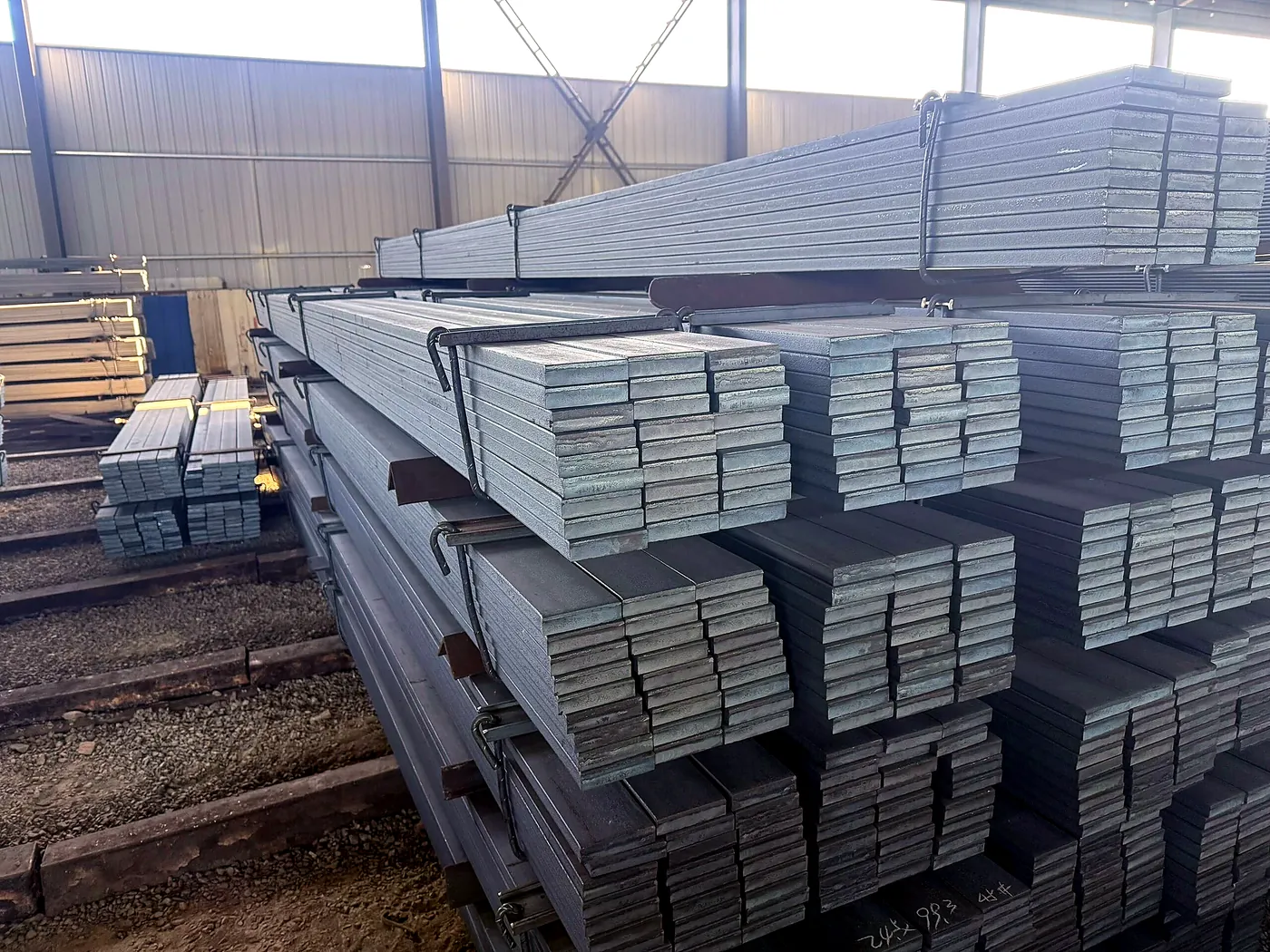
Hot-rolled flat bar is rolled from heated billet and delivered without pickling, so it carries the blue-grey oxide scale produced by the rolling line. That scale is a normal feature of the product, not a defect: it is tightly bonded, gives the steel a degree of short-term atmospheric protection, and disappears under a weld, a coat of paint or a galvanized finish. In exchange, as-rolled bar is the cheapest way to buy a rectangular solid section.
This is the workhorse flat section. It is what fabricators buy by the ton for connection plates, stiffeners, base rails and general welding, and it is also the raw material that goes on to be cold drawn or hot-dip galvanized. Because it is not reworked after rolling, the thickness range available is wider than for cold-drawn bar and the price per ton is lower.
We supply Q235B for general fabrication and welding and Q355B where a higher yield strength allows a lighter section. Unless you specify otherwise, material is supplied mill edge, as rolled, in 6 m or 12 m lengths, either loose in bundles or cut to your cutting list before despatch.
Specifications & Size Range
Common as-rolled width and thickness combinations. This page covers the plain mill-finish product; the same sections are available with tighter tolerance and a bright surface as cold-drawn bar, or with a zinc coating as galvanized flat bar. Non-standard widths and thicknesses are quoted individually.
| Width group | Common widths (mm) | Thickness range (mm) | Surface condition | Typical use |
|---|---|---|---|---|
| Narrow bar | 10, 12, 16, 20, 25, 30 | 3 – 6 | As-rolled, mill scale | Stirrups, hoops, guards, small welded brackets |
| Medium bar | 40, 50, 60, 70, 75, 80 | 3.5 – 12 | As-rolled, mill scale | Connection plates, base rails, machinery framing, fences |
| Wide bar | 100, 120, 150, 160, 180, 200 | 6 – 40 | As-rolled, mill scale | Embedded plates, stiffeners, heavy frames, trailer chassis |
| Thick bar | 60 – 200 | 40 – 60 | As-rolled, mill scale | Heavy machine bases, press plattens, structural bearing plates |
| Cut-to-length bar | Any width above | as ordered | As-rolled, cut ends | Fabrication packs cut to the cutting list before shipment |
Tolerances
Dimensions, shape and mass follow GB/T 702. Thickness and width are measured clear of the rolled edge, and bundle weight is theoretical from nominal dimensions. The oxide scale is not removed and its thickness is not controlled. Cut lengths are square cut within the tolerance agreed on the order; where a tighter width and thickness band is required, cold-drawn bar is the correct product to specify.
Steel Grades & International Equivalents
All grades below are supplied with a mill test certificate. The right-hand column shows the material type and the Chinese standard the grade is produced to; the middle columns give the nearest recognised equivalent in other national standards. Exact equivalence for a specific project should be confirmed on the enquiry.
| GB (China) | ASTM / AISI (US) | EN (Europe) | JIS (Japan) | DIN (Germany) | Type / Standard |
|---|---|---|---|---|---|
| Q235B | A36 / A283 Gr.C | S235JR (EN 10025-2) | SS400 (JIS G3101) | St37-2 | Carbon structural steel (GB/T 700) |
| Q355B | A572 Gr.50 / A992 | S355JR (EN 10025-2) | SM490 (JIS G3106) | St52-3 | High-strength low-alloy (HSLA) steel (GB/T 1591) |
Grade Notes
- Q235B — The workhorse structural grade in China. Fully weldable, excellent cost-performance, the closest Chinese equivalent to ASTM A36 / EN S235JR.
- Q355B — High-strength structural steel for heavy structures, bridges and towers. Equivalent to ASTM A572 Gr.50 / EN S355JR.
Chemical Composition (%, ladle analysis)
Typical specification limits. Actual heat values are reported on the mill test certificate supplied with every shipment.
| Grade | C | Si | Mn | P max | S max | Other elements |
|---|---|---|---|---|---|---|
| Q235B | ≤0.20 | ≤0.35 | ≤1.40 | ≤0.045 | ≤0.045 | — |
| Q355B | ≤0.24 | ≤0.55 | ≤1.60 | ≤0.035 | ≤0.035 | Ceq ≤0.45 |
Mechanical Properties
Minimum values at room temperature unless stated. ReL = yield strength; Rp0.2 = 0.2% proof stress; Rm = tensile strength; A = elongation after fracture.
| Grade | Yield (ReL) | Proof (Rp0.2) | Tensile (Rm) | Elongation A | Impact / others | |
|---|---|---|---|---|---|---|
| Q235B | ≥235 MPa | — | 370–500 MPa | ≥26% | +20 °C, ≥27 J | — |
| Q355B | ≥355 MPa (≤16 mm) | — | 470–630 MPa | ≥22% | +20 °C, ≥27 J | — |
Standards & Documents
- GB/T 702 — hot-rolled steel bars for general purposes, dimensions and tolerance
- GB/T 700 — carbon structural steels, covering Q235B
- GB/T 1591 — high-strength low-alloy structural steels, covering Q355B
- Mechanical property testing for every heat, reported on the mill test certificate
- EN 10204 3.1 mill test certificate with each heat; SGS or BV inspection on request
- Base material for subsequent hot-dip galvanizing to GB/T 13912 or cold drawing to order
Typical Applications
| Industry / Application | Typical use |
|---|---|
| Welded fabrication & structures | Gusset plates, splices, cleats, stiffeners and general welded assemblies, cut and welded on site or in the workshop. |
| Machinery framing & bases | Machine base rails, mounting ribs, guards, brackets and equipment supports where a flat face is needed for bolting. |
| Hardware & metal products | Hoops, hinges, clamps, handles, door frames and general metal goods that are punched and bent after delivery. |
| Infrastructure & municipal work | Guard-rail members, drainage cover edges, sign frames, gantry reinforcement and pipe support saddles. |
| Bridges & heavy structures | Bearing plates, splice stiffeners and secondary members in bridge, hoarding and gantry construction. |
| Base material for finishing | Feedstock for in-house cold drawing, pickling, punching or hot-dip galvanizing, bought in tonnage at the lowest unit cost. |
| General workshop stock | Everyday fabrication stock in a stockist range, held in a spread of widths and thicknesses for immediate use. |
Common Problems Buyers Face — and How We Prevent Them
These are the issues that most often cause claims on steel imports. Each one is controlled in our process before shipment.
The customer inspects the bar and reports the surface as rusty or defective
Why it happens: As-rolled bar carries a blue-grey oxide scale that looks dull next to a pickled or painted product, and the scale can flake slightly on tight bending or after long storage.
Our control: We state clearly on the documents that the material is supplied as rolled, and, where the appearance of the finished part matters, we supply pickled and oiled bar or cold-drawn bar instead. Desiccant and VCI paper are added for humid routes to keep the scale intact in transit.
Scale trapped under a weld causing porosity
Why it happens: Oxide scale, oil or rust on the faying surface burns off under the arc and produces gas that becomes porosity in the weld.
Our control: Specify pickled and oiled bar where the weld quality is important, or grind the faying surface before welding. Tell us at the enquiry that the bar will be welded and we will recommend the surface condition that suits your welding procedure.
Bar will not sit flat against a machined face
Why it happens: As-rolled bar is supplied to a normal mill tolerance for thickness, and a pressed or machined assembly that assumes a ground face can rock on it.
Our control: Where a component has to seat accurately, order cold-drawn bar to a narrow thickness tolerance, or specify that the bar will be machined after delivery and leave the machining allowance in the ordered thickness.
Weight at destination does not match the invoice
Why it happens: Flat bar is sold on theoretical weight calculated from nominal dimensions, and if the actual size runs to the plus side of tolerance the delivered mass is higher than the calculated figure.
Our control: Bundles are weighed and the weighing record accompanies the packing list, and the basis of the weight is stated on the order acknowledgement. If your contract is on actual weight, we will confirm the weighing arrangement before loading.
Wrong grade supplied for a galvanizing or bending operation
Why it happens: Higher-strength Q355B bar bends less readily and can behave differently in a galvanizing bath than the Q235B the fabricator had assumed from the drawing.
Our control: Tell us the intended process on the enquiry. We will confirm whether Q235B or Q355B suits the bend radius and the coating route, and the grade supplied is stated on the bundle tag and the certificate so it can be verified before processing.
Our Supply & Manufacturing Advantages
- Lowest cost per kilogram — No pickling, drawing or coating operation is added, so as-rolled bar is the most economical flat section we can offer in a given size.
- Widest size availability — The rolled product covers widths and thicknesses that are impractical to produce by cold drawing, including heavy sections up to 60 mm thick.
- Ready for heavy welding — Supplied mill edge and dry, in tonnage bundles suited to structural fabrication rather than to small machined parts.
- Sound mechanical properties — Hot rolling delivers consistent, fully recrystallised mechanical properties, verified per heat on the mill test certificate.
- Cut to your cutting list — Cutting to finished length before shipment reduces your offcut loss and the freight weight you pay for.
- A route to any finish — The same section can be supplied pickled and oiled, cold drawn or hot-dip galvanized, so the specification can move with the project without changing supplier.
Packaging, Delivery & Payment
- Packing: loose in bulk vessel, or bundled and containerised to your requirement. Galvanized and coated products get VCI paper, waterproof wrapping and edge protection. See our export packaging methods.
- Availability: both stock and custom production. Tell us the specification and we will confirm the route.
- MOQ: no strict minimum — one ton can ship.
- Lead time: stock dispatched to port within 3 days; orders needing export packaging about 1 week; custom production quoted per product.
- Payment: stock — 10% deposit, balance before shipment; custom production — 50% deposit, balance before shipment.
- Documents: EN 10204 3.1 mill test certificate with every shipment; third-party inspection (SGS / BV) on request.
Frequently Asked Questions
Why is hot-rolled flat bar black or blue-grey?
The colour comes from the oxide scale formed when the hot steel reacts with air on the rolling line. It is firmly bonded to the surface and is a normal characteristic of the as-rolled product, not corrosion. If you need a clean bright surface, order cold-drawn bar, or pickled and oiled bar.
Should I buy hot-rolled or cold-drawn flat bar?
Choose hot-rolled when the priority is cost and the part will be welded, painted, galvanized or machined with allowance, because it is cheaper and available in a wider range of sizes. Choose cold-drawn bar when the part is a precision component that must fit a tight tolerance or be used bright without further machining. Many workshops buy both for different jobs.
What is the equivalent of Q235B hot-rolled flat bar in other standards?
Q235B to GB/T 700 corresponds closely to ASTM A36, EN S235JR, JIS SS400, DIN St37-2 and ISO 630 Fe360. The closest match on specified yield strength is EN S235JR; against ASTM A36 the Chinese grade specifies 235 MPa minimum yield against 250 MPa, so check the design stress. We will document the equivalence in writing on request.
When should I use Q355B instead of Q235B?
Use Q355B when a lighter section must carry the same load, when the design includes fatigue or ground-movement loading, or when a high-strength grade is named on the drawing, for example ASTM A572 Gr.50 or EN S355JR. Q355B costs more per ton but the section can be thinner, which often reduces the finished weight. Send the load case and we will nominate the grade.
Can the bar be cut to length before shipment?
Yes. Send the cutting list and we will cut to finished length, deburr if required, and pack in the sequence of the list so the material can be issued straight to fabrication. Cutting before shipment also removes offcut weight from the container.
What is the difference between flat bar and steel strip?
The distinction is mainly one of thickness and delivery form. Flat bar is a hot-rolled solid section supplied in straight lengths, typically 3 mm thick and above, while strip is thinner material, often supplied in coil. For thicker, heavier members in structural and general fabrication, flat bar is the appropriate product.
Who supplies as-rolled hot-rolled flat bar from China in tonnage?
We do. Dayang supplies as-rolled flat bar to stockists, fabricators and steel service centres worldwide in Q235B and Q355B, in mixed-size consolidations or single-size tonnage, with mill test certificates and export packing arranged from our own mill network.
Do you have a minimum order quantity and what is the lead time?
There is no strict minimum and one ton can ship. Standard sizes reach the port in about three days, and orders requiring export packing or cutting to length take about a week. Non-standard widths and thicknesses are quoted with their own production lead time.
Will as-rolled bar rust during a long sea voyage?
It can develop light surface oxidation in humid conditions, because there is no protective coating on the product. Bundles are shipped dry with spacers, and VCI paper or desiccant is added for long or humid routes. Where the bar must arrive bright, we supply pickled and oiled or cold-drawn material instead.
Request a Quotation Export Packaging