
Deformed Steel Bar (Rebar) HRB400E / HRB500E
Hot-rolled deformed steel bar (rebar) in the seismic grades HRB400E and HRB500E, from 6 mm to 40 mm, supplied as 6 m, 9 m and 12 m straight lengths or as coils for the small sizes. Made to GB/T 1499.2 with a mill test certificate for every heat, and available cut, bent or threaded to your bar-bending schedule.
Product Overview
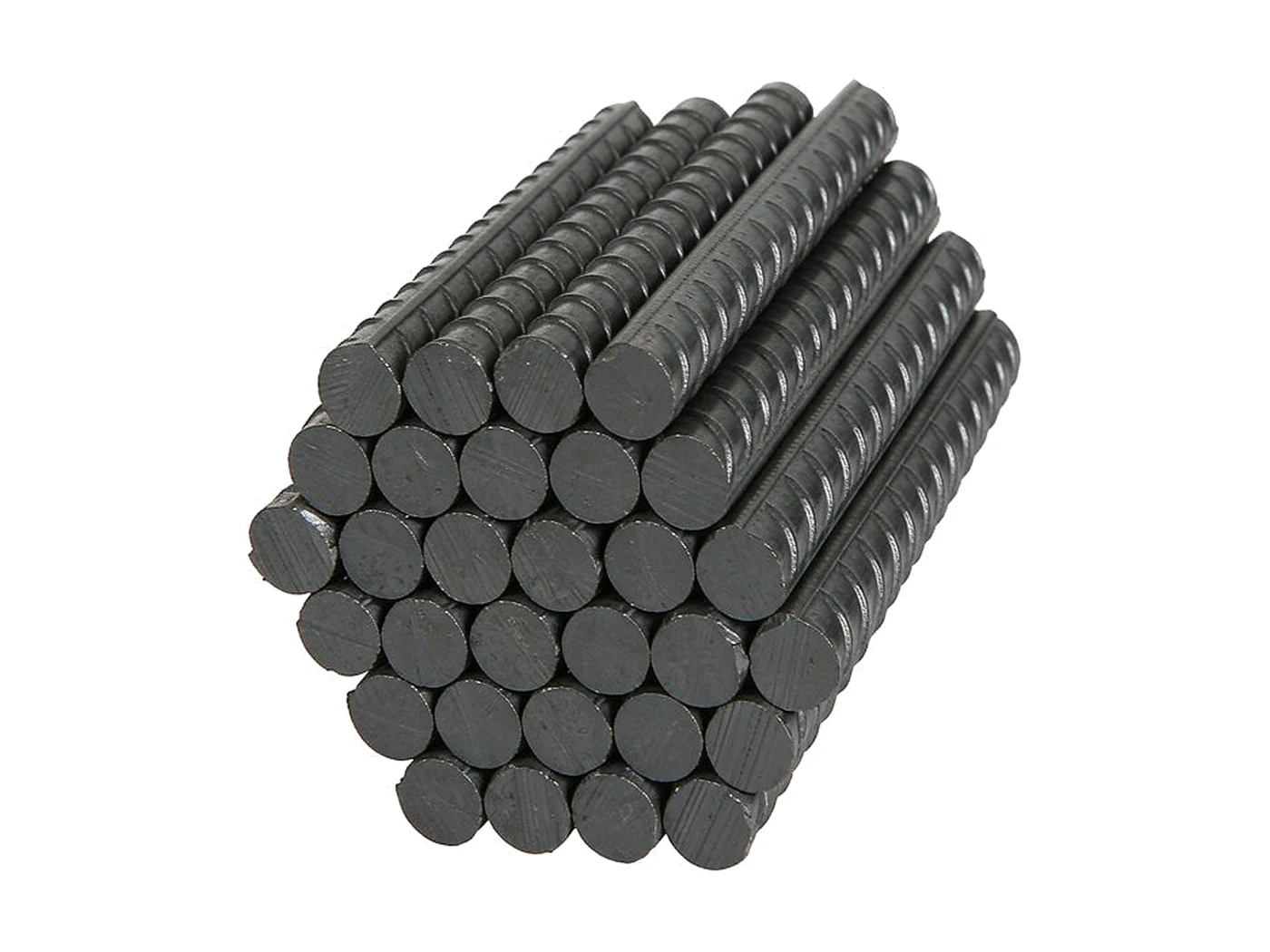
Deformed steel bar — rebar, ribbed bar or reinforcing bar — is the hot-rolled bar that carries the tensile load in reinforced concrete. The rolled rib pattern is what separates it from plain round bar: the ribs and transverse lugs lock into the concrete so that steel and concrete strain together instead of slipping, and the bar is sold against a guaranteed yield strength rather than a guaranteed composition. In the Chinese designation HRB400E, the letters stand for hot-rolled ribbed bar, 400 is the minimum yield strength in MPa, and the E suffix marks a grade that also satisfies the seismic requirements of GB/T 1499.2.
Those extra requirements are the reason to specify an E grade rather than a plain HRB400. A seismic grade must hold a tensile-to-yield ratio (Rm/ReL) of at least 1.25, a minimum uniform elongation Agt, and a controlled maximum carbon equivalent, so the bar keeps reserve strength and ductility after it yields. A structure detailed with HRB400E or HRB500E can deform and dissipate energy in an earthquake instead of failing in a brittle manner, which is why seismic grades are written into the reinforcement schedules of buildings, bridges and marine works in high-seismicity regions. HRB500E carries a nominal yield of 500 MPa and typically saves about 10–15 per cent of steel tonnage against HRB400 at equal load capacity.
We supply the full range as straight bar from 12 mm to 40 mm and as coiled bar from 6 mm to 12 mm, which is how the small diameters travel to site for straightening and cutting. Bar can be delivered in mill lengths, cut to a fixed length, bent to a shape list, or threaded for mechanical couplers, so cage assembly on site becomes a matter of positioning rather than cutting. Every heat travels with an EN 10204 3.1 mill test certificate showing chemical composition and mechanical properties.
Specifications & Size Range
Nominal sizes, delivery forms and the work each size normally does. Intermediate diameters, non-standard cut lengths and pre-bent shapes are produced to order — send the bar-bending schedule and we will quote the fabricated bar rather than the straight bar.
| Size group | Nominal diameter (mm) | Nominal area (mm²) | Delivery form | Typical use |
|---|---|---|---|---|
| Small coil sizes | 6 / 8 / 10 | 28.3 / 50.3 / 78.5 | Coil, approx. 2–3 t per coil | Stirrups, ties, slab distribution bars, wall reinforcement |
| Small straight bar | 12 / 14 / 16 / 18 | 113.1 / 153.9 / 201.1 / 254.5 | 6 m / 9 m / 12 m straight | Beams, columns, slabs, walls, footings |
| Medium straight bar | 20 / 22 / 25 / 28 | 314.2 / 380.1 / 490.9 / 615.8 | 9 m / 12 m straight | Piles, bridge decks, rafts, heavy columns |
| Large straight bar | 32 / 36 / 40 | 804.2 / 1017.9 / 1256.6 | 9 m / 12 m straight, cut to order | Diaphragm walls, tunnels, bridge piers, mass concrete |
| Fabricated bar | 6 – 40 | as per the size above | Cut, bent or threaded to drawing | Pre-assembled cages, mechanical couplers, scheduled shapes |
Tolerances
Dimensional tolerance, rib geometry (rib height, rib spacing and the gap between rib ends) and mass deviation are all governed by GB/T 1499.2, and the permitted limits for the size you order are stated on the mill certificate. Length tolerance on cut-to-order bar, and the tolerance achieved on bent shapes, are confirmed in writing on the order acknowledgement together with the weight basis (theoretical or actual) used for invoicing.
Available Sizes — Detailed Specification
Every size below has its own page with the full theoretical weight table, tolerances, grade data, applications and delivery options. Theoretical weights are the published values from GB 1499.2-2024 Tables 2 and 4.
| Nominal diameter | Theoretical weight (kg/m) | Weight per 12 m | Specification page |
|---|---|---|---|
| Ø6 mm | 0.222 | 2.7 kg | Weight & specification |
| Ø8 mm | 0.395 | 4.7 kg | Weight & specification |
| Ø10 mm | 0.617 | 7.4 kg | Weight & specification |
| Ø12 mm | 0.888 | 10.7 kg | Weight & specification |
| Ø14 mm | 1.209 | 14.5 kg | Weight & specification |
| Ø16 mm | 1.58 | 19.0 kg | Weight & specification |
| Ø18 mm | 1.999 | 24.0 kg | Weight & specification |
| Ø20 mm | 2.468 | 29.6 kg | Weight & specification |
| Ø22 mm | 2.986 | 35.8 kg | Weight & specification |
| Ø25 mm | 3.856 | 46.3 kg | Weight & specification |
| Ø28 mm | 4.837 | 58.0 kg | Weight & specification |
| Ø32 mm | 6.318 | 75.8 kg | Weight & specification |
| Ø36 mm | 7.996 | 96.0 kg | Weight & specification |
| Ø40 mm | 9.872 | 118.5 kg | Weight & specification |
| Ø50 mm | 15.425 | 185.1 kg | Weight & specification |
Steel Grades & International Equivalents
All grades below are supplied with a mill test certificate. The right-hand column shows the material type and the Chinese standard the grade is produced to; the middle columns give the nearest recognised equivalent in other national standards. Exact equivalence for a specific project should be confirmed on the enquiry.
| GB (China) | ASTM / AISI (US) | EN (Europe) | JIS (Japan) | DIN (Germany) | Type / Standard |
|---|---|---|---|---|---|
| HRB400E | A615 Gr.60 (420) | B500B / EN 10080 | SD390 (JIS G3112) | BSt420S | Hot-rolled ribbed bar (rebar), seismic (GB/T 1499.2) |
| HRB500E | A615 Gr.75 (520) | B500B (high grade) / EN 10080 | SD490 (JIS G3112) | BSt500S | Hot-rolled ribbed bar (rebar), seismic (GB/T 1499.2) |
Grade Notes
- HRB400E — The most widely used reinforcement bar in China. The ‘E’ suffix indicates seismic (earthquake-resistant) performance.
- HRB500E — High-strength seismic rebar, saves 10–15% steel tonnage versus HRB400 at equal load capacity.
Chemical Composition (%, ladle analysis)
Typical specification limits. Actual heat values are reported on the mill test certificate supplied with every shipment.
| Grade | C | Si | Mn | P max | S max | Other elements |
|---|---|---|---|---|---|---|
| HRB400E | ≤0.25 | ≤0.80 | ≤1.60 | ≤0.045 | ≤0.045 | Ceq ≤0.54 |
| HRB500E | ≤0.25 | ≤0.80 | ≤1.60 | ≤0.045 | ≤0.045 | Ceq ≤0.55 |
Mechanical Properties
Minimum values at room temperature unless stated. ReL = yield strength; Rp0.2 = 0.2% proof stress; Rm = tensile strength; A = elongation after fracture.
| Grade | Yield (ReL) | Proof (Rp0.2) | Tensile (Rm) | Elongation A | Impact / others | |
|---|---|---|---|---|---|---|
| HRB400E | ≥400 MPa | — | ≥540 MPa | — | — | — |
| HRB500E | ≥500 MPa | — | ≥630 MPa | — | — | — |

Standards & Documents
- GB/T 1499.2 — hot-rolled ribbed steel bars for the reinforcement of concrete (the governing standard for HRB400E and HRB500E)
- GB/T 1499.1 — hot-rolled plain round bar for reinforcement (HPB300) where plain bar is specified in the same structure
- ISO 6935-2 — steel for the reinforcement of concrete, ribbed bars (international reference)
- ASTM A615 / A706 — the usual comparison for an imported project is A615 Gr.60 for HRB400 and A615 Gr.75 for HRB500; grade equivalence must be confirmed against your project specification
- EN 10080 and BS 4449 (B500B), JIS G3112 (SD390 / SD490) — European and Japanese comparisons
- EN 10204 3.1 mill test certificate with every heat; SGS or BV third-party inspection and sampling on request
Typical Applications
| Industry / Application | Typical use |
|---|---|
| Residential & commercial buildings | Columns, beams, shear walls, slabs, stair flights and foundations in cast-in-place concrete frames. Seismic grades are used from the foundation up in structures designed for ductile behaviour. |
| Bridges & transport structures | Deck slabs, pier caps, abutments, culverts and tunnel linings, where the Rm/ReL and Agt requirements of the E grade provide the ductility the design assumes. |
| Marine, port & coastal works | Wharves, quay walls, breakwaters and desalination plant structures. The bar is normally protected by adequate concrete cover and a low-permeability mix, so grade and detailing matter more than coating. |
| Piles & deep foundations | Bored piles, diaphragm walls and secant piles, using cage reinforcement in sizes from 16 mm to 40 mm cut to pile depth. |
| Water, power & industrial infrastructure | Treatment works, reservoirs, dams, cooling towers, powerhouse structures, heavy industrial floors and equipment plinths. |
| Precast concrete elements | Beams, columns, wall panels, box culverts and segmental tunnel linings, where cut-and-bent bar is delivered to the precast yard already in the scheduled shape. |
| Roads, rail & ground works | Barrier bases, drainage structures, retaining walls, equipment bases and slab-on-grade reinforcement. |
Common Problems Buyers Face — and How We Prevent Them
These are the issues that most often cause claims on steel imports. Each one is controlled in our process before shipment.
Surface rust found on arrival at the port
Why it happens: Hot-rolled bar carries only a light mill scale and no coating, and damp air inside a container will produce a rust film within a few weeks of loading.
Our control: Bar is shipped dry, strapped and covered, and where appearance or a specification limit matters we agree in advance what level of surface oxidation is acceptable. A light oil film or VCI wrapping can be applied for routes and seasons where condensation is likely.
Bars do not match the bending schedule on site
Why it happens: Shapes bent on the wrong mandrel diameter, or to a radius that ignores the minimum bending requirement for the bar size, crack on the outside of the bend or jam when the cage is assembled.
Our control: Bending is done to your schedule using the minimum mandrel diameter appropriate to the size and grade, and the schedule drawing travels with the order, so a short or long leg is caught in our works rather than at the edge of a slab.
Weight or diameter query at receiving inspection
Why it happens: An importer weighs the delivery and compares it with the theoretical area, but GB/T 1499.2 permits a mass deviation, and the mass of ribbed bar per metre is not that of a plain bar of the same nominal diameter.
Our control: We state whether invoicing is on theoretical or actual weight and confirm the permitted mass deviation band before shipment, so the receiving check is made against the standard rather than against an assumption.
Cracking or brittleness after site welding
Why it happens: Rebar is a controlled-carbon product intended to be bent, not welded, and improvised cross-welding of a high carbon equivalent bar can leave a hard, brittle zone at the joint.
Our control: We confirm the carbon equivalent from the certificate and stay within the Ceq limit of the grade, and where welded cages or welded mesh are genuinely required we agree the grade and a welding procedure in advance of the order.
Grade substitution between HRB400E and HRB500E
Why it happens: The two grades look identical once the bundle tags are lost, and the difference only shows up when a test piece is taken or when a member is found to be over- or under-designed.
Our control: Bars are rolled with the grade designation in the rib marking, every bundle is tagged by heat number and grade, and the matching mill certificate is tracked with the bundle through loading so a receiving check takes minutes.
Our Supply & Manufacturing Advantages
- Seismic grades as the default — HRB400E and HRB500E are what we supply for structural work as a matter of course, not as a special order, so the Rm/ReL and Agt requirements of GB/T 1499.2 are covered on the certificate.
- Straight bar and coil on one order — Large sizes ship as straight lengths and small sizes as coils on the same shipment, so you deal with one set of certificates and one bill of lading.
- Cut, bent and threaded to schedule — Bar can arrive ready for the cage, in fixed lengths, bent to a shape list, or threaded for mechanical couplers, which removes site labour and offcut scrap.
- Documented and traceable — An EN 10204 3.1 mill test certificate for every heat, with bundle tags retained through loading so an incoming identification check is quick.
- Grade equivalence advice — Tell us the grade on your drawing (A615 Gr.60, A615 Gr.75, B500B, SD390) and we will nominate the Chinese grade and put the comparison in writing before you commit.
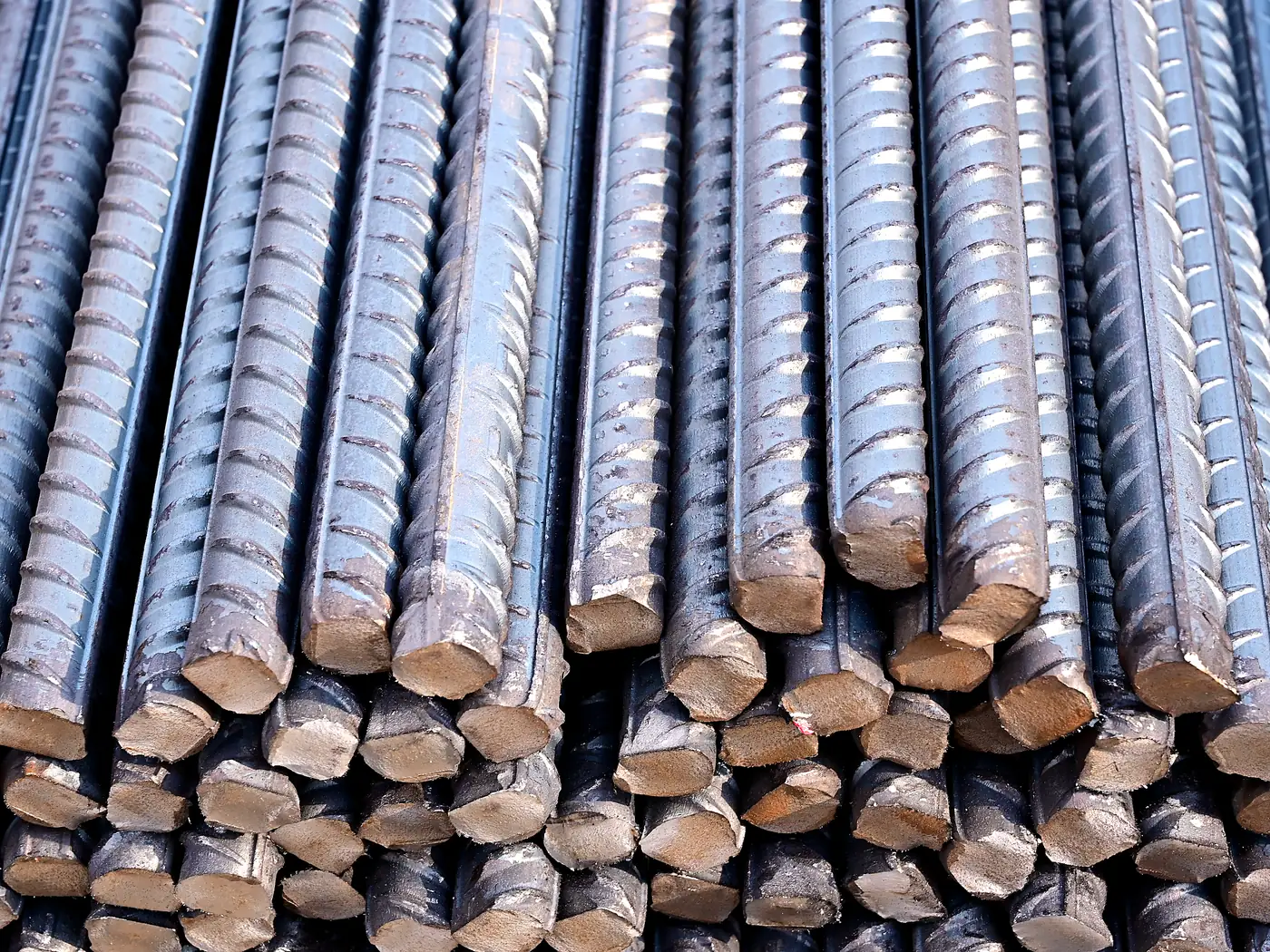
- Export packaging built in — Bundled with steel straps at lifting points for container or break-bulk loading, with bundle weights sized to stay inside the container limit.
Packaging, Delivery & Payment
- Packing: loose in bulk vessel, or bundled and containerised to your requirement. Galvanized and coated products get VCI paper, waterproof wrapping and edge protection. See our export packaging methods.
- Availability: both stock and custom production. Tell us the specification and we will confirm the route.
- MOQ: no strict minimum — one ton can ship.
- Lead time: stock dispatched to port within 3 days; orders needing export packaging about 1 week; custom production quoted per product.
- Payment: stock — 10% deposit, balance before shipment; custom production — 50% deposit, balance before shipment.
- Documents: EN 10204 3.1 mill test certificate with every shipment; third-party inspection (SGS / BV) on request.
Frequently Asked Questions
What does the E mean in HRB400E and HRB500E?
The E suffix marks a seismic grade to GB/T 1499.2. Compared with a plain HRB400, the E grade must additionally hold a tensile-to-yield ratio of at least 1.25, a minimum uniform elongation measured at maximum load, and a capped carbon equivalent. In practice that means the bar has reserve strength and ductility after yielding, so a framed structure can deform and absorb energy rather than fail suddenly. If your structural drawings are prepared for a seismic region, the E grade is normally the correct specification.
What is the Chinese equivalent of ASTM A615 Grade 60 or Grade 75?
HRB400E is the usual comparison for A615 Gr.60 and HRB500E for A615 Gr.75, and both are quoted with those comparisons every day. The grades are not identical, however: GB/T 1499.2 and ASTM A615 differ in the way yield, elongation and rib geometry are specified. Where the project specification names ASTM, send us the clause and we will confirm in writing which Chinese grade and which test regime will be used to satisfy it.
What is the difference between HRB400E and HRB500E?
HRB500E has a nominal yield strength of 500 MPa against 400 MPa, and a higher minimum tensile strength of 630 MPa against 540 MPa. Using the higher grade lets a designer reduce steel tonnage by roughly 10 to 15 per cent at equal load capacity, which matters on heavily reinforced columns and transfer beams. The trade-off is slightly lower uniform elongation and closer control needed on bending, so HRB500E is normally specified where the design genuinely calls for it.
Which grade should I choose for a building and which for a bridge?
For ordinary buildings HRB400E is the workhorse and covers slabs, beams, columns and foundations. For bridges, marine works and heavy industrial structures, HRB500E is often chosen in the main members where the design uses the higher yield, with HRB400E for the secondary reinforcement. Send us the reinforcement schedule and the governing code and we will confirm the grade split and the test requirements.
Can you supply rebar cut and bent to my bar-bending schedule?
Yes. Send the schedule as a PDF or a spreadsheet with bar marks, diameter, shape code, leg lengths and quantity, and we will quote the fabricated bar including bending, bundling by bar mark and marking. Delivering ready shapes removes site cutting and offcut waste, reduces the labour needed on the deck, and means the tolerance on the shape is checked in our works rather than on site.
Should I order straight bar or rebar in coils?
Straight bar is the right choice from 12 mm upward, for main reinforcement and for anything placed without further straightening. Coils suit 6 mm to 12 mm bar that will be straightened and cut on site or in a processing yard, especially for stirrups, ties and slab distribution bars, because a coil removes the handling of many short lengths and the scrap that fixed lengths create. Many importers take both on the same shipment.
What documents come with a rebar shipment?
An EN 10204 3.1 mill test certificate showing heat number, chemical composition and mechanical properties, plus the commercial invoice, packing list, certificate of origin and, where required, the mill production certificate. SGS or BV inspection, sampling and testing can be arranged before loading if your project or your bank requires a third-party report.
What is your minimum order quantity and lead time?
There is no strict minimum order quantity and a trial shipment of one ton is possible. Mill lengths of stock sizes normally reach the port within 3 days; orders that need cutting, bending or threading to a schedule take about one week to reach the port. Full container or break-bulk quantities are quoted per project because the freight and strapping plan changes with the size mix.
Who supplies GB/T 1499.2 HRB400E rebar from China?
We supply HRB400E and HRB500E deformed bar to GB/T 1499.2 from 6 mm to 40 mm, in straight lengths or coils, sourced from major Chinese mills with an EN 10204 3.1 mill test certificate for every heat. Send the sizes, the tonnage and the destination port and we will come back with a specification sheet, a price and a loading plan rather than a general quotation.
Request a Quotation Export Packaging