
Rebar in Coils (Coiled Rebar) HRB400E / HRB500E
Deformed steel bar supplied in coils from 6 mm to 12 mm in HRB400E and HRB500E, at a coil weight of about 2 to 3 tonnes. Coiled rebar is straightened and cut in the fabrication yard or on site, which removes the handling of many short straight lengths and the offcut waste that fixed lengths create.
Product Overview
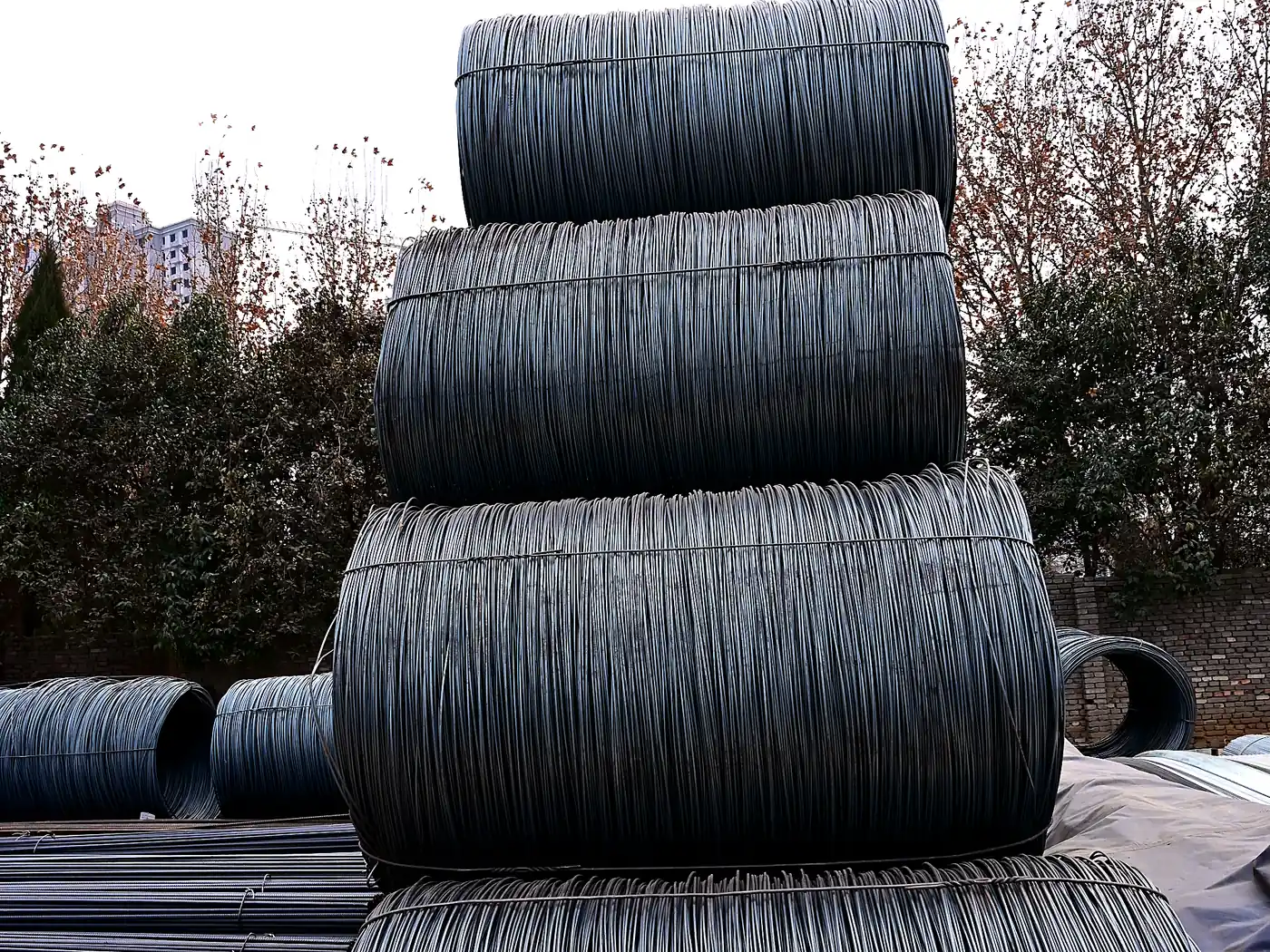
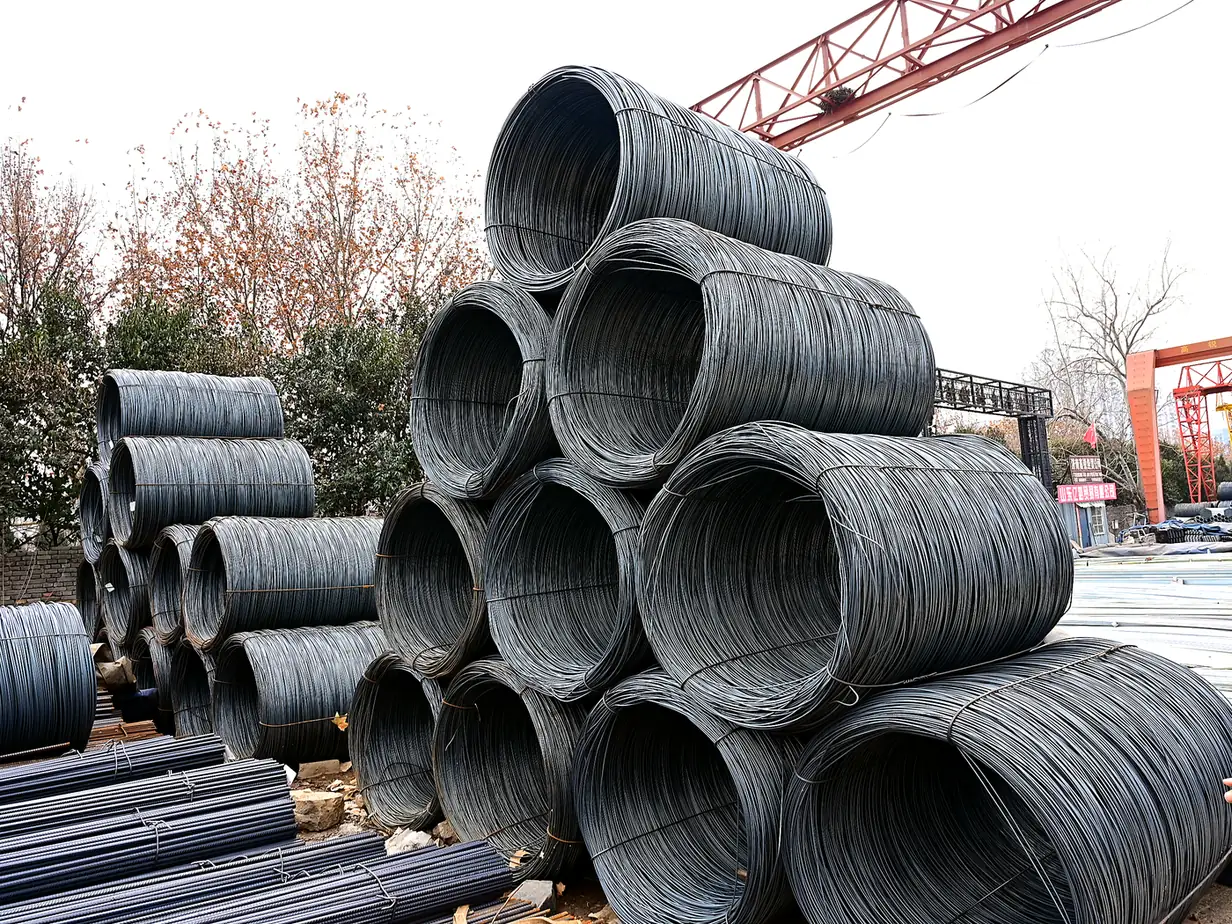
Rebar in coils — coiled rebar, or coiled ribbed bar — is the same hot-rolled deformed bar that is supplied as straight lengths, rolled down and coiled instead of being cut to a fixed length. It is produced in the small diameters only, normally 6 mm to 12 mm, and each coil carries the same continuous rib pattern as straight bar, so once it is straightened it behaves as ordinary reinforcement and bonds with concrete in the same way. The coils ship at about 2 to 3 tonnes each, which makes them easy to lift with a standard forklift or crane and economical to stow in a container.
The reason to buy coil rather than straight bar is handling and waste. Straight bar arrives in fixed lengths, so a detail that needs a 2.4 m length leaves a long offcut from a 6 m bar unless the offcuts can be used elsewhere. A coil has no fixed length at all: it is straightened and cut to exactly what the bar-bending schedule calls for, so material utilisation is higher and the volume of scrap on the deck is lower. Coils also allow a reinforcement yard to hold a large tonnage of several diameters in a small area, and a 2 to 3 tonne coil can be fed straight into a straightening and cutting machine.
Coiled bar is the normal delivery form for stirrups, ties, links, slab distribution bars and wall reinforcement, and it is also the feed stock for welded mesh and precast panel production. We supply it in seismic grades only — HRB400E and HRB500E — so the ductility requirements of GB/T 1499.2 are covered without a special request, and coils can be supplied in defined weight bands if your straightening line is rated for a particular coil size.
Specifications & Size Range
Coil diameters, coil weights and what each size is normally used for. Straightened and cut lengths can be produced from coil in our works if your site has no straightening line; coil weight bands outside the standard range are confirmed per order.
| Size group | Nominal diameter (mm) | Nominal area (mm²) | Coil weight | Typical use |
|---|---|---|---|---|
| Fine coil | 6 | 28.3 | approx. 2 t | Stirrups, ties, wall distribution bars, mesh |
| Light coil | 8 | 50.3 | approx. 2–2.5 t | Stirrups, slab mesh, ties, precast panels |
| Standard coil | 10 | 78.5 | approx. 2.5–3 t | Slabs, walls, footings, welded mesh production |
| Heavy coil | 12 | 113.1 | approx. 3 t | Slabs, beams, precast elements, ground works |
| Straightened from coil | 6 – 12 | as per the size above | coil or straightened and cut | Fixed-length bar produced from coil for sites without a straightening line |
Tolerances
Dimensional tolerance, rib geometry and mass deviation follow GB/T 1499.2, with the permitted limits for the ordered size stated on the mill certificate. Coil weight is supplied within an agreed band rather than to an exact figure, because the last wraps of a coil are not cut to a fixed mass. Straightness of straightened bar is checked against the standard for the grade, and the achieved straightness is confirmed on the order acknowledgement.
Steel Grades & International Equivalents
All grades below are supplied with a mill test certificate. The right-hand column shows the material type and the Chinese standard the grade is produced to; the middle columns give the nearest recognised equivalent in other national standards. Exact equivalence for a specific project should be confirmed on the enquiry.
| GB (China) | ASTM / AISI (US) | EN (Europe) | JIS (Japan) | DIN (Germany) | Type / Standard |
|---|---|---|---|---|---|
| HRB400E | A615 Gr.60 (420) | B500B / EN 10080 | SD390 (JIS G3112) | BSt420S | Hot-rolled ribbed bar (rebar), seismic (GB/T 1499.2) |
| HRB500E | A615 Gr.75 (520) | B500B (high grade) / EN 10080 | SD490 (JIS G3112) | BSt500S | Hot-rolled ribbed bar (rebar), seismic (GB/T 1499.2) |
Grade Notes
- HRB400E — The most widely used reinforcement bar in China. The ‘E’ suffix indicates seismic (earthquake-resistant) performance.
- HRB500E — High-strength seismic rebar, saves 10–15% steel tonnage versus HRB400 at equal load capacity.
Chemical Composition (%, ladle analysis)
Typical specification limits. Actual heat values are reported on the mill test certificate supplied with every shipment.
| Grade | C | Si | Mn | P max | S max | Other elements |
|---|---|---|---|---|---|---|
| HRB400E | ≤0.25 | ≤0.80 | ≤1.60 | ≤0.045 | ≤0.045 | Ceq ≤0.54 |
| HRB500E | ≤0.25 | ≤0.80 | ≤1.60 | ≤0.045 | ≤0.045 | Ceq ≤0.55 |
Mechanical Properties
Minimum values at room temperature unless stated. ReL = yield strength; Rp0.2 = 0.2% proof stress; Rm = tensile strength; A = elongation after fracture.
| Grade | Yield (ReL) | Proof (Rp0.2) | Tensile (Rm) | Elongation A | Impact / others | |
|---|---|---|---|---|---|---|
| HRB400E | ≥400 MPa | — | ≥540 MPa | — | — | — |
| HRB500E | ≥500 MPa | — | ≥630 MPa | — | — | — |
Standards & Documents
- GB/T 1499.2 — hot-rolled ribbed steel bars for the reinforcement of concrete (the governing standard for HRB400E and HRB500E coils)
- GB/T 1499.1 — hot-rolled plain round bar for reinforcement (HPB300), where plain coiled bar is required alongside
- ISO 6935-2 — steel for the reinforcement of concrete, ribbed bars (international reference)
- ASTM A615 / A706 — the usual comparison for an imported project is A615 Gr.60 for HRB400 and A615 Gr.75 for HRB500; equivalence must be confirmed against your specification
- EN 10080 and BS 4449 (B500B), JIS G3112 (SD390 / SD490) — European and Japanese comparisons
- EN 10204 3.1 mill test certificate with every heat; SGS or BV third-party inspection and sampling on request
Typical Applications
| Industry / Application | Typical use |
|---|---|
| Residential slabs & walls | Slab distribution reinforcement, wall reinforcement and ground slabs, where a straightening and cutting line turns a coil into the exact lengths the schedule calls for. |
| Stirrups, ties & links | Column ties, beam stirrups and link cages, the application where coil is most often preferred because it produces very little offcut. |
| Precast concrete & welded mesh | Precast panels, box culverts and welded mesh lines that consume coil continuously and prefer a defined coil weight for machine feeding. |
| Roads, drainage & small structures | Barrier bases, kerbs, drainage units, equipment plinths and small retaining structures. |
| Reinforcement processing yards | Cut-and-bend yards that buy coil by tonnage and supply straightened, cut and bent bar to contractors on their own schedules. |
| Industrial floors & ground slabs | Warehouse and factory floors, hardstandings and yard paving, where mesh or light bar reinforcement runs continuously across large areas. |
| Repairs, extensions & small contracts | Small sites that cannot justify buying fixed lengths in several diameters and would rather straighten only what the job needs. |
Common Problems Buyers Face — and How We Prevent Them
These are the issues that most often cause claims on steel imports. Each one is controlled in our process before shipment.
Coil collapsed, tangled or deformed on arrival
Why it happens: Coils stacked flat instead of eye-to-sky, or lifted with a single sling through the eye, will collapse into an oval and the wraps will tangle during unwinding.
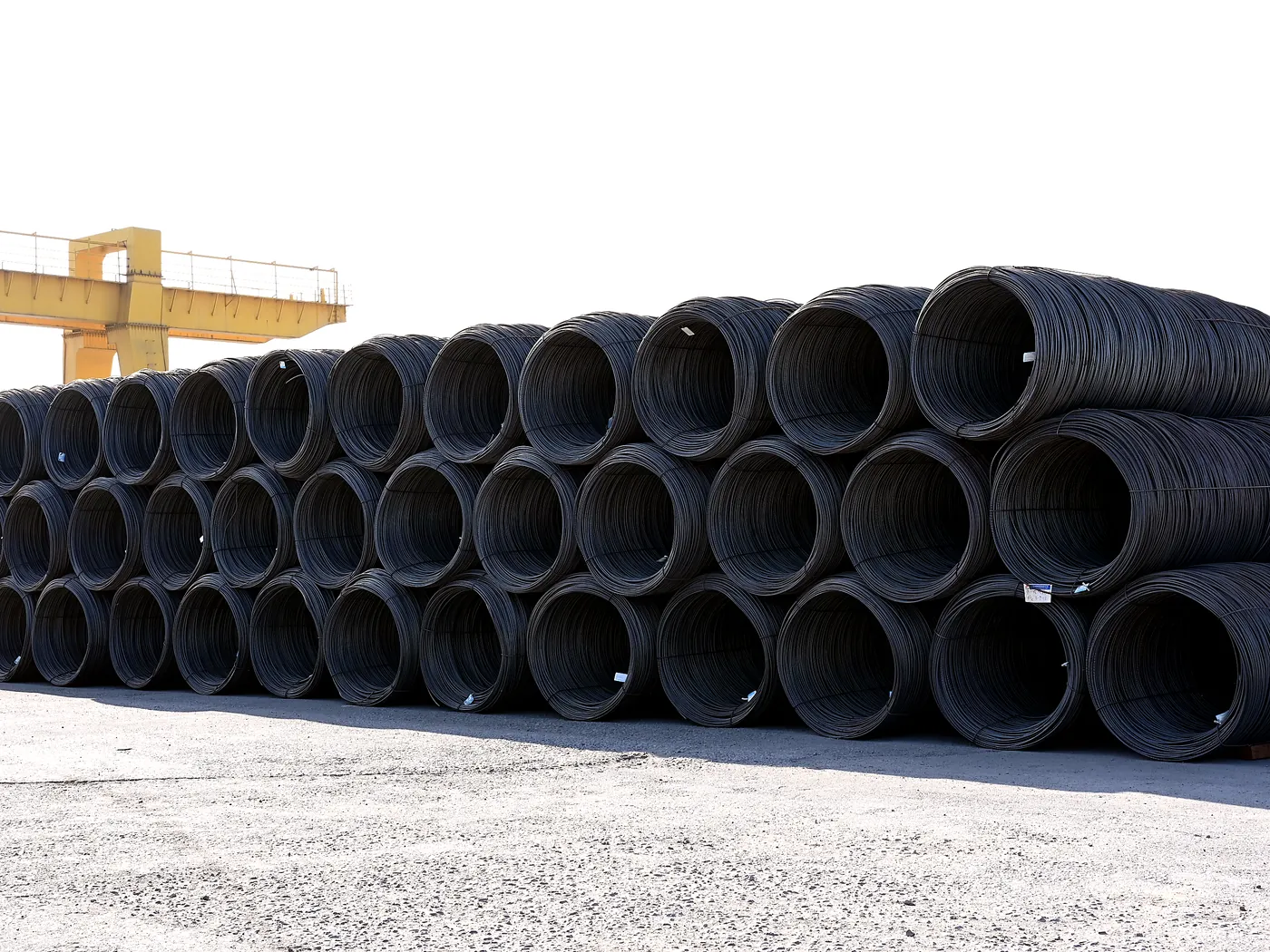
Our control: Coils are strapped at several points, stacked eye to sky and loaded so that lifting is done with a proper C-hook or a two-point sling. Coil counts per layer and the stacking arrangement are shown on the packing list so the container can be unloaded safely.
Rust between the wraps of a coil
Why it happens: Air cannot circulate inside a tightly wound coil, so condensation during a long sea voyage produces rust on the wrap faces even where the outside looks clean.
Our control: Coils are shipped dry, strapped and covered, with desiccant in the container where the route or the season makes condensation likely. Agree the acceptable level of surface oxidation on the enquiry so that a receiving inspection is measured against a stated limit rather than an expectation.
Cracks or breaks during straightening
Why it happens: A straightening line set up with too small a roller diameter, or too much tension for the bar size, will crack a coiled bar that would perform perfectly well in service.
Our control: We confirm the bar size, grade and carbon equivalent so that the straightening line can be set correctly, and we can supply straightened and cut bar produced in our own works if you would rather control that operation.
Coil weight does not match the straightening line rating
Why it happens: A heavy 3 tonne coil cannot be loaded onto a line designed for 2 tonne coils, and the coil then has to be cut down by hand before it can be run.
Our control: Tell us the coil weight band and the inner diameter your line accepts, and the coils will be produced inside that band. Defined weight bands are confirmed on the order acknowledgement rather than left to the mill default.
Grade mix-up between HRB400E and HRB500E coils
Why it happens: Coils of the two grades are visually indistinguishable, and a mix-up is only discovered when a member is tested or the cage is checked against the schedule.
Our control: Every coil is tagged by heat number and grade, coils are not combined within a bundle, and the mill certificate is matched to the tag through loading so a receiving check can be completed from the tags alone.
Our Supply & Manufacturing Advantages
- Less handling, less scrap — A coil has no fixed length, so bar is straightened and cut to suit the schedule and the volume of offcut on site falls sharply against buying fixed lengths.
- Coil weight to suit your line — Coils are supplied at about 2 to 3 tonnes in a defined weight band agreed on the order, so they can be lifted and fed without hand cutting.
- Seismic grades as standard — HRB400E and HRB500E only, so the Rm/ReL and Agt requirements of GB/T 1499.2 are on the certificate without a special request.
- Small diameters covered properly — 6 mm to 12 mm in coil, which is the economic delivery form for the sizes that dominate stirrup, tie and slab reinforcement.
- Straightened and cut on request — Where a site has no straightening line, coils can be straightened and cut to fixed lengths in our works and shipped as straight bar instead.
- Documented and traceable — An EN 10204 3.1 mill test certificate for every heat, with coil tags retained through loading and shown on the packing list.
Packaging, Delivery & Payment
- Packing: loose in bulk vessel, or bundled and containerised to your requirement. Galvanized and coated products get VCI paper, waterproof wrapping and edge protection. See our export packaging methods.
- Availability: both stock and custom production. Tell us the specification and we will confirm the route.
- MOQ: no strict minimum — one ton can ship.
- Lead time: stock dispatched to port within 3 days; orders needing export packaging about 1 week; custom production quoted per product.
- Payment: stock — 10% deposit, balance before shipment; custom production — 50% deposit, balance before shipment.
- Documents: EN 10204 3.1 mill test certificate with every shipment; third-party inspection (SGS / BV) on request.
Frequently Asked Questions
What is the difference between rebar in coils and straight rebar?
It is the same hot-rolled deformed bar to the same standard and in the same seismic grades, delivered in a different form. Straight bar is cut to a fixed mill length and used as delivered; coiled bar is wound into a coil of about 2 to 3 tonnes and must be straightened and cut before use. Coil is the practical form for 6 mm to 12 mm bar and for applications such as stirrups and slab reinforcement where straight lengths would leave a lot of offcut. Straight bar is the normal form from 12 mm upward.
What coil weight can you supply?
The standard range is about 2 to 3 tonnes per coil, with the exact weight band agreed on the order so it matches the rating of your straightening line. Coils below or above that range can be produced for a specific line, and where a defined weight is critical we confirm it on the order acknowledgement rather than leaving it to the mill default.
Do I need a straightening machine to use coiled rebar?
Coiled bar has to be straightened and cut before it can be placed, which is normally done on a straightening and cutting machine either in a fabrication yard or on site. If your project has no such line, we can straighten and cut the coil in our works and ship the result as straight bar in fixed lengths, which avoids a capital cost on a small contract.
Can coiled rebar be used for the main reinforcement of a beam?
It can be straightened and used, but main beam and column reinforcement is usually specified as straight bar from 12 mm upward because the diameters are larger and the bars are long. Coil is normally used for stirrups, ties, links, distribution bars and slab mesh. Send the schedule and we will confirm which bar marks are better supplied as coil and which as straight bar.
What is the Chinese equivalent of ASTM A615 Grade 60 in coiled bar?
HRB400E in coil is the usual comparison for A615 Gr.60, and HRB500E in coil for A615 Gr.75. The grades are similar in yield level but not identical, because GB/T 1499.2 and ASTM A615 differ in how yield, elongation and rib geometry are specified. Tell us the ASTM clause your project references and we will confirm which Chinese grade and which test regime will be used.
What is your minimum order quantity and lead time?
There is no strict minimum order quantity and a trial shipment of one ton is possible. Stock coils of common sizes reach the port within about 3 days; coils that have to be produced in a defined weight band, or straightened and cut, take about one week. Because coils are dense, the freight cost per ton is normally better than for straight bar in the same diameters.
What documents come with a coiled rebar shipment?
An EN 10204 3.1 mill test certificate showing heat number, chemical composition and mechanical properties, plus the commercial invoice, packing list, certificate of origin and, where required, the mill production certificate. SGS or BV inspection and sampling can be arranged before loading if the project or the letter of credit calls for it.
How is coiled rebar packed and shipped?
Coils are strapped at several points, stacked eye to sky so they cannot collapse, and secured with timber chocks and lashing inside the container. Coil counts, coil weights and the stacking arrangement are listed on the packing list so that unloading is safe and the coils can be checked against the documents without cutting the straps.
Who supplies HRB400E rebar in coils from China?
We supply coiled HRB400E and HRB500E deformed bar from 6 mm to 12 mm to GB/T 1499.2, at about 2 to 3 tonnes per coil in a weight band agreed with you. Coils come from major Chinese mills with an EN 10204 3.1 mill test certificate for every heat, and coils of several diameters can be combined in one shipment. Send the diameters, tonnages and discharge port and we will return a specification sheet, price and loading plan.
Request a Quotation Export Packaging