
Hot-Dip Galvanized I-Beam | I10 – I36 a/b, 30–700 g/m²
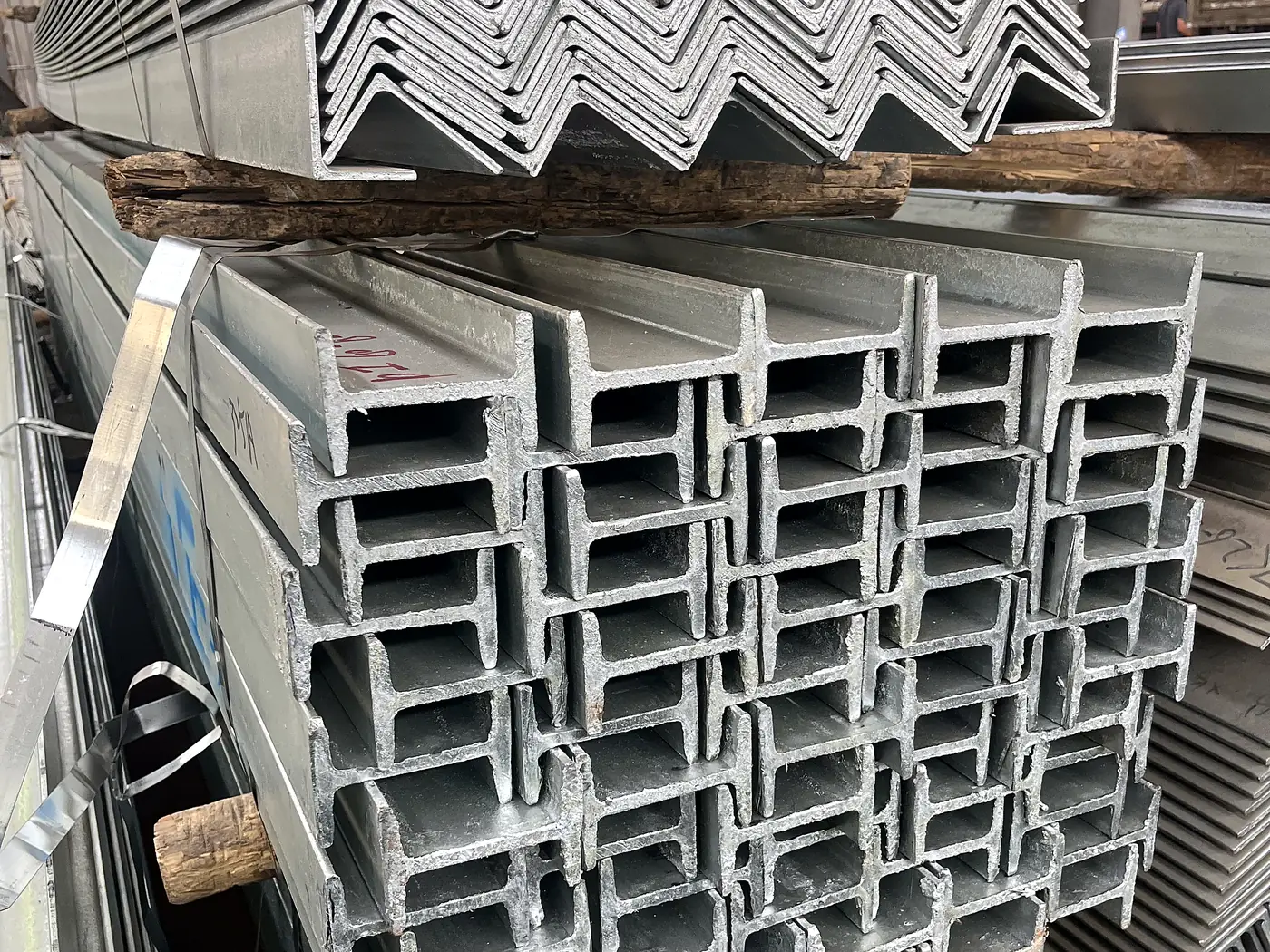
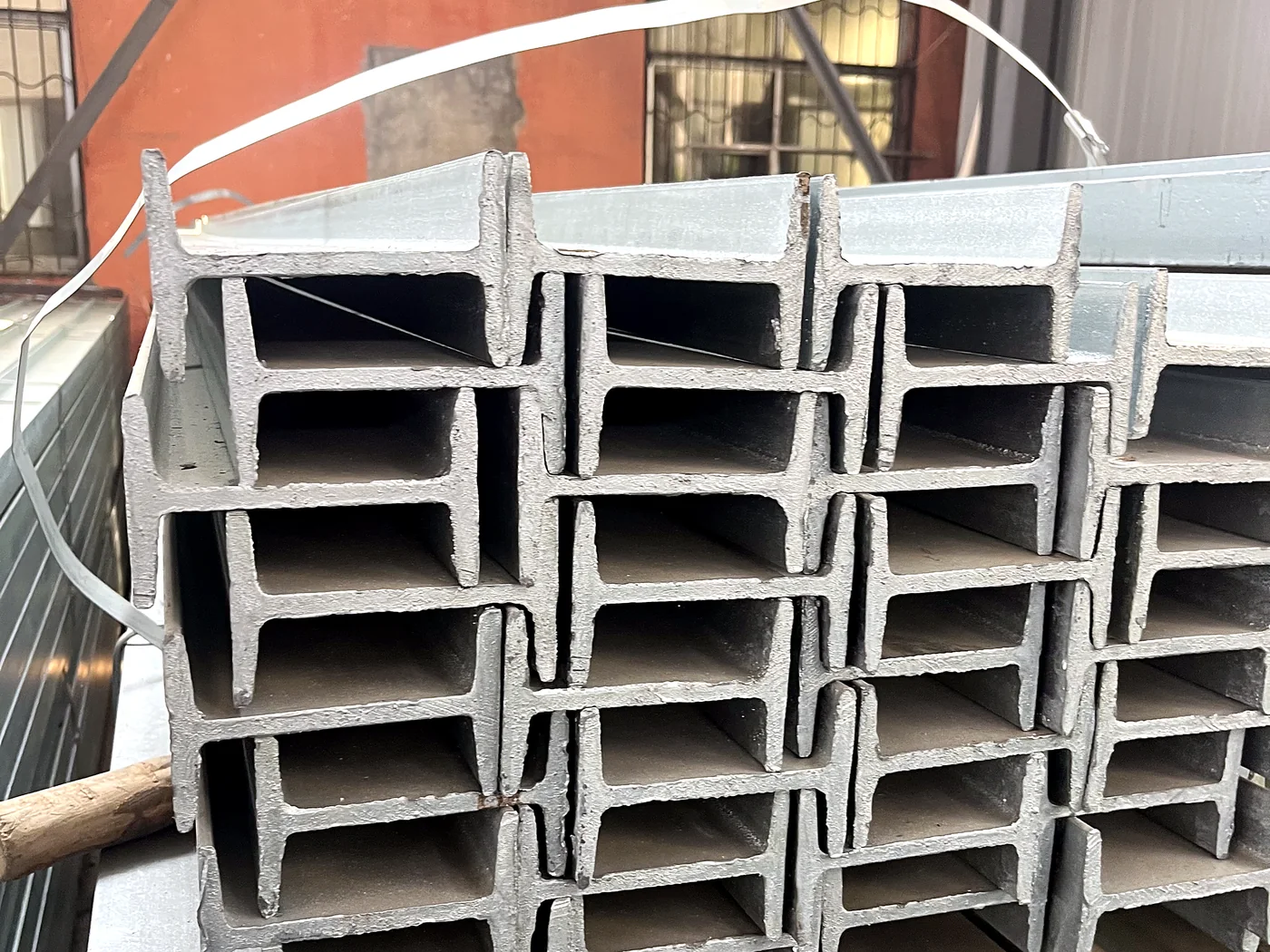
Hot-rolled I-beams hot-dip galvanized to EN ISO 1461, ASTM A123 or GB/T 13912 with a zinc coating from 30 to 700 g/m² on all surfaces. Stock sizes I10 to I36 in both the a and b series, cut, bevelled and drilled to your drawing before dipping so nothing is left bare.
Product Overview
A galvanized I-beam is a hot-rolled beam that has been immersed in molten zinc, forming a metallurgically bonded zinc-iron alloy coating across the whole section — flanges, web, cut ends and hole walls. The galvanizing does not change the mechanical properties of the base steel, so the beam that was designed from its section modulus is the same beam that arrives on site, with its bending, shear and stiffness performance unchanged.
The reason to specify it is life cycle cost. A beam exposed to weather, salt spray or industrial atmosphere in mill finish has to be blast cleaned and painted, then inspected and repainted on a cycle that runs for as long as the structure stands. Galvanizing removes that cycle: the coating protects the steel sacrificially, including at edges and bolt holes where a paint film always fails first.
Stock covers I10 up to I36 in both the standard and heavy-web a and b versions, in base grades Q235B and Q355B, with SS400 also available. Coating weight is nominated against the service environment and quoted as the total on both surfaces, with a coating mass test report issued for each lot.
Specifications & Size Range
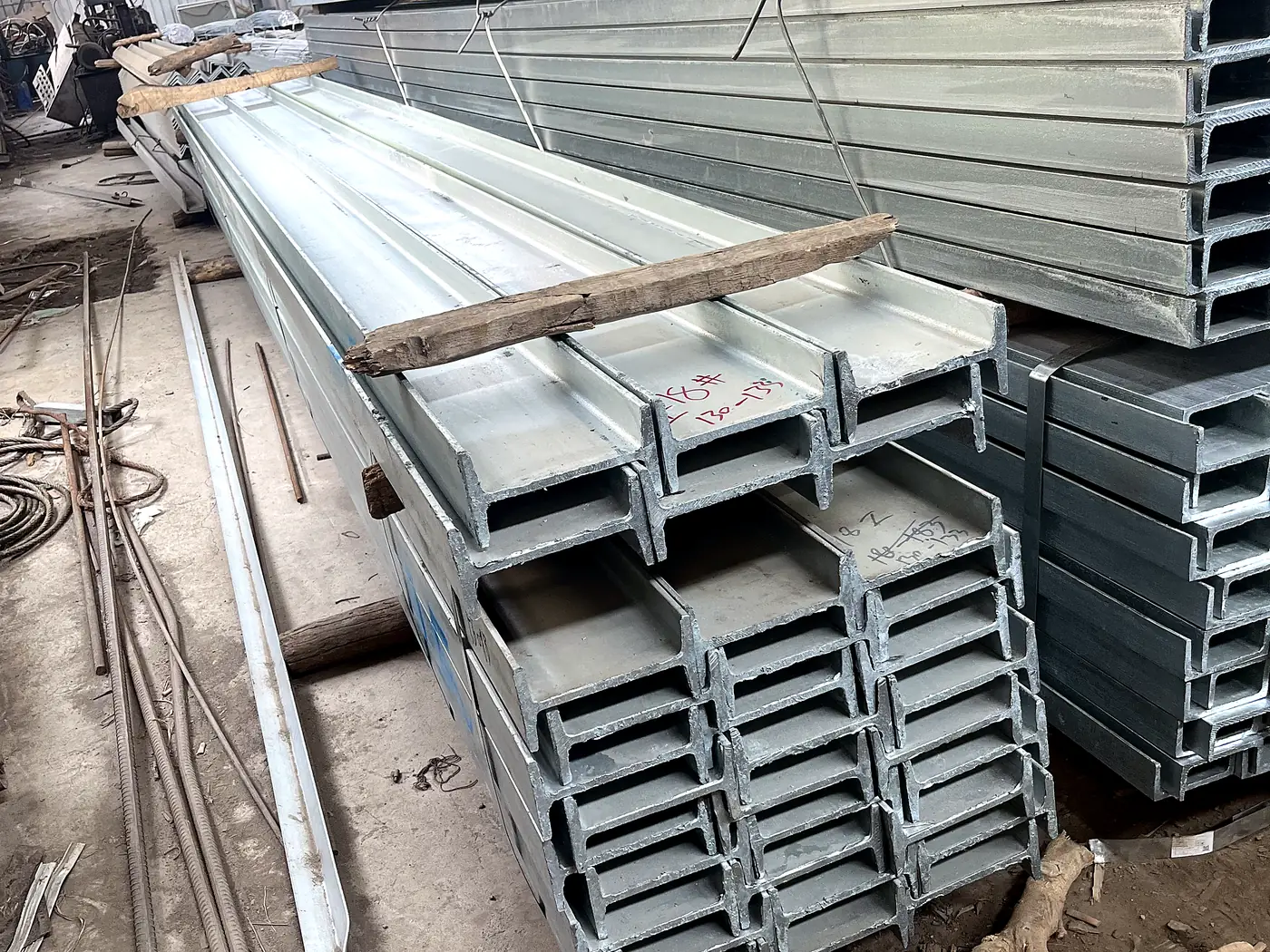
Galvanized I-beam range with the coating weights normally nominated for each exposure class. Mill lengths are 6 m, 9 m and 12 m; cutting, bevelling, drilling and coping are carried out before galvanizing. Heavier sections in the same series are galvanized to order.
| Size group | Designations | Web height (mm) | Coating weight (g/m², both surfaces) | Typical use |
|---|---|---|---|---|
| Light beam | I10, I12, I14, I16, I18 | 100 – 180 | 180 – 275 | Outdoor purlins, racking beams, equipment frames |
| Medium beam | I20a / I20b, I22a / I22b, I24a / I24b | 200 – 240 | 275 – 400 | Coastal building beams, plant frames, walkway supports |
| Heavy beam | I25a / I25b, I27a / I27b, I28a / I28b | 250 – 280 | 275 – 500 | Crane rails, gantry beams, jetty and quay structures |
| Large beam | I30a / I30b, I32a / I32b, I36a / I36b | 300 – 360 | 350 – 700 | Heavy outdoor structures, marine frames, bridge members |
| Processed galvanized | Any size above | as above | as specified | Beams cut, bevelled and drilled to drawing, dipped after processing |
Tolerances
Zinc coating to GB/T 13912, EN ISO 1461, ASTM A123 / A153 and JIS H8641, quoted in g/m² total on both surfaces, with a working guide of about 7 µm of coating thickness per 100 g/m². Base beam dimensions, straightness and mass follow GB/T 706. Coating mass is checked on a sample basis per lot and reported with the shipment.
Steel Grades & International Equivalents
All grades below are supplied with a mill test certificate. The right-hand column shows the material type and the Chinese standard the grade is produced to; the middle columns give the nearest recognised equivalent in other national standards. Exact equivalence for a specific project should be confirmed on the enquiry.
| GB (China) | ASTM / AISI (US) | EN (Europe) | JIS (Japan) | DIN (Germany) | Type / Standard |
|---|---|---|---|---|---|
| Q235B + hot-dip galvanized | A123 / A153 (ASTM) | EN ISO 1461 | JIS H8641 | DIN 50976 | Hot-dip galvanized structural steel (GB/T 13912) |
| Q235B | A36 / A283 Gr.C | S235JR (EN 10025-2) | SS400 (JIS G3101) | St37-2 | Carbon structural steel (GB/T 700) |
| Q355B | A572 Gr.50 / A992 | S355JR (EN 10025-2) | SM490 (JIS G3106) | St52-3 | High-strength low-alloy (HSLA) steel (GB/T 1591) |
Grade Notes
- Q235B + hot-dip galvanized — Zinc coating of 30–700 g/m² gives 5–30+ years of atmospheric corrosion protection depending on thickness and environment.
- Q235B — The workhorse structural grade in China. Fully weldable, excellent cost-performance, the closest Chinese equivalent to ASTM A36 / EN S235JR.
- Q355B — High-strength structural steel for heavy structures, bridges and towers. Equivalent to ASTM A572 Gr.50 / EN S355JR.
Chemical Composition (%, ladle analysis)
Typical specification limits. Actual heat values are reported on the mill test certificate supplied with every shipment.
| Grade | C | Si | Mn | P max | S max | Other elements |
|---|---|---|---|---|---|---|
| Q235B | ≤0.20 | ≤0.35 | ≤1.40 | ≤0.045 | ≤0.045 | — |
| Q355B | ≤0.24 | ≤0.55 | ≤1.60 | ≤0.035 | ≤0.035 | Ceq ≤0.45 |
Mechanical Properties
Minimum values at room temperature unless stated. ReL = yield strength; Rp0.2 = 0.2% proof stress; Rm = tensile strength; A = elongation after fracture.
| Grade | Yield (ReL) | Proof (Rp0.2) | Tensile (Rm) | Elongation A | Impact / others | |
|---|---|---|---|---|---|---|
| Q235B + hot-dip galvanized | — | — | — | — | — | Coating 30–700 g/m² (both sides), made to order Adhesion per GB/T 13912 bend test |
| Q235B | ≥235 MPa | — | 370–500 MPa | ≥26% | +20 °C, ≥27 J | — |
| Q355B | ≥355 MPa (≤16 mm) | — | 470–630 MPa | ≥22% | +20 °C, ≥27 J | — |
Standards & Documents
- GB/T 13912 — hot-dip galvanized coatings on fabricated iron and steel articles
- EN ISO 1461 / ISO 1461 — hot-dip galvanized coatings (international equivalent)
- ASTM A123 / A153 — zinc (hot-dip galvanized) coatings on iron and steel products
- JIS H8641 — hot-dip zinc coatings (Japanese equivalent)
- GB/T 706 — base I-beam dimensions, shape, mass and tolerance
- Zinc bath to EN 1179 (Zn ≥ 99.995%); coating mass test report with every lot; EN 10204 3.1 mill certificate for the base beam
Typical Applications
| Industry / Application | Typical use |
|---|---|
| Coastal industrial buildings | Roof and floor beams, crane runway girders and plant frames in coastal or chemical environments, where repainting would need scaffolding every few years. |
| Outdoor bridges & walkways | Footbridge beams, viewing platforms, boardwalk supports and small road bridge members that are exposed to rain and salt spray for their whole life. |
| Power & PV structures | Substation beam supports, transmission structure members and large ground-mount solar framing, where the coating weight is set by the corrosion class of the site. |
| Marine & port works | Quay platform beams, jetty frames, fender supports and offshore deck framing, where 500 g/m² and heavier coatings are used. |
| Water & treatment plant | Beam supports over tanks, clarifier and settling tank framing, pipe bridges and walkway beams in permanently damp conditions. |
| Agricultural & food plant structures | Livestock building frames, barn and silo supports and wash-down area framing in humid or ammoniacal environments. |
| Outdoor material handling | Stacker and transfer frames, conveyor gantries and crane supports that operate outdoors and cannot be taken out of service for repainting. |
Common Problems Buyers Face — and How We Prevent Them
These are the issues that most often cause claims on steel imports. Each one is controlled in our process before shipment.
White rust on the coating after a sea voyage
Why it happens: Trapped moisture between tightly bundled beams reacts with the zinc surface, producing wet-storage stain that looks like a coating failure on arrival.
Our control: Beams are bundled with spacers so air can move through the pack, shipped dry, and VCI paper is added for long or humid routes. Chromate passivation is available where appearance is critical; light white film can be washed off and does not affect coating life.
Coating mass below specification on a thick section
Why it happens: Heavy sections hold more heat, and if dipping time and bath temperature are not adjusted for the section size the coating can be thin in places.
Our control: Dipping parameters are set for the section mass and the coating is checked on a sample basis per lot to GB/T 13912 with the results reported against the specified minimum average, so the material passes receiving inspection.
Site welding destroys the coating
Why it happens: Connections are welded after galvanizing, and the heat burns the zinc away in and around the weld, leaving bare steel in the most stressed area.
Our control: Beams are cut, drilled and bevelled before dipping so bolted connections can be used throughout the fabricated structure. Where site welding is unavoidable, the weld zone must be cleaned and treated with zinc-rich repair paint, and we can supply compatible touch-up material with the order.
Coating scuffed or chipped during handling and loading
Why it happens: Chains and slings bite into the coating when heavy beams are lifted without protection, and a chipped area becomes the start of corrosion.
Our control: Beams are lifted with belt or nylon slings on protected contact points, timber is placed between layers, and the pack is lashed so members cannot rub. Repair material for minor transit damage is supplied with the shipment.
Distortion or bow after galvanizing
Why it happens: The thermal cycle of dipping releases rolling stresses, and long slender beams are the most sensitive to it.
Our control: Jigging and dipping sequence are controlled for long sections, and straightness is checked after galvanizing against the standard. For distortion-sensitive members we will propose a heavier section or an alternative treatment at enquiry stage.
Our Supply & Manufacturing Advantages
- Coating weight nominated to the site — From 180 g/m² for general outdoor service up to 700 g/m² for severe marine exposure, with the total on both surfaces confirmed on the order.
- Mechanical properties unchanged — Galvanizing does not alter the strength, stiffness or fatigue performance of the base beam, so the section you designed is the section you receive.
- Processed before dipping — Cutting, bevelling, drilling and coping are carried out before galvanizing, so the finished member has coated holes and ends and needs no site rework.
- Documented steel and coating — EN 10204 3.1 mill certificate for the base beam plus a coating mass test report for the zinc layer, so both can be verified on arrival.
- Maintenance eliminated — No blasting, priming, painting, inspection or repainting cycle for the life of the structure, which is where most of the cost saving is realised.
- Export packing that protects the coating — Spacers, timber separators, edge protection and strapping designed for container loading or bulk vessel shipment.
Packaging, Delivery & Payment
- Packing: loose in bulk vessel, or bundled and containerised to your requirement. Galvanized and coated products get VCI paper, waterproof wrapping and edge protection. See our export packaging methods.
- Availability: both stock and custom production. Tell us the specification and we will confirm the route.
- MOQ: no strict minimum — one ton can ship.
- Lead time: stock dispatched to port within 3 days; orders needing export packaging about 1 week; custom production quoted per product.
- Payment: stock — 10% deposit, balance before shipment; custom production — 50% deposit, balance before shipment.
- Documents: EN 10204 3.1 mill test certificate with every shipment; third-party inspection (SGS / BV) on request.
Frequently Asked Questions
How much zinc coating do I need on a beam?
As a working guide: 60 to 100 g/m² for dry indoor service, 180 to 275 g/m² for general outdoor exposure which is the most common export specification, 350 to 500 g/m² for coastal and industrial atmospheres, and 600 to 700 g/m² for severe marine or chemical exposure. The figure is the total on both surfaces. Tell us the site and we will nominate the coating weight.
Does galvanizing reduce the strength of an I-beam?
No. Hot-dip galvanizing is carried out at around 450 °C, well below the temperature at which the microstructure and mechanical properties of Q235B or Q355B structural steel change, so the yield strength, tensile strength, stiffness and fatigue performance of the base beam are unaffected. The mill certificate for the base beam remains valid.
Can a galvanized beam be welded on site?
It can be welded, but the heat destroys the zinc coating in and around the weld and leaves bare steel that will corrode unless it is treated. The right sequence is to weld before galvanizing wherever possible. Where site welding is unavoidable, clean the weld and the surrounding zone and apply zinc-rich repair paint to restore protection.
What is the Chinese equivalent of EN S235JR for galvanized beams?
Q235B to GB/T 700 is the base grade closest to S235JR, and it is the grade we galvanize for the European market, referenced in our library as S235-GALV. Where a higher strength is needed the base is Q355B, the equivalent of S355JR. Both are supplied with the mill certificate and the grade equivalence in writing.
Who supplies galvanized I-beams from China for coastal projects?
We supply hot-dip galvanized I-beams from I10 to I36 in the a and b series in base grades Q235B, Q355B and the S235-GALV reference, with coating weights nominated against the exposure class, processing to drawing before dipping and a coating test report per lot. Send the section list, exposure class and destination port for a quotation.
Is galvanized beam cheaper than painted beam?
The galvanized beam costs more per ton, typically in the region of 20 to 30 percent once the coating is included, but it removes blasting, priming, painting, inspection and the repainting cycle over the life of the structure. On an outdoor or coastal project with a design life of 25 years or more, the whole-life cost is normally lower, and the maintenance access cost is usually the deciding factor.
What is the difference between hot-dip galvanizing and zinc-rich paint?
Zinc-rich paint is a coating applied on site or in the shop and gives a much thinner, less abrasion-resistant layer that needs periodic renewal. Hot-dip galvanizing forms a metallurgically bonded zinc-iron alloy of far greater thickness that protects the steel sacrificially at cut edges, bolt holes and scratches. For structural steel outdoors, hot-dip galvanizing gives dramatically longer protection.
Do you have a minimum order quantity?
No strict minimum, and one ton can ship. Because galvanizing is a batch process, small quantities are usually grouped into a bath load, so we will confirm the real lead time rather than promise an immediate dispatch.
How are galvanized beams packed for export?
Bundled into stiff packs with timber separators and steel straps sized for container loading, or shipped loose in a bulk vessel. Spacers keep air moving through the pack to avoid wet-storage stain, contact points are protected with timber, and lift points are marked so the coating is not damaged during stevedoring.
Request a Quotation Export Packaging