
Custom Welded H-Beam (Built-Up Section) | Made to Drawing
Built-up H-beams fabricated from plate by submerged arc welding to your drawing, in Q235B and Q355B. Web height 200 to 1500 mm, flange width 200 to 500 mm, web thickness 6 to 25 mm and flange thickness 8 to 40 mm, in lengths from 6 to 15 m, with welding procedure qualification and weld ultrasonic testing available.
Product Overview
A welded H-beam — also called a built-up section or fabricated girder — is made by cutting plate to size, assembling the web and flanges in a jigging machine and welding them with submerged arc welding. Because the section is built rather than rolled, its dimensions are not limited by what a rolling mill can produce: any combination of web height, flange width and plate thickness within the shop envelope can be manufactured.
That freedom is the reason to specify it. Rolled sections come in a fixed catalogue, so a design that needs a deeper beam, a wider flange or a heavier thickness than the nearest rolled size has to either accept the extra weight of the next rolled section up, or use a built-up member sized exactly to the load. On a non-standard structure the second option is often both lighter and cheaper, and it gives the designer direct control over the section modulus and the stiffness.
The shop envelope covers web heights from 200 to 1500 mm, flange widths from 200 to 500 mm, web thicknesses from 6 to 25 mm and flange thicknesses from 8 to 40 mm, in Q235B and Q355B, with lengths from 6 m to 15 m. Welding is by submerged arc welding with welding procedure qualification, and ultrasonic testing of the welds at the level your specification requires.
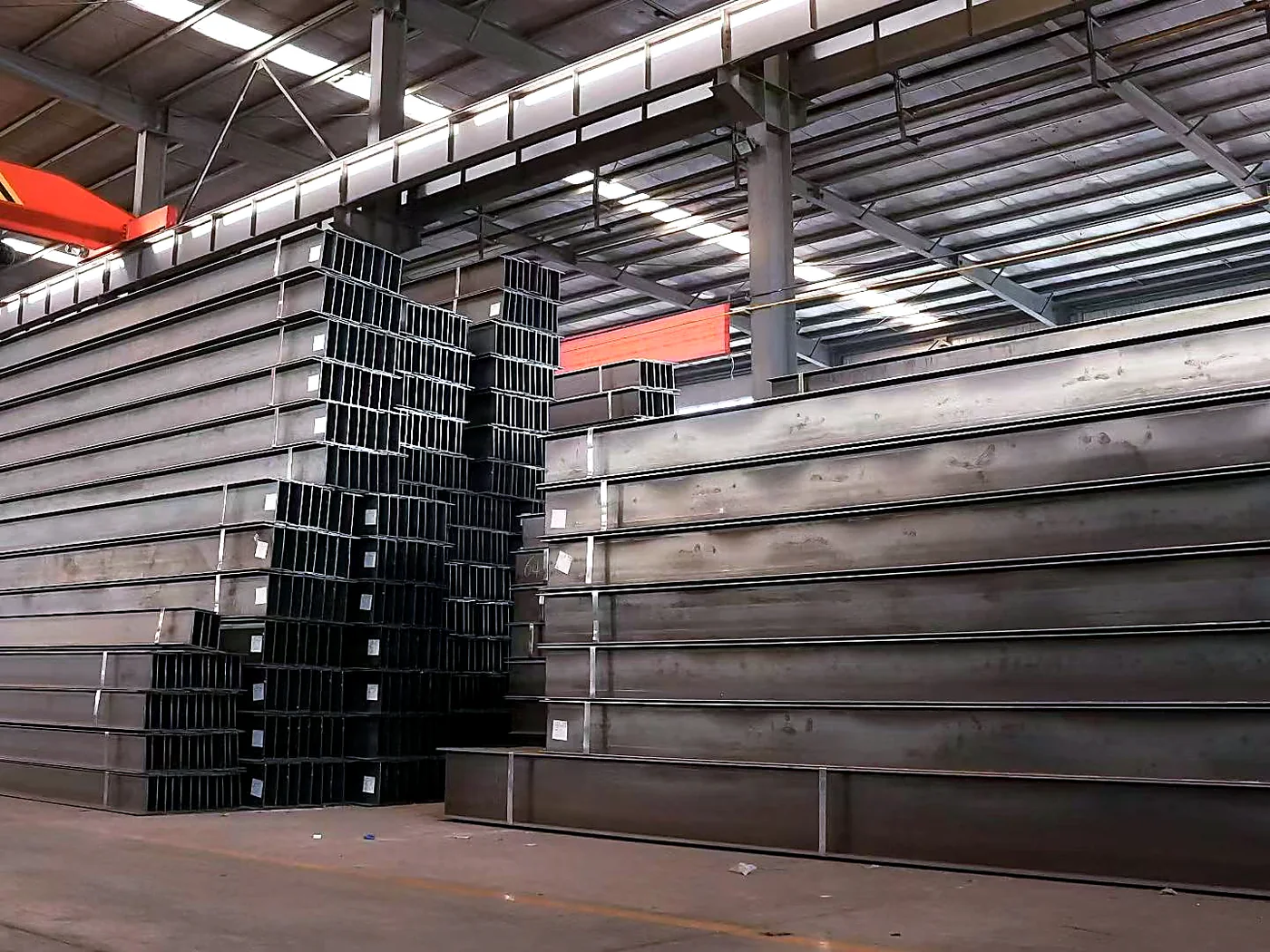
Specifications & Size Range
Fabrication envelope for built-up H-beams. Any combination of web and flange within these limits can be produced; sections outside the range are quoted individually. Tell us the required section properties rather than a catalogue designation and we will confirm the most economical geometry.
| Dimension | Range (mm) | Typical step (mm) | Length | Notes |
|---|---|---|---|---|
| Web height | 200 – 1500 | 10 mm increments | 6 – 15 m | Sized from the required bending capacity and deflection limit |
| Flange width | 200 – 500 | 10 mm increments | 6 – 15 m | Wider flanges improve buckling resistance and bolted connection room |
| Web thickness | 6 – 25 | 2 mm increments | 6 – 15 m | Set by shear and by the welding procedure qualification |
| Flange thickness | 8 – 40 | 2 mm increments | 6 – 15 m | Set by bending capacity and, for compression flanges, by buckling |
| Welding & testing | Submerged arc welding | — | 6 – 15 m | Weld ultrasound testing to the level your specification requires |
| Material | Q235B / Q355B plate | — | 6 – 15 m | Mill certificate for each plate heat supplied with the shipment |
Tolerances
Tolerances for web height, flange width, plate thickness, squareness, straightness and camber are agreed on the order acknowledgement and the fabrication drawing before production, since a built-up section has no single rolled standard to fall back on. Welding is carried out to a qualified procedure, and weld inspection by ultrasonic testing is reported against the level stated in your specification.
Steel Grades & International Equivalents
All grades below are supplied with a mill test certificate. The right-hand column shows the material type and the Chinese standard the grade is produced to; the middle columns give the nearest recognised equivalent in other national standards. Exact equivalence for a specific project should be confirmed on the enquiry.
| GB (China) | ASTM / AISI (US) | EN (Europe) | JIS (Japan) | DIN (Germany) | Type / Standard |
|---|---|---|---|---|---|
| Q235B | A36 / A283 Gr.C | S235JR (EN 10025-2) | SS400 (JIS G3101) | St37-2 | Carbon structural steel (GB/T 700) |
| Q355B | A572 Gr.50 / A992 | S355JR (EN 10025-2) | SM490 (JIS G3106) | St52-3 | High-strength low-alloy (HSLA) steel (GB/T 1591) |
Grade Notes
- Q235B — The workhorse structural grade in China. Fully weldable, excellent cost-performance, the closest Chinese equivalent to ASTM A36 / EN S235JR.
- Q355B — High-strength structural steel for heavy structures, bridges and towers. Equivalent to ASTM A572 Gr.50 / EN S355JR.
Chemical Composition (%, ladle analysis)
Typical specification limits. Actual heat values are reported on the mill test certificate supplied with every shipment.
| Grade | C | Si | Mn | P max | S max | Other elements |
|---|---|---|---|---|---|---|
| Q235B | ≤0.20 | ≤0.35 | ≤1.40 | ≤0.045 | ≤0.045 | — |
| Q355B | ≤0.24 | ≤0.55 | ≤1.60 | ≤0.035 | ≤0.035 | Ceq ≤0.45 |
Mechanical Properties
Minimum values at room temperature unless stated. ReL = yield strength; Rp0.2 = 0.2% proof stress; Rm = tensile strength; A = elongation after fracture.
| Grade | Yield (ReL) | Proof (Rp0.2) | Tensile (Rm) | Elongation A | Impact / others | |
|---|---|---|---|---|---|---|
| Q235B | ≥235 MPa | — | 370–500 MPa | ≥26% | +20 °C, ≥27 J | — |
| Q355B | ≥355 MPa (≤16 mm) | — | 470–630 MPa | ≥22% | +20 °C, ≥27 J | — |
Standards & Documents
- GB 50661 — code for welding of steel structures (welding procedure qualification and inspection)
- GB/T 700 — carbon structural steels (Q235B plate)
- GB/T 1591 — high-strength low-alloy structural steels (Q355B plate, Ceq ≤ 0.45)
- GB/T 11345 / GB/T 29712 — ultrasonic testing of welds and acceptance levels
- EN 1090-2 / AWS D1.1 — design and fabrication references available where the project specifies them
- Welding procedure qualification record, welder qualification, weld UT report and EN 10204 3.1 mill certificate for the plate with every order
Typical Applications
| Industry / Application | Typical use |
|---|---|
| Non-standard industrial buildings | Columns and beams for structures whose spans or loads do not match any rolled section, including long single-span factory roofs and heavy aisle frames. |
| Long-span & architectural structures | Exhibition halls, stadium roofs, atria and canopies where the section depth is driven by deflection and rolled sections cannot deliver enough stiffness. |
| Equipment & machinery supports | Heavy equipment bases, press and mill supports and non-standard machine frames sized to the actual load rather than rounded up to the next rolled size. |
| Crane girders & heavy handling | Crane runway girders and gantry members where fatigue duty and deflection control demand a section larger than the rolled range. |
| Bridges & temporary works | Bridge girders, launch beams, heavy trestles and shoring members that have to be designed to a specific load case and re-used across projects. |
| Building extension & retrofit | Reinforcement and transfer members in existing buildings where the section has to fit a restricted headroom or tie into an existing connection. |
| Industrial plant & process structures | Pipe rack and equipment support members in plant where the layout dictates irregular spans and non-standard section sizes. |
Common Problems Buyers Face — and How We Prevent Them
These are the issues that most often cause claims on steel imports. Each one is controlled in our process before shipment.
Weld defects found by the receiving inspector
Why it happens: Inconsistent welding parameters, moisture in the flux or poor fit-up between web and flange produce defects that are only discovered after the member has crossed an ocean.
Our control: Fabrication follows a qualified welding procedure with recorded parameters, flux is stored dry, and weld ultrasonic testing is carried out to the required acceptance level before shipment. Where your specification calls for full inspection, it is quoted and performed in the shop rather than argued about on arrival.
Distortion or camber loss after welding
Why it happens: The heat input of welding pulls a fabricated section out of line, and a long girder can lose the camber that was built into it.
Our control: Members are assembled in jigs, welded with a balanced sequence and measured for straightness and camber after welding. Where a specific camber is required, it is stated on the drawing and checked on a bed before packing.
Web and flange plate of mismatched grade
Why it happens: A built-up section combines several plates, and if plate heat numbers are not kept together it is impossible to prove afterwards which grade went into which member.
Our control: Each plate heat is recorded against the member number, and the mill certificates are issued collated to the member list so every beam can be traced back to the plates it was made from.
The rolled alternative was cheaper after all
Why it happens: A built-up section carries cutting, assembly and welding cost that a rolled section does not, so for a size that is available rolled, fabrication is usually the more expensive route.
Our control: We check the design against the rolled range before quoting. If a rolled section meets the requirement we will say so and quote that instead, and we only recommend a built-up member where it genuinely saves weight or is the only way to meet the drawing.
The section is too large to ship economically
Why it happens: A very deep or very long welded girder may exceed what will fit in a container or stow efficiently in a bulk vessel.
Our control: Splices are designed into the member with bolted or welded connections at agreed points so the beam can be shipped in sections and assembled on site. The splice location and detail are shown on the fabrication drawing and agreed before production.
Our Supply & Manufacturing Advantages
- Exactly the section the design needs — Any combination of web height, flange width and plate thickness inside the shop envelope, so the section can be sized to the load instead of rounded up to the nearest rolled size.
- Weight and depth saved on non-standard work — A built-up member sized precisely to the load is often lighter, and therefore cheaper, than the next rolled section up for the same duty.
- Qualified welding and documented inspection — Submerged arc welding to a qualified procedure, with weld ultrasonic testing reported against the acceptance level your specification states.
- Full traceability — Plate heat numbers are recorded against each member and EN 10204 3.1 mill certificates are issued collated to the member list.
- Processed and prepared in the shop — Cut to length, holes drilled, ends bevelled and stiffeners or splice plates fitted before packing, so site work is erection only.
- Splice design for shipping — Where a member is too large to ship whole, splices are designed and agreed so it can travel in sections and be assembled on site.
Packaging, Delivery & Payment
- Packing: loose in bulk vessel, or bundled and containerised to your requirement. Galvanized and coated products get VCI paper, waterproof wrapping and edge protection. See our export packaging methods.
- Availability: both stock and custom production. Tell us the specification and we will confirm the route.
- MOQ: no strict minimum — one ton can ship.
- Lead time: stock dispatched to port within 3 days; orders needing export packaging about 1 week; custom production quoted per product.
- Payment: stock — 10% deposit, balance before shipment; custom production — 50% deposit, balance before shipment.
- Documents: EN 10204 3.1 mill test certificate with every shipment; third-party inspection (SGS / BV) on request.
Frequently Asked Questions
When should I use a welded H-beam instead of a rolled H-beam?
Use a rolled H-beam whenever a standard section meets the requirement, because it is cheaper per ton and has no weld to inspect. Use a welded H-beam when the design needs a depth, flange width, thickness or length that the rolled range does not cover, when a non-standard section saves significant weight, or when the member must fit a restricted space. We check the design against the rolled range first and will tell you if a rolled section will do.
What is the maximum size of welded H-beam you can produce?
Web heights from 200 to 1500 mm, flange widths from 200 to 500 mm, web thicknesses from 6 to 25 mm and flange thicknesses from 8 to 40 mm. Lengths run from 6 m to 15 m. Anything outside that envelope is quoted individually, and where a member is too large to ship whole we design a splice so it can travel in sections.
What welding and inspection standards do you work to?
Welding follows a qualified procedure to GB 50661, with welding procedure qualification records and welder qualifications available with the order. Weld ultrasonic testing is carried out to GB/T 11345 or GB/T 29712 to the acceptance level your specification states. Where your project references EN 1090-2 or AWS D1.1 we will confirm how the fabrication and inspection will be aligned to it.
Can you work from my fabrication drawing?
Yes, and that is the normal route. Send the drawing or the required section properties — depth, flange width, thicknesses, length, camber, hole positions and end preparation — and we will confirm the most economical geometry, produce the member and issue the inspection documents. Where a drawing is not available we can size the section from your load and deflection limit.
What is the difference between a welded H-beam and a rolled H-beam in performance?
For the same section geometry the bending and axial performance is essentially the same, because the section properties depend on the shape rather than on how it was made. The differences are that a welded member has weld seams and a heat-affected zone that must be inspected, and it does not carry the residual stress pattern of a rolled section. Properly qualified and inspected, a welded member is entirely suitable for primary structural use.
Who supplies custom welded H-beams from China for export?
We fabricate built-up H-beams to drawing in Q235B and Q355B plate, with web height up to 1500 mm and flange width up to 500 mm, qualified welding, ultrasonic testing of welds and full plate traceability. Send the drawing or the section properties, the quantity and the destination port for a quotation including the shipping arrangement.
What is the lead time for a custom welded H-beam?
Standard geometry is produced in about 3 to 5 working days and reaches the port within one to two weeks. Large quantities or special requirements such as heavy section thickness, camber or full weld inspection take about 7 to 15 working days, and urgent orders can be prioritised if you tell us the required date at enquiry stage.
What documents are supplied with a welded H-beam order?
The welding procedure qualification record, welder qualification certificates, weld ultrasonic testing report, EN 10204 3.1 mill certificate for each plate heat, dimensional inspection record, and the usual commercial documents including invoice, packing list, bill of lading and certificate of origin.
Is a welded H-beam suitable for a galvanized finish?
Yes. Because the member is fabricated first and galvanized afterwards, the coating covers the welds, the cut plate edges and the drilled holes as well as the flat surfaces, which is exactly what a welded structure needs. Cutting, drilling and welding must all be completed before dipping so no bare steel is left.
Request a Quotation Export Packaging