
Hot-Rolled H-Beam / Wide Flange Section | HW, HM, HN Series
Hot-rolled H-beam (wide flange section, universal column) in Q235B and Q355B, covering the HW wide-flange, HM medium-flange and HN narrow-flange series from 100×100 up to 900×300. Standard lengths 6 m, 9 m and 12 m, cut to your fabricator's list, with a mill test certificate for every heat.
Product Overview
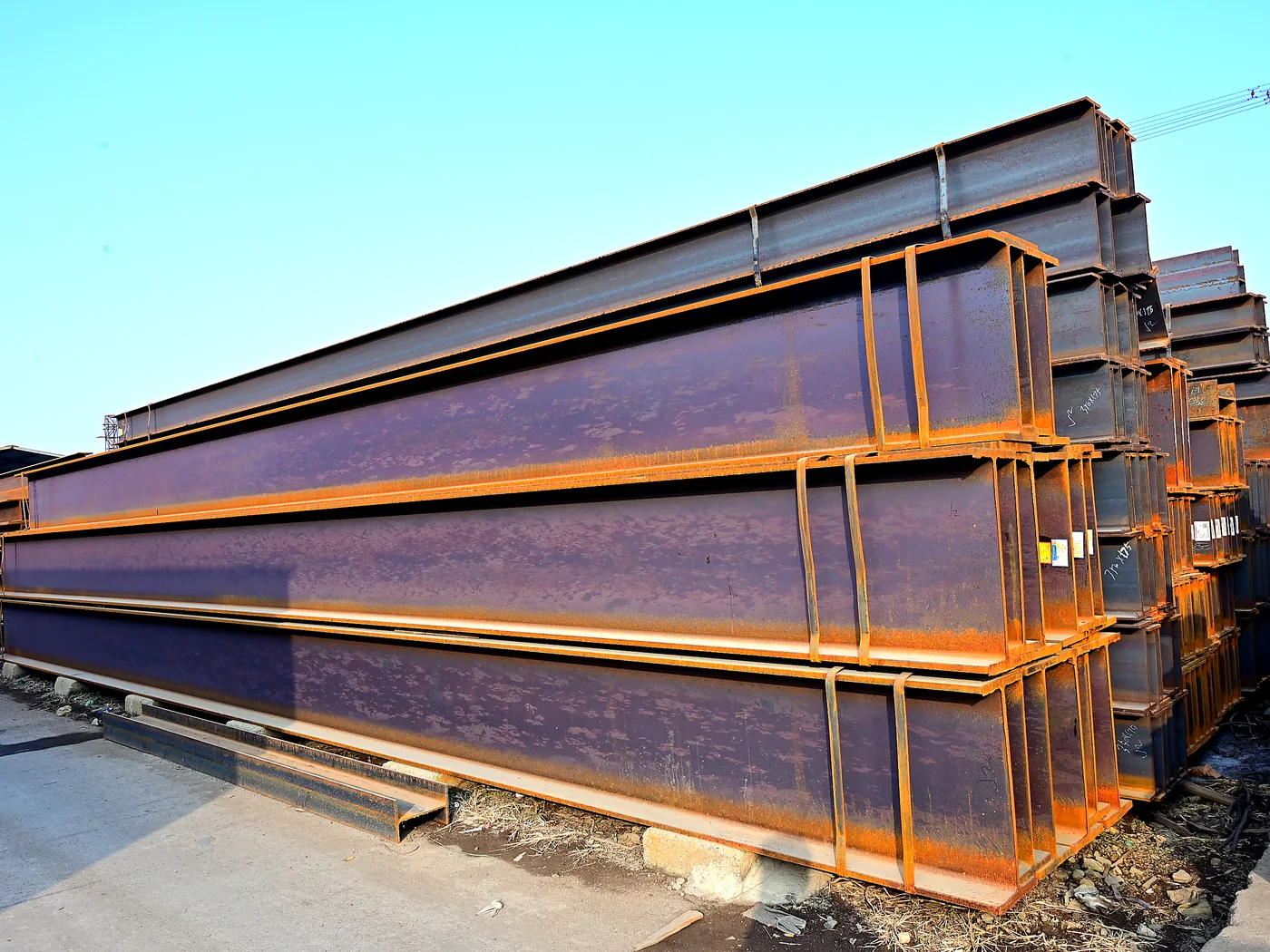
An H-beam, also called a wide flange section or universal column, is a hot-rolled section whose two flanges are wide and parallel rather than tapered. Because the flanges are parallel it can be bolted face to face without tapered washers, and because they are wide the section carries more bending moment for the same weight than an I-beam and performs far better as a compression member. That combination is why it is the default profile for building frames, long-span beams and heavy equipment structures.
The Chinese series is split into three families by flange width relative to depth. HW (wide flange) is roughly square in section and is used for columns. HM (medium flange) sits between the two and works as either a beam or a column. HN (narrow flange) is deeper than it is wide and is used as a beam. Within each family the designation is written as depth × flange width in millimetres, for example HW200×200 or HN400×200.
Stock runs from HW100×100 to HW400×400, HM150×100 to HM400×300, and HN100×50 up to HN900×300, in Q235B (GB/T 700) and Q355B (GB/T 1591). Sections are supplied in 6 m, 9 m and 12 m lengths or cut to your cutting list, and can be hot-dip galvanized or supplied as a custom welded section where the rolled range does not reach.
Specifications & Size Range
HW, HM and HN series with typical designations. Mill lengths are 6 m, 9 m and 12 m; cut-to-length and end preparation are available. Sections outside the rolled range can be produced as a custom welded H-beam to the same drawing.
| Series | Typical designations (mm) | Depth range (mm) | Best used as | Typical application |
|---|---|---|---|---|
| HW — wide flange | HW100×100, HW125×125, HW150×150, HW175×175, HW200×200 | 100 – 200 | Column | Building columns, equipment supports, low-rise frames |
| HW — wide flange | HW250×250, HW300×300, HW350×350, HW400×400 | 250 – 400 | Heavy column | High-rise columns, crane columns, heavy plant frames |
| HM — medium flange | HM150×100, HM200×150, HM250×175, HM300×200, HM350×250, HM400×300 | 150 – 400 | Beam or column | Portal frames, mezzanine beams, combined duties |
| HN — narrow flange | HN100×50, HN150×75, HN200×100, HN250×125, HN300×150 | 100 – 300 | Beam | Roof and floor beams, purlins, light long-span beams |
| HN — narrow flange | HN400×200, HN450×200, HN500×200, HN600×200, HN700×300, HN800×300, HN900×300 | 400 – 900 | Long-span beam | Long-span roof beams, bridge and gantry girders |
| Processed H-beam | Any series above | as above | as designed | Beams cut, drilled and bevelled ready for erection |
Tolerances
Dimensions, flange and web thickness, straightness and mass follow GB/T 11263 for hot-rolled H-beams, with the applicable tolerance band stated on the mill certificate and repeated on the order acknowledgement. Where the section is welded into a moment connection, flange squareness and end preparation are agreed on the order acknowledgement before production starts.
Steel Grades & International Equivalents
All grades below are supplied with a mill test certificate. The right-hand column shows the material type and the Chinese standard the grade is produced to; the middle columns give the nearest recognised equivalent in other national standards. Exact equivalence for a specific project should be confirmed on the enquiry.
| GB (China) | ASTM / AISI (US) | EN (Europe) | JIS (Japan) | DIN (Germany) | Type / Standard |
|---|---|---|---|---|---|
| Q235B | A36 / A283 Gr.C | S235JR (EN 10025-2) | SS400 (JIS G3101) | St37-2 | Carbon structural steel (GB/T 700) |
| Q355B | A572 Gr.50 / A992 | S355JR (EN 10025-2) | SM490 (JIS G3106) | St52-3 | High-strength low-alloy (HSLA) steel (GB/T 1591) |
Grade Notes
- Q235B — The workhorse structural grade in China. Fully weldable, excellent cost-performance, the closest Chinese equivalent to ASTM A36 / EN S235JR.
- Q355B — High-strength structural steel for heavy structures, bridges and towers. Equivalent to ASTM A572 Gr.50 / EN S355JR.
Chemical Composition (%, ladle analysis)
Typical specification limits. Actual heat values are reported on the mill test certificate supplied with every shipment.
| Grade | C | Si | Mn | P max | S max | Other elements |
|---|---|---|---|---|---|---|
| Q235B | ≤0.20 | ≤0.35 | ≤1.40 | ≤0.045 | ≤0.045 | — |
| Q355B | ≤0.24 | ≤0.55 | ≤1.60 | ≤0.035 | ≤0.035 | Ceq ≤0.45 |
Mechanical Properties
Minimum values at room temperature unless stated. ReL = yield strength; Rp0.2 = 0.2% proof stress; Rm = tensile strength; A = elongation after fracture.
| Grade | Yield (ReL) | Proof (Rp0.2) | Tensile (Rm) | Elongation A | Impact / others | |
|---|---|---|---|---|---|---|
| Q235B | ≥235 MPa | — | 370–500 MPa | ≥26% | +20 °C, ≥27 J | — |
| Q355B | ≥355 MPa (≤16 mm) | — | 470–630 MPa | ≥22% | +20 °C, ≥27 J | — |
Standards & Documents
- GB/T 11263 — hot-rolled H-beams and cut T-sections (dimensions, shape, mass and tolerance)
- GB/T 700 — carbon structural steels (Q235B: ReH ≥ 235 MPa)
- GB/T 1591 — high-strength low-alloy structural steels (Q355B: ReH ≥ 355 MPa to 16 mm, Ceq ≤ 0.45)
- EN 10025-2 S235JR / S355JR and ASTM A36 / A572 Gr.50 / A992 — grade equivalences confirmed in writing
- EN 10365 / EN 10346 dimensional references — section properties available on request
- EN 10204 3.1 mill test certificate with every lot; hot-dip galvanizing and SGS or BV inspection available
Typical Applications
| Industry / Application | Typical use |
|---|---|
| Industrial buildings & warehouse frames | Columns, roof beams, crane runway girders and clear-span frames, where the wide parallel flanges simplify moment connections and bracing details. |
| High-rise & multi-storey structures | Frame columns, core support members, transfer and outrigger framing and floor beams in steel-framed buildings. |
| Bridges & infrastructure | Highway and rail bridge girders, footbridge beams, ramp supports and temporary works bridges, in Q235B or Q355B to suit the design code. |
| Cranes & material handling | Crane girder and column members, gantry structures, monorail supports and stacker frames, sized from wheel load and fatigue duty. |
| Heavy machinery & plant | Press frames, mill stands, crusher supports and equipment bases where stiffness under dynamic load is as important as strength. |
| Offshore & marine structures | Deck framing, module supports and jetty platform beams, normally supplied hot-dip galvanized and often to a higher impact requirement. |
| Solar, wind & energy plant | Support structures, tracker frames and equipment platforms where the parallel flanges give a simple bolted connection to the foundation. |
Common Problems Buyers Face — and How We Prevent Them
These are the issues that most often cause claims on steel imports. Each one is controlled in our process before shipment.
A moment connection will not close up on site
Why it happens: Flange tilt or web offset in the rolled section, combined with a fabrication allowance that assumed perfect squareness, leaves a gap that cannot be pulled up with bolts.
Our control: Flange squareness and web offset are checked against GB/T 11263 at loading and reported, and the achievable tolerance is confirmed on the order acknowledgement so the fabricator can set the right allowance in the shop drawings.
The section chosen is heavier than the design needs
Why it happens: HN, HM and HW families overlap, so a beam duty has been specified in a column section, adding weight over the whole structure.
Our control: Send the span, the load and the deflection limit and we will confirm which family and depth gives the required capacity at the lowest weight. Using HN instead of HW for a pure beam duty typically saves several percent of steel tonnage.
Rust and scale before the steel is painted
Why it happens: Hot-rolled sections travel with mill scale and no coating, and a long sea voyage in humid conditions starts surface oxidation.
Our control: Material is shipped dry and covered with VCI paper on long routes. Where the beams will be stored outdoors before erection we supply shot-blasted and primed sections, or hot-dip galvanized beams for exposed structures.
Cracking or lamellar tearing at a heavy welded joint
Why it happens: Thick flanges and a heavily restrained connection make the through-thickness properties and the carbon equivalent of the section critical.
Our control: The certificate reports the actual chemistry including carbon equivalent, and where a joint is heavily restrained we will advise on the grade band to specify. Tell us at enquiry stage if through-thickness properties matter so the section can be selected accordingly.
Beams arriving bowed, twisted or with damaged flanges
Why it happens: Long sections sag if they are stacked without support or lifted by a single point during transhipment, and unprotected flange edges get scored.
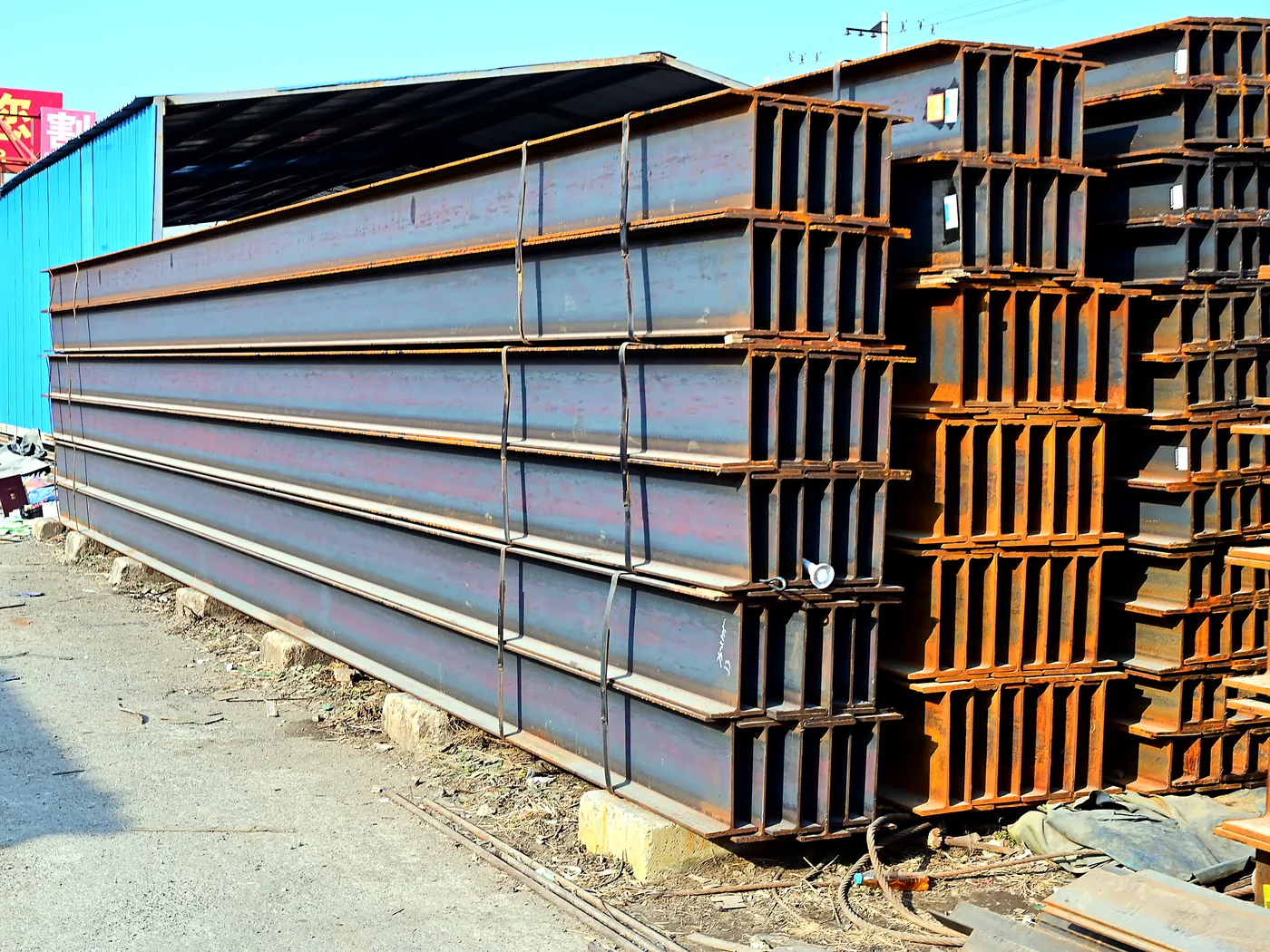
Our control: Packs are built stiff, lifted at two points with approved slings, supported along their length in the stow, and flange edges protected with timber. Straightness is checked at loading against the standard for the section.
Our Supply & Manufacturing Advantages
- The right family for the duty — HW, HM and HN from one supplier, so a column duty and a beam duty in the same frame are sized from the same range rather than over-specified.
- Parallel flanges — Bolted moment and shear connections need no tapered washers or packing, which simplifies both the shop drawings and the site work.
- More bending capacity per kilogram — The wide parallel flanges put more material away from the neutral axis than an equivalent-weight I-beam, so the beam is lighter for the same moment.
- Grades matched to the drawing — Q235B and Q355B with written equivalence to A36, A992, A572 Gr.50, S235JR and S355JR, certified to EN 10204 3.1.
- Cut and prepared before shipment — Cut to length, drilled and bevelled to your fabricator's list, which reduces offcuts, freight weight and shop time.
- Options beyond the rolled range — Where a design needs a section the mills do not roll, the same drawing can be produced as a custom welded H-beam with weld inspection.
Packaging, Delivery & Payment
- Packing: loose in bulk vessel, or bundled and containerised to your requirement. Galvanized and coated products get VCI paper, waterproof wrapping and edge protection. See our export packaging methods.
- Availability: both stock and custom production. Tell us the specification and we will confirm the route.
- MOQ: no strict minimum — one ton can ship.
- Lead time: stock dispatched to port within 3 days; orders needing export packaging about 1 week; custom production quoted per product.
- Payment: stock — 10% deposit, balance before shipment; custom production — 50% deposit, balance before shipment.
- Documents: EN 10204 3.1 mill test certificate with every shipment; third-party inspection (SGS / BV) on request.
Frequently Asked Questions
What is the Chinese equivalent of EN S355JR for an H-beam?
Q355B to GB/T 1591 is the equivalent grade, with a minimum yield strength of 355 MPa at thicknesses up to 16 mm, a tensile range of 470 to 630 MPa and an impact requirement of 27 J at +20 °C. It also corresponds closely to ASTM A572 Gr.50 and, for building frames, to A992. The mill certificate reports the actual chemistry and mechanical properties so the equivalence can be verified.
What is the difference between HW, HM and HN H-beams?
HW is the wide-flange family, roughly square in section, and it is used mainly for columns because it resists compression and bending in both directions. HM is the medium-flange family, used for members that act as both beam and column. HN is the narrow-flange family, deeper than it is wide, used mainly as a beam because it is efficient in one-direction bending. Matching the family to the duty is where most of the weight saving comes from.
What is the difference between an H-beam and an I-beam?
An I-beam has tapered, relatively narrow flanges, while an H-beam has wide parallel flanges. The H-beam carries more bending moment for the same weight and is much better as a compression member, and its parallel flanges make bolted connections far simpler. I-beams still have a place in machinery and where a narrow flange is required, but for building and bridge structures the H-beam is normally the more efficient and more practical choice.
How do I choose between Q235B and Q355B for an H-beam?
Q235B is the economical grade for ordinary building frames where strength is not critical. Q355B is chosen where a lighter section must carry the same load, where a long span is required, or where the specification demands a 355 MPa minimum yield. Because Q355B carries a carbon-equivalent limit of 0.45, tell us the welding procedure so we can confirm the chemistry band suits it.
Who supplies hot-rolled H-beams from China for export construction projects?
We supply hot-rolled H-beams across the HW, HM and HN series in Q235B and Q355B, cut and prepared to your fabricator's list, with EN 10204 3.1 mill certificates, grade equivalence documentation and export packing for container or bulk vessel. Send the section list with quantities, the grade and the destination port for a quotation with weights and packing.
Can an H-beam be supplied with a section outside the standard range?
Yes. Where the design needs a depth, flange width or thickness that the rolling mills do not produce, the same member can be produced as a custom welded H-beam from plate with submerged arc welding and ultrasonic testing of the welds. See our custom welded H-beam page for the available envelope.
Do you provide section properties and weights for the sizes you quote?
Yes. Every quotation lists the designation, depth, flange width, web and flange thickness, mass per metre and the standard length. Unit weights and section properties are taken from the applicable standard, and if your design software needs a particular property set we will supply it rather than leave you to look it up.
What is the minimum order quantity and the lead time?
There is no strict minimum order quantity and one ton can ship, although long heavy sections are far more economic in container or full-vessel quantities. Common sizes are dispatched to the port within 3 days; cut, drilled or galvanized orders take about one to two weeks.
How are H-beams packed and shipped?
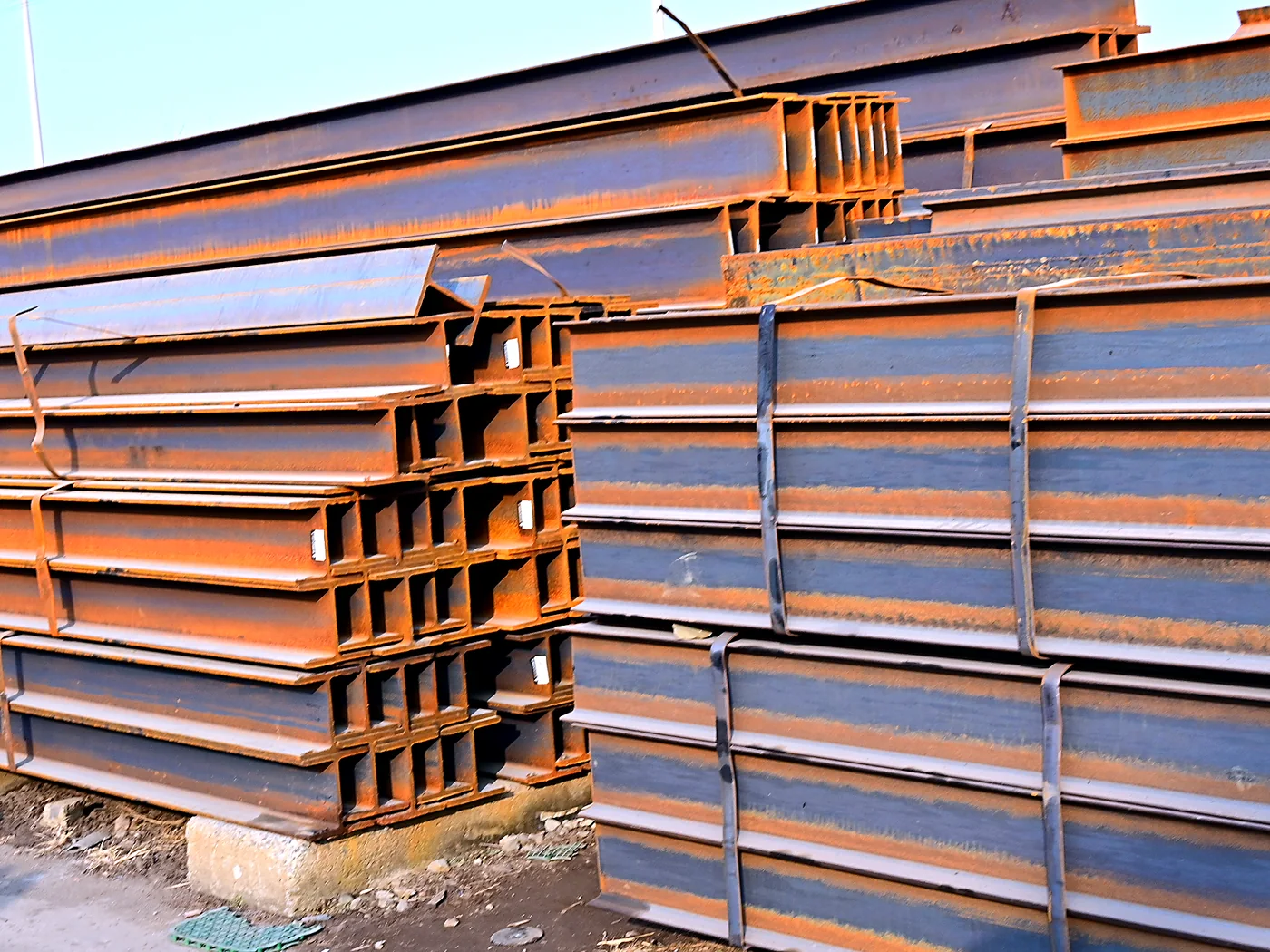
Beams are bundled into stiff packs and strapped to container dimensions, or shipped loose in a bulk vessel for large tonnage. Flange contact points are protected with timber, the pack is lifted at two points, and the stow is planned so each bundle is supported along its length for the whole voyage without sagging or twisting.
Request a Quotation Export Packaging