
Manganese Channel Steel (Q355B High-Strength U-Channel) 8# – 40#
High-strength low-alloy channel steel in Q355B (formerly Q345B) from 8# to 40#, giving a minimum yield strength of 355 MPa — around 50 percent higher than Q235B channel — so a lighter section can carry the same load. Supplied in 6 m, 9 m and 12 m lengths and cut to your cutting list.
Product Overview
Manganese channel steel is the trade name for channel rolled in a low-alloy, high-strength grade — in current Chinese standards Q355B to GB/T 1591, previously designated Q345B. Manganese is one of the principal alloying additions in that grade, which is where the name comes from, and the result is a minimum yield strength of 355 MPa against 235 MPa for ordinary Q235B channel: roughly 40 to 50 percent more load capacity from the same section.
That difference matters most in heavy structures. On a long-span or heavily loaded beam the choice is often between a heavier section in Q235B and the same section in Q355B, and the high-strength route saves steel weight, reduces the depth of the structure and cuts the load on the foundations. The grade also retains good low-temperature toughness and a controlled carbon equivalent, so it can be welded with a normal procedure without preheating at ordinary thicknesses.
Stock covers 8#, 10#, 12#, 14#, 16#, 18#, 20#, 22#, 25#, 28#, 32#, 36# and 40# in Q355B, with Q235B available as the economical alternative where the load does not justify the higher grade. Every lot ships with a mill certificate showing chemistry including carbon equivalent and the mechanical properties.
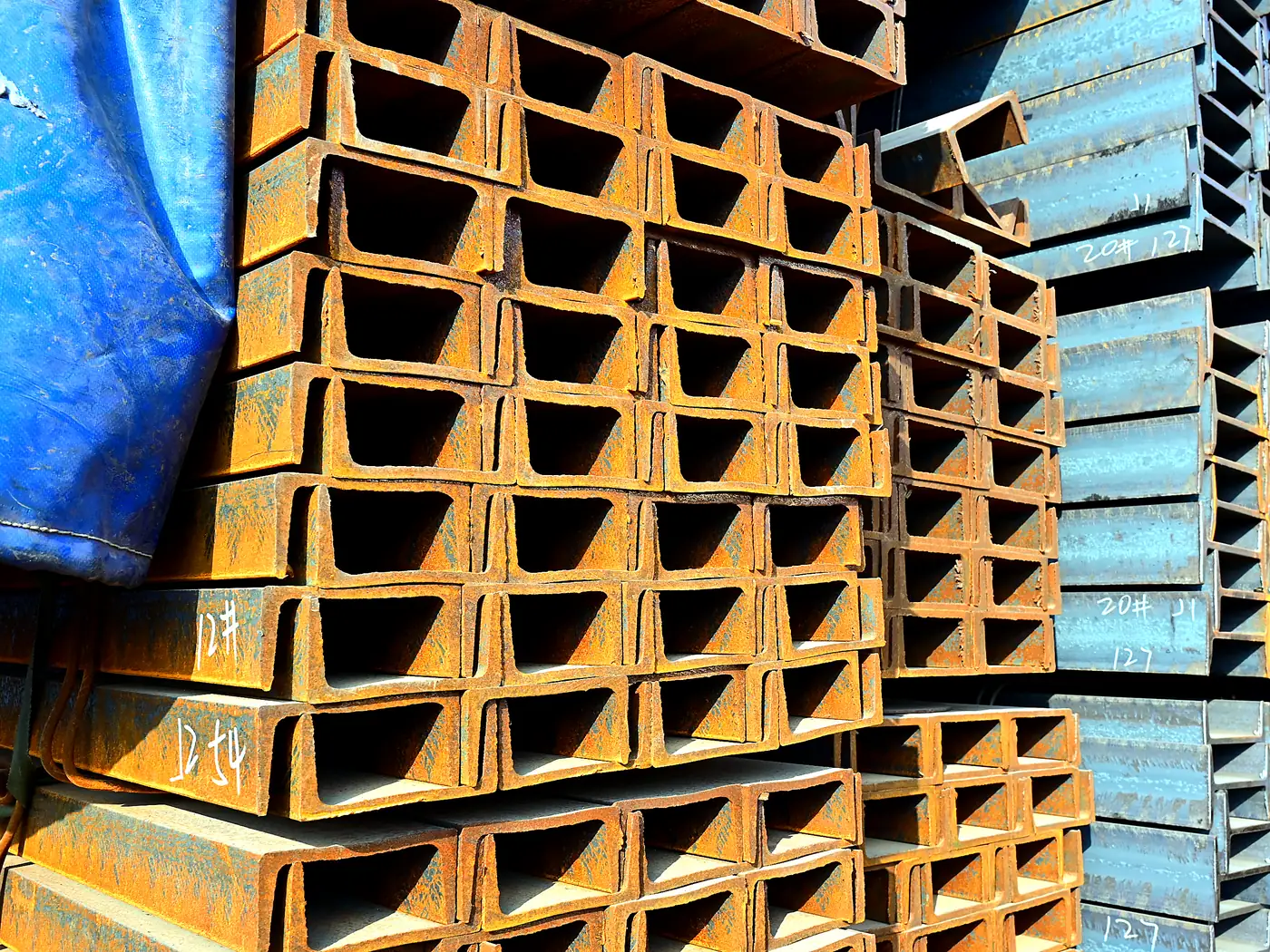
Specifications & Size Range
High-strength channel range in Q355B. Mill lengths are 6 m, 9 m and 12 m; cut-to-length and drilling are available. Because the grade carries 355 MPa minimum yield, it is common to step down one or two sizes against an equivalent Q235B design — send us the load and we will confirm the section.
| Size group | Designations | Web height (mm) | ReH (MPa) | Typical use |
|---|---|---|---|---|
| Light high-strength | 8#, 10#, 12#, 14# | 80 – 140 | ≥ 355 | Heavy purlins, equipment frames, transport frames |
| Medium high-strength | 16#, 18#, 20#, 22# | 160 – 220 | ≥ 355 | Plant columns, heavy beams, machine bases, gantries |
| Heavy high-strength | 25#, 28#, 32# | 250 – 320 | ≥ 345 – 355 (thickness dependent) | Bridge members, crane supports, mining equipment frames |
| Large high-strength | 36#, 40# | 360 – 400 | ≥ 335 – 345 (thickness dependent) | Heavy industrial structures, long-span girders |
| Processed high-strength | Any size above | as above | ≥ 355 | Members cut and drilled to drawing for welded or bolted assembly |
Tolerances
Dimensions, web and flange thickness, straightness and mass follow GB/T 706. Chemical composition and mechanical properties, including carbon equivalent (Ceq ≤ 0.45 for Q355B), follow GB/T 1591 and are reported on the mill certificate. Note that the minimum yield strength of Q355B reduces with thickness above 16 mm, and the certificate states the guaranteed value for the thickness supplied.
Steel Grades & International Equivalents
All grades below are supplied with a mill test certificate. The right-hand column shows the material type and the Chinese standard the grade is produced to; the middle columns give the nearest recognised equivalent in other national standards. Exact equivalence for a specific project should be confirmed on the enquiry.
| GB (China) | ASTM / AISI (US) | EN (Europe) | JIS (Japan) | DIN (Germany) | Type / Standard |
|---|---|---|---|---|---|
| Q355B | A572 Gr.50 / A992 | S355JR (EN 10025-2) | SM490 (JIS G3106) | St52-3 | High-strength low-alloy (HSLA) steel (GB/T 1591) |
| Q235B | A36 / A283 Gr.C | S235JR (EN 10025-2) | SS400 (JIS G3101) | St37-2 | Carbon structural steel (GB/T 700) |
Grade Notes
- Q355B — High-strength structural steel for heavy structures, bridges and towers. Equivalent to ASTM A572 Gr.50 / EN S355JR.
- Q235B — The workhorse structural grade in China. Fully weldable, excellent cost-performance, the closest Chinese equivalent to ASTM A36 / EN S235JR.
Chemical Composition (%, ladle analysis)
Typical specification limits. Actual heat values are reported on the mill test certificate supplied with every shipment.
| Grade | C | Si | Mn | P max | S max | Other elements |
|---|---|---|---|---|---|---|
| Q355B | ≤0.24 | ≤0.55 | ≤1.60 | ≤0.035 | ≤0.035 | Ceq ≤0.45 |
| Q235B | ≤0.20 | ≤0.35 | ≤1.40 | ≤0.045 | ≤0.045 | — |
Mechanical Properties
Minimum values at room temperature unless stated. ReL = yield strength; Rp0.2 = 0.2% proof stress; Rm = tensile strength; A = elongation after fracture.
| Grade | Yield (ReL) | Proof (Rp0.2) | Tensile (Rm) | Elongation A | Impact / others | |
|---|---|---|---|---|---|---|
| Q355B | ≥355 MPa (≤16 mm) | — | 470–630 MPa | ≥22% | +20 °C, ≥27 J | — |
| Q235B | ≥235 MPa | — | 370–500 MPa | ≥26% | +20 °C, ≥27 J | — |
Standards & Documents
- GB/T 1591 — high-strength low-alloy structural steels (Q355B: ReH ≥ 355 MPa to 16 mm, Ceq ≤ 0.45)
- GB/T 706 — hot-rolled section steel (channel dimensions, shape, mass and tolerance)
- GB/T 700 — carbon structural steels (Q235B, the economical alternative grade)
- EN 10025-2 S355JR / ASTM A572 Gr.50 — grade equivalences confirmed in writing on request
- Impact toughness: 27 J minimum at +20 °C, reported on the mill certificate
- EN 10204 3.1 mill test certificate with chemistry, carbon equivalent and mechanical properties for every lot
Typical Applications
| Industry / Application | Typical use |
|---|---|
| Heavy industrial buildings | Long-span plant columns, heavy roof and floor beams, crane runway supports and equipment platforms where the load cannot be carried efficiently by Q235B. |
| Bridge & infrastructure members | Bridge parapet supports, deck beams, culvert and drainage supports and temporary works bridges, where fatigue and dynamic loading favour the higher grade. |
| Mining & heavy machinery | Crusher and screen frames, conveyor gantries, feeder supports and heavy equipment bases subject to impact and vibration. |
| Transport & trailer equipment | Trailer chassis rails, tipper body framing and heavy transport structures where weight saving directly increases payload. |
| Crane & lifting structures | Gantry and jib crane members, lifting frame sections and monorail supports designed to a controlled stress limit. |
| High-rise & transfer structures | Reinforcement and transfer-level framing, core support members and outrigger details in tall buildings. |
| Wind & energy structures | Support frames for wind, solar and energy plant where higher strength reduces section size and wind area. |
Common Problems Buyers Face — and How We Prevent Them
These are the issues that most often cause claims on steel imports. Each one is controlled in our process before shipment.
Assuming Q355B has the same yield strength at every thickness
Why it happens: The 355 MPa minimum applies only at thicknesses up to 16 mm; above that the guaranteed minimum reduces with section thickness, and a design checked against 355 MPa for a thick web can be non-conservative.
Our control: The mill certificate states the guaranteed yield for the actual thickness supplied, and we will tell you the value at enquiry stage. If your design assumed 355 MPa throughout, check the section thickness before confirming.
Weld cracking in a restrained connection
Why it happens: Q355B carries a carbon-equivalent limit of 0.45, which is weldable with ordinary procedures but needs more control than Q235B in thick, heavily restrained joints.
Our control: The certificate reports the actual carbon equivalent so your welding engineer can validate the procedure, and for thick sections we recommend preheating to about 50 to 80 °C with slow cooling after welding. State the welding process on the enquiry and we will confirm the chemistry band.
Choosing the high-strength grade when it saves nothing
Why it happens: Q355B costs more per ton, and on a short-span lightly loaded member designed by deflection rather than strength, the higher yield does not reduce the section at all.
Our control: We will compare both grades against your load, span and deflection limit. If deflection governs, Q235B is usually the cheaper answer and we will say so rather than sell the higher grade.
Distortion and bow in long high-strength channel
Why it happens: Asymmetric sections bow during cooling and handling, and the risk rises with length whichever grade is used.
Our control: Straightness is agreed at order stage for members that must assemble without straightening, checked at loading against the standard, and reported on the inspection record. Long packs are supported along their length for the whole voyage.
Material mixed with Q235B channel on the same site
Why it happens: Q355B and Q235B channel look identical in mill finish, so a picking error can put the lower grade into a heavily loaded member.
Our control: Every bundle is tagged by grade and heat number, and the mill certificate is matched to the bundle so a receiving bay can verify the grade without laboratory testing. Heat-number traceability is retained through loading.
Our Supply & Manufacturing Advantages
- Up to 50 percent more capacity from the same section — A minimum yield of 355 MPa against 235 MPa, which usually means a smaller or lighter section for the same load rather than a bigger one.
- Weight and depth saved — Steel tonnage falls, the structural depth falls, and the loads transmitted to the foundations and to the columns fall with them.
- Weldable without special measures — Carbon equivalent is controlled to 0.45 or below, so ordinary welding procedures apply; we recommend preheat only for thick, heavily restrained joints.
- Good low-temperature toughness — A minimum impact energy of 27 J at +20 °C is reported on the certificate, suited to outdoor and cold-weather construction.
- Full chemistry on the certificate — Carbon equivalent, alloy content, yield, tensile strength, elongation and impact results are all reported so the design assumptions can be verified.
- Both grades from one supplier — Q355B and Q235B channel from the same order, so you can use the high-strength grade only where it earns its place.
Packaging, Delivery & Payment
- Packing: loose in bulk vessel, or bundled and containerised to your requirement. Galvanized and coated products get VCI paper, waterproof wrapping and edge protection. See our export packaging methods.
- Availability: both stock and custom production. Tell us the specification and we will confirm the route.
- MOQ: no strict minimum — one ton can ship.
- Lead time: stock dispatched to port within 3 days; orders needing export packaging about 1 week; custom production quoted per product.
- Payment: stock — 10% deposit, balance before shipment; custom production — 50% deposit, balance before shipment.
- Documents: EN 10204 3.1 mill test certificate with every shipment; third-party inspection (SGS / BV) on request.
Frequently Asked Questions
Is Q355B the same as Q345B?
It is the same material under a new designation. Q345B was the grade under the older Chinese standard; GB/T 1591-2018 replaced it with Q355B, which specifies a 355 MPa minimum yield strength at thicknesses up to 16 mm. For practical purposes the two are equivalent, and certificates issued today will normally show Q355B.
What is the Chinese equivalent of EN S355JR for channel steel?
Q355B to GB/T 1591 is the equivalent grade, with a minimum yield of 355 MPa up to 16 mm thickness, a tensile range of 470 to 630 MPa and an impact requirement of 27 J at +20 °C. It is also the closest Chinese equivalent to ASTM A572 Gr.50. The mill certificate reports the actual chemistry and mechanical properties so the equivalence can be verified.
How much steel weight does Q355B channel save against Q235B?
That depends entirely on the member. Where bending strength governs, the higher yield typically allows a section one or two sizes smaller, so the saving can be substantial. Where deflection or buckling governs, the saving is smaller or nil, because those are governed by stiffness and geometry rather than yield strength. Send us the span, the load and the deflection limit and we will compare both grades honestly.
What preheat is needed for welding Q355B channel?
At ordinary thicknesses Q355B can be welded without preheating because the carbon equivalent is controlled to 0.45 or below. For thicker sections, and typically from about 25 mm upward in a restrained joint, we recommend preheating to 50 to 80 °C and slow cooling after welding. The certificate reports the actual carbon equivalent so your welding engineer can confirm the procedure.
How can I tell manganese channel steel from ordinary channel steel on arrival?
Visually you cannot — Q355B and Q235B channel look identical in mill finish. Verification is by documentation: every bundle is tagged with the grade and heat number and shipped with the matching mill certificate, so a receiving inspection can confirm the grade by matching the heat number. Heat-number traceability is retained from the mill through loading.
Should I use manganese channel instead of an I-beam?
Channel is more efficient to bolt to a flat surface and lighter for a given depth, but an I-beam is stronger in bending for the same weight and much better in compression. Where the member acts mainly as a purlin, frame rail or chassis rail, high-strength channel is usually the better answer; where it is a long-span beam or a column, an I-beam or H-beam in Q355B is normally lighter overall.
Who supplies manganese channel steel from China for export?
We supply high-strength Q355B channel from 8# to 40#, with Q235B available as the economical alternative, cut and drilled to your cutting list, with EN 10204 3.1 mill certificates reporting carbon equivalent and mechanical properties, and export packing for container or bulk vessel. Send the section list and the design loads and we will confirm the sizing.
Do you have a minimum order quantity?
No strict minimum and one ton can ship, which makes it practical to trial the grade on a single member before committing a whole project to it. For small quantities the freight cost per ton will dominate the landed price and we will tell you where the break point is.
What is the lead time and how is the material packed?
Common sizes are dispatched to the port within 3 days of order confirmation, and cut-to-length orders take about one week. Channel is bundled with the flanges nested and strapped to container dimensions, or shipped loose in a bulk vessel, with edge protection and bundle tags carrying the grade and heat number.
Request a Quotation Export Packaging