
Cold-Formed Steel Sections, Custom Profiles to Drawing
Cold-formed steel sections produced to your drawing by roll forming from Q235B and Q355B strip, to GB/T 6723 and GB/T 6725. C, Z, U and hat sections, profiled decking and bespoke profiles in thicknesses from 1.5 mm to 4.0 mm, in lengths cut to order and with holes punched for fixings.
Product Overview
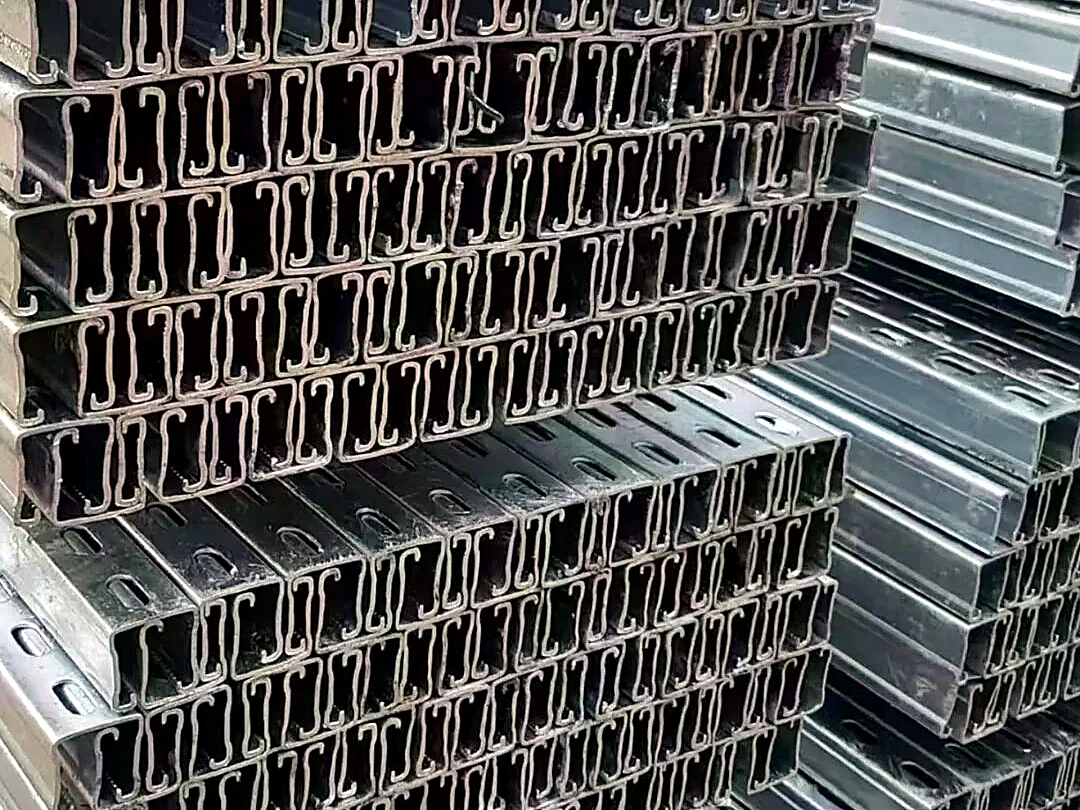
Cold-formed sections are produced by feeding steel strip through a series of rolls, each of which bends the strip a little further until the finished profile emerges. Because the strip is bent rather than cast or hot-rolled, the section is formed from thin material while the corners are cold-worked and strengthened. That is the reason a cold-formed section can carry the same load as a considerably heavier hot-rolled section: the material is placed where it resists bending, and the cold work at the corners raises the local yield strength.
The practical effect is weight saving. Where a hot-rolled channel would be needed to provide the same bending resistance, a cold-formed C section of similar depth will usually do the same job at appreciably lower weight, which reduces the load on the frame it sits on as well as the material cost. The trade-off is that the wall is thinner, so cold-formed sections are less tolerant of local damage, of corrosion, and of welding heat, and they are normally used where the load is distributed along the member rather than applied at a point. That is why they dominate purlins, decking, studs and framing rather than primary structural members.
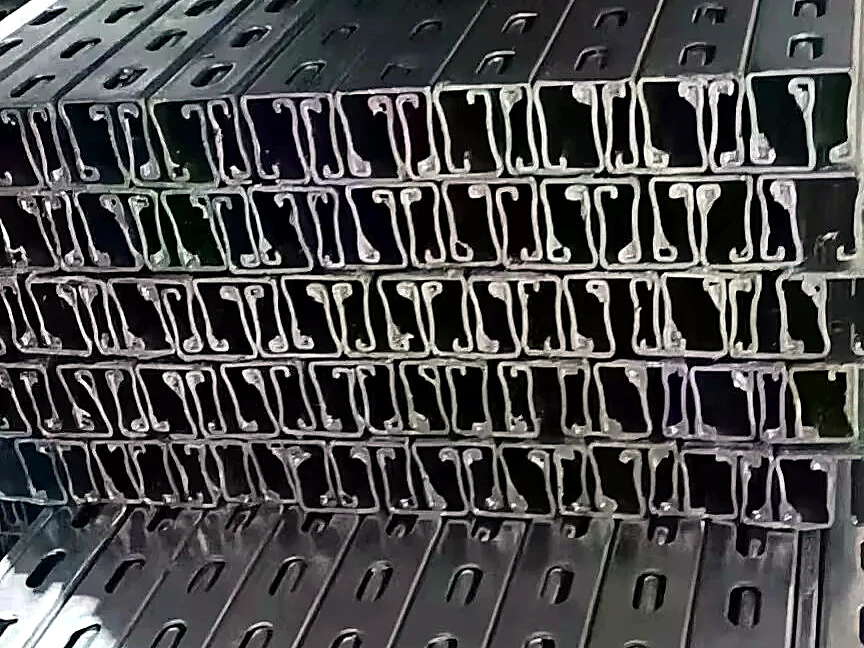
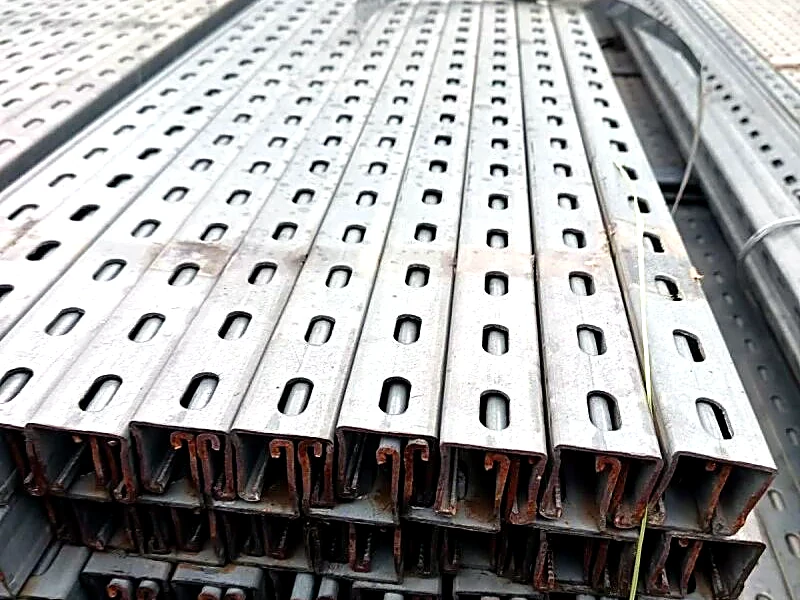
The second advantage of roll forming is that a profile is not limited to standard shapes. A section can be designed for the job: a deep lip to stiffen the flange, a stiffening rib in the web, a return on the edge, a wider flange for screw fixing, or a shape that nests into the member below it. Send a drawing, a DXF or even a dimensioned sketch, and the profile is developed and rolled to suit. Holes, slots and notches for fixings and services are punched in line with the forming, which removes an entire drilling operation from the site or the fabrication shop.
Specifications & Size Range
Standard section families and the range produced to drawing. Depth 80 mm to 400 mm for C sections and 100 mm to 300 mm for Z sections, in thicknesses from 1.5 mm to 4.0 mm, with heavier gauges produced to drawing. Lengths are cut to order, and holes, slots and notches are punched to your pattern.
| Section family | Depth range (mm) | Thickness (mm) | Supply length | Typical use |
|---|---|---|---|---|
| C section | C80 to C400 | 1.5-4.0 | cut to order, to 12 m | Purlins, wall rails, floor joists, racking, frame members |
| Z section | Z100 to Z300 | 1.5-4.0 | cut to order, to 12 m | Continuous roof and wall purlins, long span roofs |
| U / channel section | 80 to 400 | 1.5-4.0 | cut to order, to 12 m | Tracks, edge members, trim, framing and closures |
| Hat & stiffened profiles | to drawing | 1.5-4.0 | cut to order | Decking support, cassette panels, composite panels, cladding rails |
| Profiled decking | to drawing | 0.8-1.5 | cut to order | Roof and wall profile sheet, permanent formwork and floor decking |
| Bespoke profile to drawing | to drawing | 1.5-4.0 | cut to order | Purpose-designed sections, punched and notched to your pattern |
Tolerances
Sections are produced to GB/T 6723 for dimensions and tolerances and GB/T 6725 for general technical requirements. Depth, flange width, lip height and thickness are held to the standard for the section family, and hole position and cut length are held to the dimensional tolerance confirmed on the order acknowledgement. Where a profile is developed for a specific detail, the critical dimensions and the fit-up against the adjacent members are agreed before rolling.
Steel Grades & International Equivalents
All grades below are supplied with a mill test certificate. The right-hand column shows the material type and the Chinese standard the grade is produced to; the middle columns give the nearest recognised equivalent in other national standards. Exact equivalence for a specific project should be confirmed on the enquiry.
| GB (China) | ASTM / AISI (US) | EN (Europe) | JIS (Japan) | DIN (Germany) | Type / Standard |
|---|---|---|---|---|---|
| Q235B | A36 / A283 Gr.C | S235JR (EN 10025-2) | SS400 (JIS G3101) | St37-2 | Carbon structural steel (GB/T 700) |
| Q355B | A572 Gr.50 / A992 | S355JR (EN 10025-2) | SM490 (JIS G3106) | St52-3 | High-strength low-alloy (HSLA) steel (GB/T 1591) |
Grade Notes
- Q235B — The workhorse structural grade in China. Fully weldable, excellent cost-performance, the closest Chinese equivalent to ASTM A36 / EN S235JR.
- Q355B — High-strength structural steel for heavy structures, bridges and towers. Equivalent to ASTM A572 Gr.50 / EN S355JR.
Chemical Composition (%, ladle analysis)
Typical specification limits. Actual heat values are reported on the mill test certificate supplied with every shipment.
| Grade | C | Si | Mn | P max | S max | Other elements |
|---|---|---|---|---|---|---|
| Q235B | ≤0.20 | ≤0.35 | ≤1.40 | ≤0.045 | ≤0.045 | — |
| Q355B | ≤0.24 | ≤0.55 | ≤1.60 | ≤0.035 | ≤0.035 | Ceq ≤0.45 |
Mechanical Properties
Minimum values at room temperature unless stated. ReL = yield strength; Rp0.2 = 0.2% proof stress; Rm = tensile strength; A = elongation after fracture.
| Grade | Yield (ReL) | Proof (Rp0.2) | Tensile (Rm) | Elongation A | Impact / others | |
|---|---|---|---|---|---|---|
| Q235B | ≥235 MPa | — | 370–500 MPa | ≥26% | +20 °C, ≥27 J | — |
| Q355B | ≥355 MPa (≤16 mm) | — | 470–630 MPa | ≥22% | +20 °C, ≥27 J | — |
Standards & Documents
- GB/T 6723 — cold-formed steel sections for general structure: dimensions, shape and tolerances
- GB/T 6725 — cold-formed steel sections for general structure: general technical requirements
- GB/T 700 — carbon structural steels (Q235B); GB/T 1591 — high-strength structural steels (Q355B)
- Strip material to the applicable hot-rolled or cold-rolled strip standard, with thickness and mechanical properties certified
- Holes, slots and notches punched in line with forming to the pattern agreed on the drawing
- EN 10204 3.1 mill test certificate for the base strip with heat number, chemistry and mechanical properties; dimensional report on request
Typical Applications
| Industry / Application | Typical use |
|---|---|
| Roof & wall purlins | Purlins and side rails for steel-framed industrial, commercial and agricultural buildings, where cold-formed sections are the standard solution because the load is distributed along the member. |
| Floor & roof decking | Profiled steel decking used as permanent formwork for concrete floors, and as the structural roof and wall sheeting of industrial buildings. |
| Steel framing & secondary structure | Studs, joists, bracing, trimmers and infill framing in light steel framing systems for buildings and modular construction. |
| Solar & photovoltaic mounting | Main beams, rails, cross members and supports for ground-mounted and rooftop photovoltaic arrays, where the profile is designed around the module fixing detail. |
| Racking, shelving & storage | Rack uprights, beams, shelf profiles, storage cage frames and warehouse fit-out, in profiles designed for the load and the fixing system. |
| Equipment frames & housings | Frames, rails and enclosures for machinery, electrical equipment, conveyors and vehicles, where a bespoke profile replaces a welded assembly. |
| Architectural & façade framing | Secondary framing, mullion and spacer profiles, panel edge members and cladding rails, where the profile is designed into the façade detail. |
Common Problems Buyers Face — and How We Prevent Them
These are the issues that most often cause claims on steel imports. Each one is controlled in our process before shipment.
The finished section is heavier or more expensive than expected
Why it happens: Cold-formed sections are only cheaper than hot-rolled alternatives when the profile is designed for the real load. A section copied from a drawing without knowing the span and the load can be over-specified, and an over-deep or over-thick profile carries the cost of the extra steel.
Our control: Send the span, the load and the fixing detail as well as the dimensions. Where a profile is being designed rather than copied, we will advise on the depth and thickness that will actually carry the load, and the saving usually exceeds the cost of the change.
Holes and slots do not line up with the adjacent structure
Why it happens: Punched holes are positioned from the drawing, so an incorrect or ambiguous hole pattern produces a section that cannot be assembled on site, and re-drilling in the field weakens the member.
Our control: The hole pattern, its position from a stated datum and the orientation of the section are confirmed in writing before rolling starts. Where a first-off sample is practical, one length is produced and checked against the adjacent member before the production run.
Local distortion or buckling at a point load
Why it happens: Cold-formed sections have thin walls, so a concentrated load applied through a small bearing area can cripple the web or the flange, even though the member is adequate in overall bending.
Our control: Tell us where point loads and supports occur. Stiffening can be designed into the profile in the form of a web rib or a return lip, or a local bearing stiffener can be added, and in many cases this is cheaper than increasing the thickness of the whole member.
The section corrodes at the cut ends and around punched holes
Why it happens: Cold-formed sections are made from thin strip, so the same loss of section thickness that would be tolerable on a heavy member removes a much larger proportion of the capacity, and cut ends and punched holes are where corrosion starts.
Our control: For exposed or humid service specify galvanized material rather than bare steel, and for coastal service use a heavier zinc coating. Processing sections from pre-galvanized coil leaves the punched holes protected by the sacrificial action of the zinc, which is not the case if bare sections are drilled on site.
Welding distorts or embrittles a thin cold-formed section
Why it happens: The wall is thin, so weld heat input that would be harmless on a heavy section will distort a cold-formed member, and rapid cooling of a small heat-affected zone can leave it brittle.
Our control: Cold-formed sections are normally connected by screws, bolts or rivets rather than welded, and the profile is designed so that the connections are made through the flanges and webs. If welding is unavoidable for your detail, tell us at the enquiry stage and we will advise on the thickness and profile that will tolerate it.
Our Supply & Manufacturing Advantages
- Profiles designed for the job — C, Z, U, hat and fully bespoke sections developed to your drawing, with stiffening ribs, return lips and fixing flanges placed where the detail needs them.
- Weight saving against hot-rolled — Cold-formed sections place the material where it resists bending, so a lighter section usually replaces a heavier hot-rolled member, reducing both material cost and the load on the supporting frame.
- Punched and notched in line — Holes, slots and notches for fixings and services are punched during forming, removing a drilling operation from your site or fabrication shop and keeping every length identical.
- Long lengths with fewer joints — Sections are supplied in long cut lengths, so purlins and rails run further between joints, which reduces the number of connections and speeds up erection.
- Galvanized option for exposed service — The same profiles are available in pre-galvanized strip or hot-dip galvanized finish for outdoor, humid and coastal installations.
- Documented strip material — EN 10204 3.1 mill test certificate for the base strip with heat number, chemistry and mechanical properties, plus a dimensional check report on request.
Packaging, Delivery & Payment
- Packing: loose in bulk vessel, or bundled and containerised to your requirement. Galvanized and coated products get VCI paper, waterproof wrapping and edge protection. See our export packaging methods.
- Availability: both stock and custom production. Tell us the specification and we will confirm the route.
- MOQ: no strict minimum — one ton can ship.
- Lead time: stock dispatched to port within 3 days; orders needing export packaging about 1 week; custom production quoted per product.
- Payment: stock — 10% deposit, balance before shipment; custom production — 50% deposit, balance before shipment.
- Documents: EN 10204 3.1 mill test certificate with every shipment; third-party inspection (SGS / BV) on request.
Frequently Asked Questions
What is the difference between cold-formed and hot-rolled steel sections?
Hot-rolled sections are rolled at high temperature into a fixed catalogue of shapes, and they have a thick wall and a generous mass per metre. Cold-formed sections are bent from thin strip at room temperature, so the shape can be designed freely and the material sits where it resists bending. A cold-formed section is normally lighter for the same load, but has a thinner wall, which makes it less tolerant of point loads, corrosion and welding. Cold-formed suits purlins, decking and framing; hot-rolled suits primary structure.
Why does cold forming save weight?
Two reasons. First, the profile can be shaped so that the material is concentrated in the flanges and lips where it contributes most to bending resistance, whereas a hot-rolled catalogue section is a compromise shape. Second, bending the strip cold work-hardens the corners and raises the local yield strength, so the section gains capacity from a thinner wall. In practice a cold-formed C section often replaces a heavier hot-rolled channel at a lower weight per metre.
Can you produce a section to my own drawing?
Yes, that is what the roll-forming process is best at. Send a fully dimensioned drawing, a DXF or even a dimensioned sketch with the critical dimensions marked, and we will confirm whether the profile can be rolled, what thickness it suits and how the holes are to be positioned. Where a profile is being designed rather than copied, tell us the span and the load and we will advise on the depth and thickness.
What is the difference between GB/T 6723 and GB/T 6725?
GB/T 6723 covers the dimensions, shape and tolerances of cold-formed steel sections, so it is the standard that defines how accurately the profile must be produced. GB/T 6725 covers the general technical requirements, including the material and the mechanical properties that the finished section must meet. A conforming supply references both.
Can holes, slots and notches be punched during production?
Yes. Punching and notching are carried out in line with the roll forming, so every length leaves the line identical and no drilling is needed on site or in your shop. The hole pattern, the datum it is measured from and the orientation of the section are confirmed before the run starts, because once the tooling is set the pattern is fixed for the whole order.
Who supplies cold-formed steel sections from China?
We do. Sections are roll formed from Q235B and Q355B strip to GB/T 6723 and GB/T 6725, with punched holes and cut lengths, and shipped with a mill test certificate for the base strip. Send the profile drawing, the thickness, the length and the quantity, and we will confirm whether special tooling is required and what the lead time will be.
Should I choose Q235B or Q355B for a cold-formed section?
Q235B is the economical choice for the great majority of purlin, decking and framing applications and is easier to form. Choose Q355B where the design needs higher strength, where the section depth is limited by the detail and the load must be carried in a shallower or thinner profile, or where reducing weight is the priority. Tell us the span and the load if you want the choice confirmed.
Do you have a minimum order quantity and what is the lead time?
There is no strict minimum for standard profiles and one ton can ship. Bespoke profiles require tooling, so the economic quantity is higher and the tooling cost is quoted with the first order. Standard profiles reach the port in about one week; a new profile with tooling takes longer, confirmed at the quotation stage.
How are rolled sections packed for export?
Sections are bundled and strapped, with the bundle weight and length planned around container loading or break-bulk stowage, and lifting points marked. Bundle labels show the profile, material, thickness, length and quantity so the receiving check is straightforward.
Request a Quotation Export Packaging