
Hot-Dip Galvanized C & Z Purlins (S235, Q235B), Coastal Grade
Galvanized C and Z purlins in Q235B base material, C80 to C400 and Z100 to Z300, in thicknesses of 1.5 mm to 4.0 mm, with zinc coating from 30 to 700 g/m². Supplied either hot-dip galvanized after forming or roll formed from continuously galvanized coil, cut and punched to your purlin schedule for coastal and long-life structures.
Product Overview
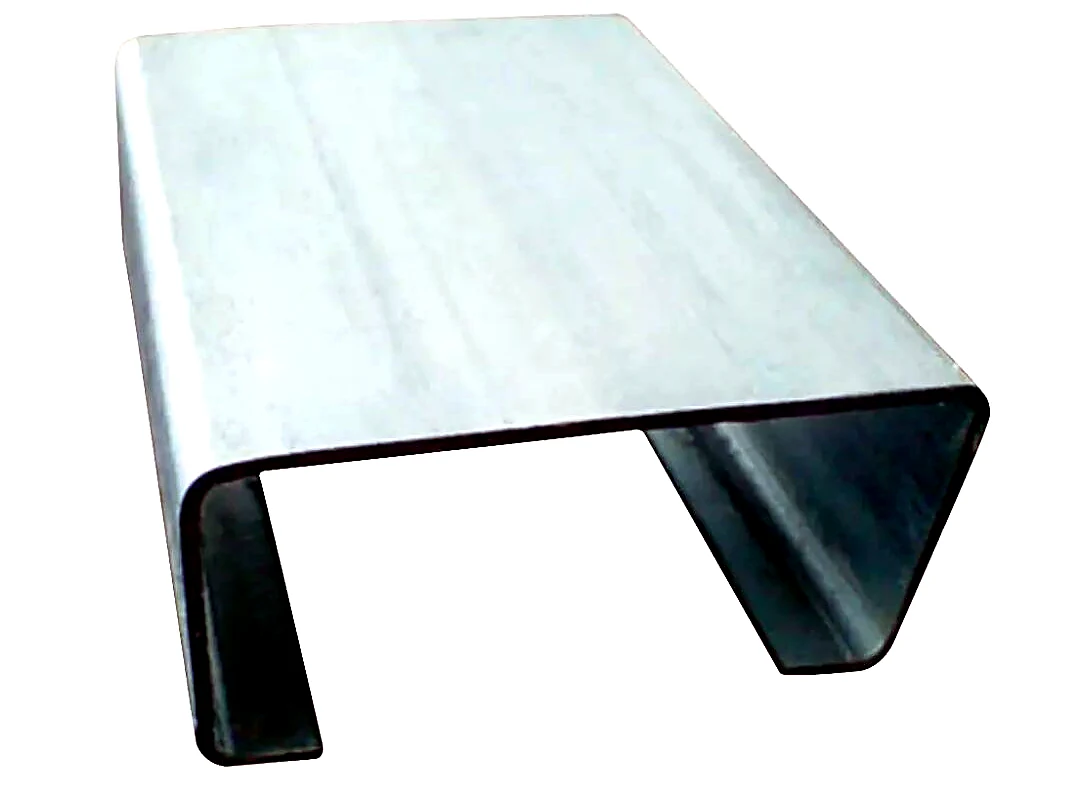
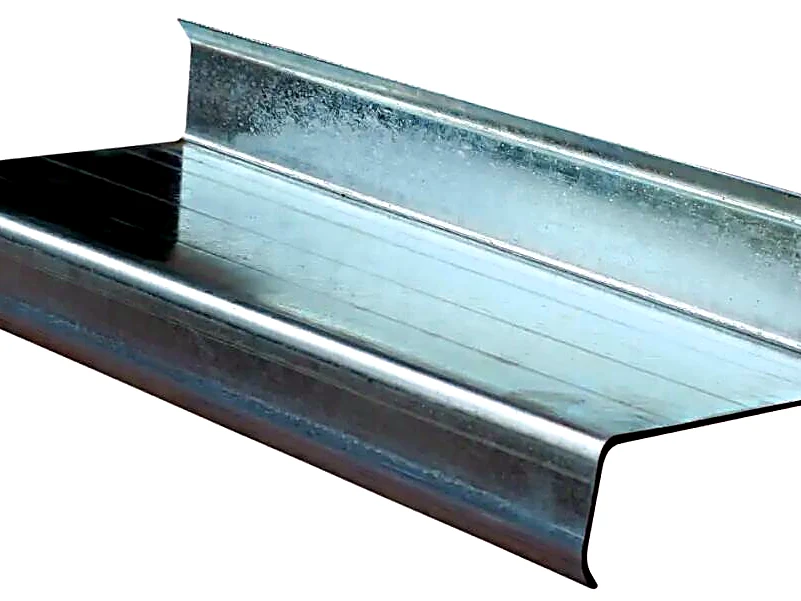
A galvanized C or Z purlin is the same section as a bare purlin with one difference that decides its service life: a zinc coating on every surface. Purlins are thin-walled, so a modest loss of section thickness from corrosion takes away a much larger share of the member’s capacity than the same loss would on a heavy hot-rolled section. In a humid, coastal or exposed building, that is the difference between a roof that lasts and a roof that needs replacing.
There are two ways to get a galvanized purlin and they are not equivalent. Hot-dip galvanizing after forming immerses the finished section in molten zinc, so the coating covers the cut ends, the punched holes and every formed edge, and it is the process used where the highest durability is required. Roll forming from continuously galvanized coil forms the purlin out of already-coated strip, which is faster and cheaper and gives a uniform, thin, smooth coating that is sufficient for ordinary outdoor and humid service. The first is the right answer for coastal and heavy industrial atmospheres; the second is efficient where the exposure is moderate.
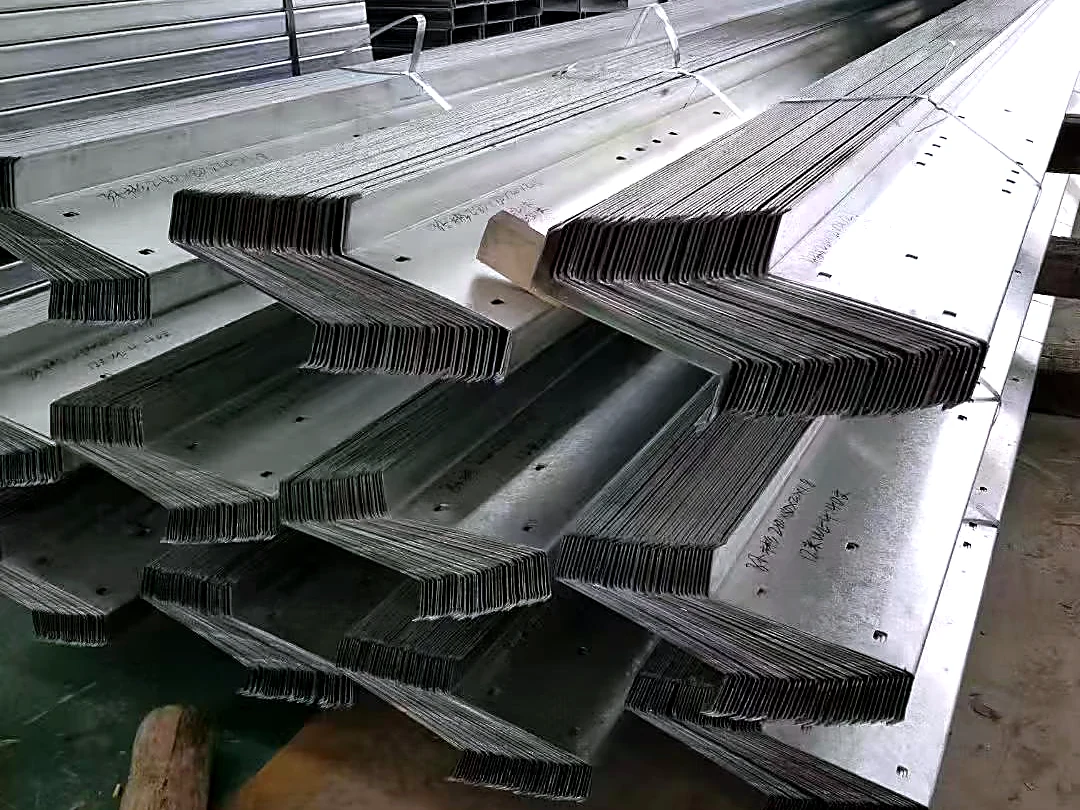
Coating weight is the specification that decides corrosion life, and it is quoted as the total on both surfaces. Around 100 g/m² suits sheltered and indoor service, 120 to 275 g/m² covers general outdoor exposure, and 275 g/m² and above is specified for coastal, marine and aggressive industrial locations. Coating weights from 30 to 700 g/m² can be supplied. Whichever route is used, the purlins are cut and punched to the same schedule as bare material, so the fabrication detailing does not change.
Specifications & Size Range
Galvanized C and Z sections with the coating route and typical exposure for each section. Sections are cut to your purlin schedule and punched to your fixing pattern, with the punch holes protected by the coating. Coating weight is nominated against the atmosphere of the site.
| Section family | Depths (mm) | Thickness (mm) | Coating | Typical use |
|---|---|---|---|---|
| Galvanized C, light | C80, C100, C120, C140 | 1.5-2.5 | galvanized coil, 100-275 g/m² | Canopies, carports, wall rails, agricultural buildings |
| Galvanized C, general | C160, C180, C200, C220 | 2.0-3.0 | galvanized coil or hot-dip, 120-275 g/m² | Industrial and commercial roofs, humid process buildings |
| Galvanized C, heavy | C250, C300, C400 | 2.5-4.0 | hot-dip, 275 g/m² and above | Long span roofs, coastal and heavy industrial buildings |
| Galvanized Z, light | Z100, Z120, Z140, Z160 | 1.5-2.5 | galvanized coil, 100-275 g/m² | Continuous wall rails, short span lapped roof runs |
| Galvanized Z, general | Z180, Z200, Z220 | 2.0-3.0 | galvanized coil or hot-dip, 120-275 g/m² | Continuous lapped roofs, coastal and humid locations |
| Galvanized Z, heavy | Z250, Z300 | 2.5-4.0 | hot-dip, 275 g/m² and above | Long span continuous roofs on coastal and offshore projects |
Tolerances
Sections are produced to GB/T 6723 for dimensions and tolerances and GB/T 6725 for general technical requirements. Coating weight is specified to GB/T 13912, ISO 1461 and ASTM A123, quoted as g/m² total on both surfaces, with about 7 microns of coating thickness per 100 g/m². Coating mass and adhesion are tested per lot and a coating test report is issued with the mill certificate.
Steel Grades & International Equivalents
All grades below are supplied with a mill test certificate. The right-hand column shows the material type and the Chinese standard the grade is produced to; the middle columns give the nearest recognised equivalent in other national standards. Exact equivalence for a specific project should be confirmed on the enquiry.
| GB (China) | ASTM / AISI (US) | EN (Europe) | JIS (Japan) | DIN (Germany) | Type / Standard |
|---|---|---|---|---|---|
| Q235B + hot-dip galvanized | A123 / A153 (ASTM) | EN ISO 1461 | JIS H8641 | DIN 50976 | Hot-dip galvanized structural steel (GB/T 13912) |
| Q235B | A36 / A283 Gr.C | S235JR (EN 10025-2) | SS400 (JIS G3101) | St37-2 | Carbon structural steel (GB/T 700) |
Grade Notes
- Q235B + hot-dip galvanized — Zinc coating of 30–700 g/m² gives 5–30+ years of atmospheric corrosion protection depending on thickness and environment.
- Q235B — The workhorse structural grade in China. Fully weldable, excellent cost-performance, the closest Chinese equivalent to ASTM A36 / EN S235JR.
Chemical Composition (%, ladle analysis)
Typical specification limits. Actual heat values are reported on the mill test certificate supplied with every shipment.
| Grade | C | Si | Mn | P max | S max | Other elements |
|---|---|---|---|---|---|---|
| Q235B | ≤0.20 | ≤0.35 | ≤1.40 | ≤0.045 | ≤0.045 | — |
Mechanical Properties
Minimum values at room temperature unless stated. ReL = yield strength; Rp0.2 = 0.2% proof stress; Rm = tensile strength; A = elongation after fracture.
| Grade | Yield (ReL) | Proof (Rp0.2) | Tensile (Rm) | Elongation A | Impact / others | |
|---|---|---|---|---|---|---|
| Q235B + hot-dip galvanized | — | — | — | — | — | Coating 30–700 g/m² (both sides), made to order Adhesion per GB/T 13912 bend test |
| Q235B | ≥235 MPa | — | 370–500 MPa | ≥26% | +20 °C, ≥27 J | — |
Standards & Documents
- GB/T 13912 — hot-dip galvanized coatings on fabricated iron and steel articles: coating mass and adhesion
- ISO 1461 / EN ISO 1461 and ASTM A123 — international and American equivalents for hot-dip galvanized coatings
- GB/T 6723 and GB/T 6725 — cold-formed steel section dimensions and general technical requirements
- GB/T 700 — carbon structural steels (Q235B base material for the formed section)
- Coating weights from 30 to 700 g/m² total on both surfaces, or roll formed from continuously galvanized coil
- Coating mass test report plus EN 10204 3.1 mill test certificate for the base material; third-party inspection on request
Typical Applications
| Industry / Application | Typical use |
|---|---|
| Coastal & marine building roofs | Roof and wall purlins on buildings within reach of salt spray, where a hot-dip coating of 275 g/m² or heavier is specified to give a maintenance-free life. |
| Photovoltaic mounting structures | Rails, beams and cross members for rooftop and ground-mounted solar arrays, where the structure is expected to last the life of the modules and cannot be repainted. |
| Humid & wet process buildings | Purlins and rails in food processing, water treatment, laundry, swimming pool and agricultural buildings, where permanent humidity makes bare steel unsuitable. |
| Cold stores & refrigerated buildings | Purlins and rails in cold storage and refrigerated facilities, where condensation on cold surfaces drives continuous corrosion on uncoated steel. |
| Chemical & industrial plant | Secondary framing, cladding rails and support members in chemical, fertilizer and heavy industrial plant where the atmosphere is aggressive. |
| Agricultural & livestock buildings | Purlins and rails in livestock and poultry buildings, where ammonia and humidity attack uncoated steel rapidly and the structure is difficult to maintain. |
| Walkway canopies & shelters | Framing for canopies, walkway roofs, shelters and open-fronted structures, where the framing is permanently exposed to weather. |
Common Problems Buyers Face — and How We Prevent Them
These are the issues that most often cause claims on steel imports. Each one is controlled in our process before shipment.
White rust on the galvanized purlins on arrival
Why it happens: Zinc reacts with moisture when air cannot circulate between bundled, closely nested sections, producing wet-storage stain. It is a surface product rather than a loss of coating, but it looks like a defect at the receiving inspection.
Our control: Bundles are shipped dry with spacers so air can move between sections, and VCI paper is added on long or humid routes. Where appearance matters, ask for a passivation treatment. On site, keeping the bundles dry and open until erection prevents the problem from developing further.
Coating too light for the location
Why it happens: Galvanized coil purlins are often quoted on price without reference to coating weight, and a light coating that is adequate inland will fail within a few years in a coastal atmosphere.
Our control: Tell us the location and the intended service life and we will nominate the coating weight and the process. Where salt spray is present, hot-dip galvanizing after forming at 275 g/m² or heavier is the correct specification rather than roll forming from lightly coated coil.
Cut ends and punched holes showing rust
Why it happens: If the material is cut or drilled after coating, the exposed steel at the cut is unprotected, and on a thin purlin wall those exposed edges corrode first.
Our control: Punching and cutting are carried out as part of forming, and where the section is hot-dip galvanized after forming the cut ends and holes are coated as well. Processing before coating is the reason we recommend the hot-dip route for aggressive environments.
Panels and purlins galvanically incompatible with fixings
Why it happens: Dissimilar metals in contact in a wet environment cause galvanic corrosion, and a purlin fastened with the wrong type of screw or bracket corrodes locally around every fixing, well before the rest of the coating is consumed.
Our control: Use galvanized or stainless fixings with galvanized purlins, and avoid direct contact with copper, brass or bare carbon steel in exposed positions. Tell us the fixing specification and we will confirm compatibility before the order is placed.
Distortion of thin sections during hot-dip galvanizing
Why it happens: The galvanizing thermal cycle releases the stresses left by roll forming, and thin light sections can bow or twist during dipping if they are not jigged and handled correctly.
Our control: Jigging and dip sequence are planned for thin sections, and straightness is checked after galvanizing. Where a section is especially slender, we will suggest a slightly heavier thickness or a different detail so the finished purlin stays straight.
Our Supply & Manufacturing Advantages
- Two coating routes, chosen for the site — Roll formed from continuously galvanized coil for moderate exposure, or hot-dip galvanized after forming with the coating on every cut end and punched hole for coastal and aggressive sites.
- Coating weight specified, not assumed — Coating from 30 to 700 g/m² total on both surfaces, nominated against the atmosphere the building will actually stand in, and reported on a coating test certificate.
- Long life without repainting — A galvanized purlin needs no maintenance painting, which matters most where the purlins are behind cladding and cannot be reached again without dismantling the roof.
- Punched and cut as part of the order — Sections arrive cut to the purlin schedule and punched to the sheeting layout, so the coating is not damaged by site drilling and the roof is assembled rather than fabricated.
- Same detailing as bare purlins — The section dimensions are unchanged, so a galvanized purlin can be substituted into an existing design without altering the sheeting, the fixings or the frame connections.
- Documented coating and material — Coating mass test report plus EN 10204 3.1 mill test certificate for the base material with every lot, and third-party inspection on request.
Packaging, Delivery & Payment
- Packing: loose in bulk vessel, or bundled and containerised to your requirement. Galvanized and coated products get VCI paper, waterproof wrapping and edge protection. See our export packaging methods.
- Availability: both stock and custom production. Tell us the specification and we will confirm the route.
- MOQ: no strict minimum — one ton can ship.
- Lead time: stock dispatched to port within 3 days; orders needing export packaging about 1 week; custom production quoted per product.
- Payment: stock — 10% deposit, balance before shipment; custom production — 50% deposit, balance before shipment.
- Documents: EN 10204 3.1 mill test certificate with every shipment; third-party inspection (SGS / BV) on request.
Frequently Asked Questions
Should I choose galvanized purlins or bare steel purlins?
For a dry, heated, controlled interior, bare steel purlins are adequate and less expensive. For anything else — humid, coastal, industrial, agricultural, cold store or open-sided — galvanized purlins are the correct choice, because purlins are thin-walled and even modest corrosion removes a significant share of their capacity. Once cladding is on, purlins cannot be repainted, so the decision is effectively permanent.
What is the difference between hot-dip galvanized purlins and purlins made from galvanized coil?
Hot-dip galvanizing after forming immerses the finished section in molten zinc, so the coating covers every surface including the cut ends, the punched holes and the formed edges, and heavier coatings are achievable. Roll forming from galvanized coil forms the purlin from already-coated strip, which is faster and less expensive and gives a uniform thin coating, but the cut ends are uncoated. For coastal or aggressive sites, choose hot-dip; for moderate exposure, galvanized coil is efficient.
What coating weight do I need for a coastal building?
For coastal, marine or offshore locations specify 275 g/m² or heavier, which gives roughly 19 microns of coating per face and protects the steel by sacrificial action at cut edges and fixings. For general inland outdoor exposure 120 to 275 g/m² is normal, and for sheltered or interior service around 100 g/m² is adequate. The figure quoted is the total on both surfaces.
Can galvanized purlins be welded on site?
Welding burns off the zinc coating locally and leaves bare steel at the weld, which is exactly where corrosion will start in an exposed building. If site welding is unavoidable, the weld zone must be repaired with zinc-rich paint. For most purlin systems, bolted or screwed connections are used instead, and the purlins are punched for those fixings at production.
Is galvanized purlin coating compliant with ASTM A123?
Yes. Coating is produced and tested to meet ASTM A123 as well as GB/T 13912 and ISO 1461. If your project specification references ASTM A123, state it on the enquiry and the coating will be inspected and reported against that standard, with the test report issued with the shipment.
Who supplies galvanized C and Z purlins from China for export?
We do. Galvanized C80 to C400 and Z100 to Z300 purlins are supplied in Q235B base material, either hot-dip galvanized after forming or roll formed from continuously galvanized coil, cut and punched to your schedule and shipped with a mill certificate and coating test report.
What is the difference between galvanized purlins and painted purlins?
Paint is a barrier film: once it is scratched or the section is cut, corrosion begins at the break, and a painted purlin behind cladding cannot be inspected or repainted. Galvanizing forms a metallurgically bonded zinc coating that protects the steel sacrificially, including at damaged areas and cut edges, and needs no maintenance. For a structure with a design life beyond a few years, galvanizing is the more durable specification.
Do you have a minimum order quantity and what is the lead time?
There is no strict minimum and one ton can ship. Purlins roll formed from galvanized coil reach the port in about one week. Where hot-dip galvanizing after forming is specified, the purlins are cut and punched first and then dipped, and the lead time is confirmed at the quotation stage.
What documents come with a galvanized purlin shipment?
A coating mass test report giving the coating weight in g/m² for the lot, together with an EN 10204 3.1 mill test certificate showing heat number, chemistry and mechanical properties for the base material. The commercial invoice, packing list and certificate of origin are included, and third-party inspection can be arranged before loading.
Request a Quotation Export Packaging