
Steel Fabrication & Processing Services (Cutting, Bending, Rolling, Welding)
Steel processing and fabrication to your drawing: profile forming, press-brake bending, flame, plasma and laser cutting, cylinder rolling, curved bending of sections, and welding and assembly. Working from Q235B and Q355B material in thicknesses from 1 mm to 200 mm, with dimensional inspection reports and a typical turnaround of 3 to 5 days, or 24 hours for urgent work.
Product Overview
This is a service, not a stock item. We take a drawing and either the material you supply or material we purchase on your behalf, and deliver finished parts: cut, bent, rolled, formed, welded, inspected and packed for export. The capability covers steel plate from 1 mm to 200 mm, sections in angle, channel, I-beam and tube, and profiled sheet and decking from coil. Processing before shipment is usually cheaper than processing after it, because offcut material never pays freight, and because a finished part does not need the floor space, the machine time or the skilled operators that would otherwise be required in your own plant.
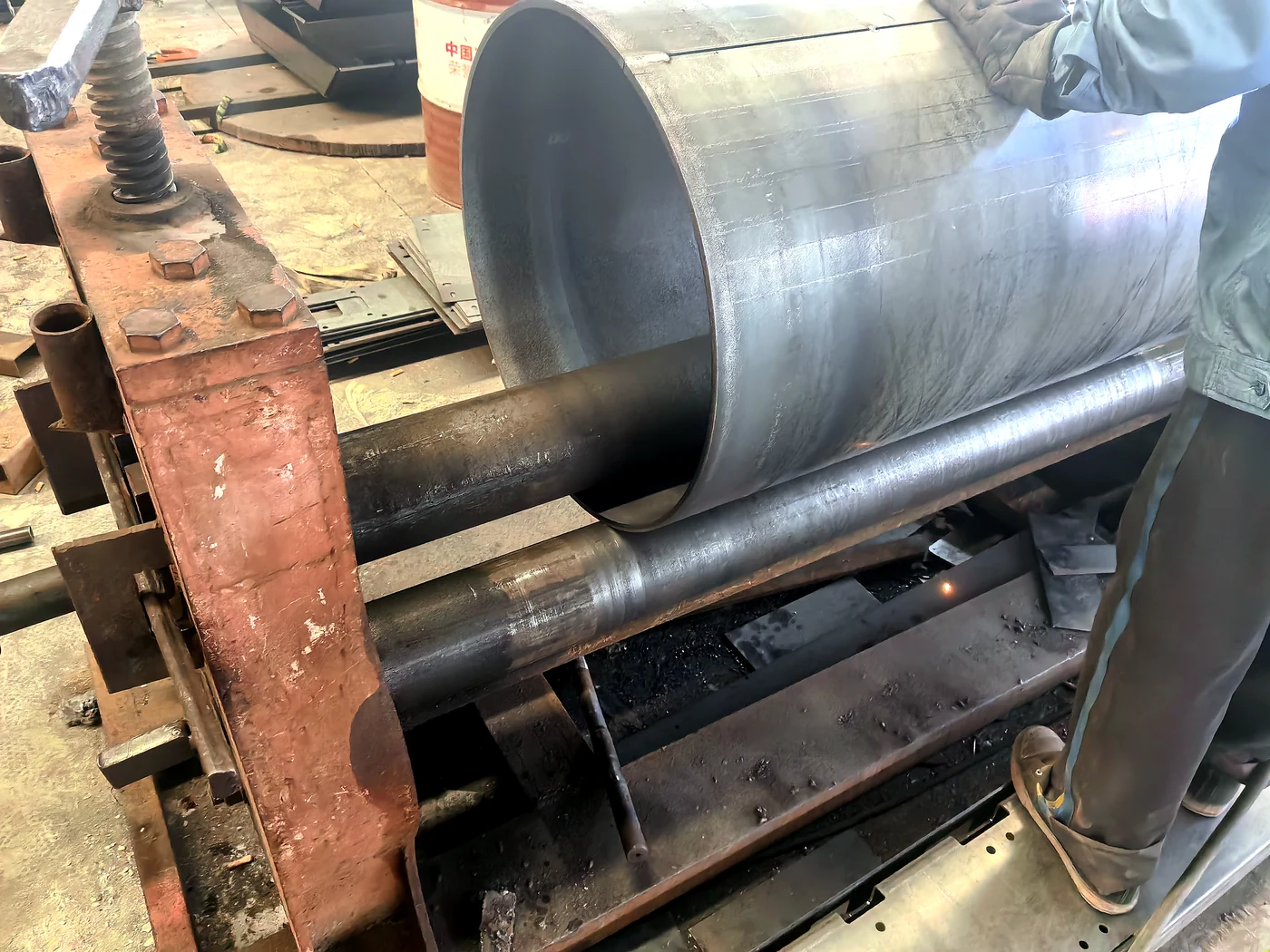
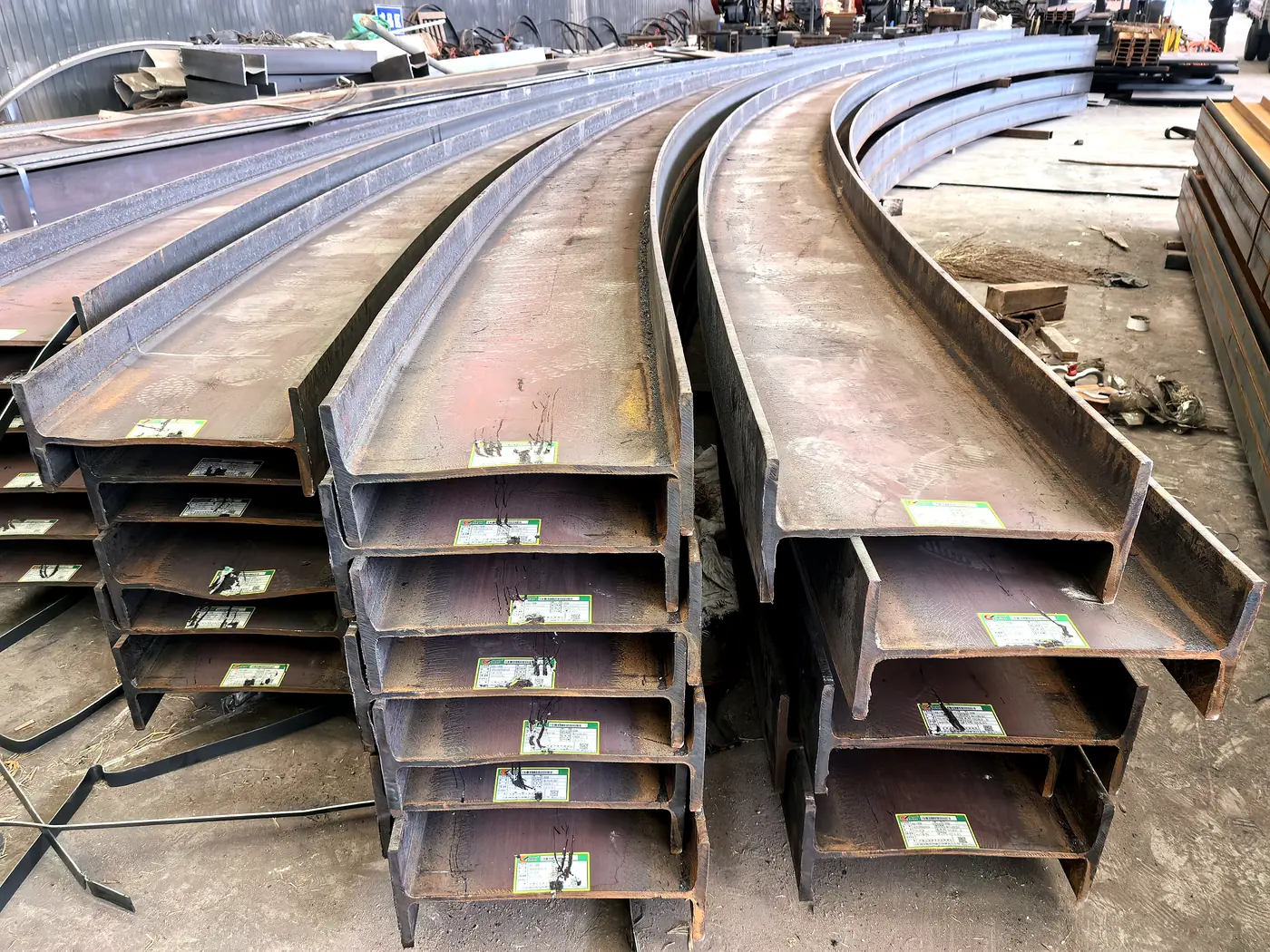
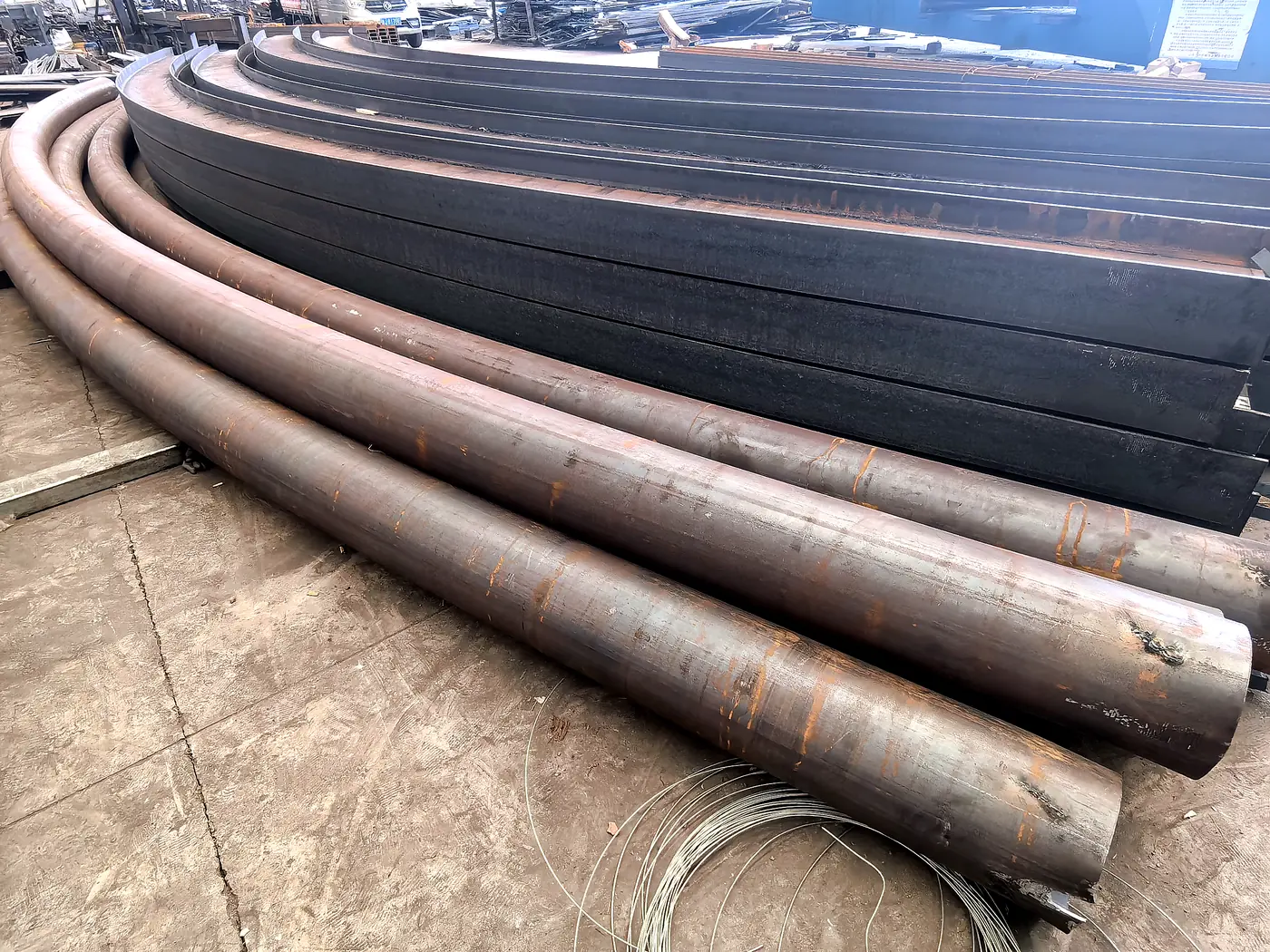
The equipment is the ordinary workshop set for this class of work and each machine has a defined limit. Cutting is by flame for thick plate, plasma for stainless and for mid-range thickness, and laser for thin sheet and for profiles with fine detail: flame cutting covers up to 200 mm, plasma up to 80 mm and laser up to 25 mm. Plate is bent on a CNC press brake up to 25 mm thickness and 6 m in length. Cylinders and curved plate are rolled on a three-roll bender from 2 mm to 30 mm. Angle, channel, I-beam and square tube are curved by cold roll bending for arched and curved members. Profiled sheet, floor decking and roofing profiles are formed on roll formers, and welding is carried out by MIG/MAG, submerged arc and TIG as the joint and the material require.
Working tolerance is stated up front because it decides what can be achieved: about plus or minus 1 mm on cutting, plus or minus 0.5 mm on press-brake bending and about plus or minus 2 mm on rolled and curved work. Both service modes are available. In the first, you supply the material and we process it, which suits a buyer who already has steel or who needs a specific mill certificate. In the second, we purchase the material and process it, and deliver a finished part against a single purchase order, which is usually the simpler route for an overseas buyer.
Specifications & Size Range
Process capability by machine, with the thickness or size range, the achievable accuracy and the typical output. Tolerances shown are working figures; where a drawing demands tighter limits, tell us and we will confirm whether the part can be produced to them before quoting.
| Process | Method / machine | Range | Working accuracy | Typical output |
|---|---|---|---|---|
| Plate cutting | Flame, plasma and laser on CNC tables | 1-200 mm (flame to 200, plasma to 80, laser to 25) | about ±1 mm | Profiled blanks, brackets, gussets, holes and edge profiles |
| Press-brake bending | CNC press brake, length to 6 m | 1-25 mm plate | about ±0.5 mm | Folded panels, channels, edge-stiffened parts, formed sections |
| Cylinder rolling | Three-roll plate bender | 2-30 mm plate | about ±2 mm | Cylinder shells, arcs, tank and duct sections, rolled rings |
| Curved bending of sections | Cold roll bending of angle, channel, I-beam, square tube | section and radius dependent | to drawing | Arched beams, curved members, canopies, tunnels and arches |
| Profile forming | Roll former, sheet and coil | profiled sheet and decking | to drawing | Roof and wall profile sheet, floor decking, liner trays |
| Welding & assembly | MIG/MAG, submerged arc, TIG | to drawing and procedure | per agreed procedure | Welded frames, structures, supports, fittings and assemblies |
Tolerances
Working tolerance is about plus or minus 1 mm on cut parts, plus or minus 0.5 mm on press-brake bending and about plus or minus 2 mm on rolled and curved work, measured against the drawing and reported on a dimensional inspection report for the order. Where a drawing specifies a tighter tolerance, the part is reviewed before quoting and the achievable limit is confirmed in writing. Welded assemblies are checked against the agreed procedure, with visual inspection as standard and further weld inspection on request.
Steel Grades & International Equivalents
All grades below are supplied with a mill test certificate. The right-hand column shows the material type and the Chinese standard the grade is produced to; the middle columns give the nearest recognised equivalent in other national standards. Exact equivalence for a specific project should be confirmed on the enquiry.
| GB (China) | ASTM / AISI (US) | EN (Europe) | JIS (Japan) | DIN (Germany) | Type / Standard |
|---|---|---|---|---|---|
| Q235B | A36 / A283 Gr.C | S235JR (EN 10025-2) | SS400 (JIS G3101) | St37-2 | Carbon structural steel (GB/T 700) |
| Q355B | A572 Gr.50 / A992 | S355JR (EN 10025-2) | SM490 (JIS G3106) | St52-3 | High-strength low-alloy (HSLA) steel (GB/T 1591) |
Grade Notes
- Q235B — The workhorse structural grade in China. Fully weldable, excellent cost-performance, the closest Chinese equivalent to ASTM A36 / EN S235JR.
- Q355B — High-strength structural steel for heavy structures, bridges and towers. Equivalent to ASTM A572 Gr.50 / EN S355JR.
Chemical Composition (%, ladle analysis)
Typical specification limits. Actual heat values are reported on the mill test certificate supplied with every shipment.
| Grade | C | Si | Mn | P max | S max | Other elements |
|---|---|---|---|---|---|---|
| Q235B | ≤0.20 | ≤0.35 | ≤1.40 | ≤0.045 | ≤0.045 | — |
| Q355B | ≤0.24 | ≤0.55 | ≤1.60 | ≤0.035 | ≤0.035 | Ceq ≤0.45 |
Mechanical Properties
Minimum values at room temperature unless stated. ReL = yield strength; Rp0.2 = 0.2% proof stress; Rm = tensile strength; A = elongation after fracture.
| Grade | Yield (ReL) | Proof (Rp0.2) | Tensile (Rm) | Elongation A | Impact / others | |
|---|---|---|---|---|---|---|
| Q235B | ≥235 MPa | — | 370–500 MPa | ≥26% | +20 °C, ≥27 J | — |
| Q355B | ≥355 MPa (≤16 mm) | — | 470–630 MPa | ≥22% | +20 °C, ≥27 J | — |
Standards & Documents
- Cold-formed sections produced to GB/T 6723 (dimensions) and GB/T 6725 (general technical requirements)
- Base plate and section material certified to EN 10204 3.1 where we purchase the material; your material processed to the same drawings with your certificate retained
- Processing tolerances referenced to the applicable plate and section standards, with the dimensional tolerance stated on the order acknowledgement
- Welding to an agreed procedure (MIG/MAG, submerged arc, TIG), visual inspection as standard and weld inspection reports on request
- Dimensional inspection report for processed parts supplied with each order
- Third-party inspection of finished parts by SGS or BV arranged on request before packing
Typical Applications
| Industry / Application | Typical use |
|---|---|
| Structural steelwork packages | Cut, drilled, bevelled and welded structural members, node plates, gussets, base plates and connections supplied ready for erection or ready for site welding. |
| Material preparation for export | Plate and sections cut to your cutting list before shipment, so offcut never pays freight and the receiving yard only has to assemble rather than fabricate. |
| Machine & equipment components | Cut and machined blanks, brackets, guards, frames and bases for machinery manufacturers, produced to the drawing and dimensional report. |
| Tanks, ducts & cylinders | Rolled cylinder shells, duct sections, tank rings and arcs, with the longitudinal seam welded and the shell checked for diameter. |
| Curved & architectural steelwork | Curved beams, arches, hoop members and canopies formed from angle, channel, I-beam and tube, for architectural and structural applications. |
| Profiled roofing & decking | Roof and wall profile sheet, floor and roof decking and liner trays formed from coil or flat sheet to the profile you specify. |
| Jobbing & single-piece work | One-off parts, prototypes and replacement components, where the requirement is a correct part rather than a production quantity. |
Common Problems Buyers Face — and How We Prevent Them
These are the issues that most often cause claims on steel imports. Each one is controlled in our process before shipment.
Parts arrive outside the tolerance the drawing required
Why it happens: Tolerance is rarely stated on a drawing, and a fabricator that has not been told the critical dimensions will work to workshop norms, which can be acceptable for one dimension and unacceptable for another.
Our control: Critical dimensions and their tolerances are marked and agreed before production, and the achievable limit is confirmed in writing at the quotation stage. Every order is supplied with a dimensional inspection report, so the check is documented rather than argued about after arrival.
The wrong material is used for the part
Why it happens: When material is supplied by the fabricator without a stated grade, the substitution of a similar-looking section or plate can change strength, weldability or corrosion behaviour, and the change is invisible on arrival.
Our control: State the grade and, if it matters, the heat number. Where we purchase the material, the mill certificate is retained and matched to the finished parts; where you supply the material, it is kept segregated and processed to the same drawing so your certificate still applies.
Distortion after welding or after cutting
Why it happens: Heat input from welding and from flame cutting releases internal stress in the material, and a part that was flat when it was cut can pull out of shape once it has been welded.
Our control: Weld sequence, tacking and restraint are planned for distortion-sensitive parts, and heat input is kept to the minimum the procedure allows. Where necessary, fabricated parts are checked after welding and corrected before packing rather than leaving the correction to site.
Drawings in different units or with missing views
Why it happens: An imperial drawing processed as metric, or a drawing without a view showing the bend direction or the hole pattern, will be made as interpreted and be wrong in a way that only appears at assembly.
Our control: State the units on the drawing and include the views needed to define the part. Where a detail is ambiguous, we will raise a query rather than assume, and for repeat parts it is worth sending a sample or the mating component so the first article can be checked against it.
Finished parts damaged in transit or packed for the wrong handling
Why it happens: Processed parts are more delicate than raw material, and a bundle of folded, drilled or rolled parts packed like a plate bundle will arrive bent, scratched or with the coating knocked off.
Our control: Packing is designed around the part rather than the tonnage: parts are nested and separated, edges protected and lifting points marked, and where the part has a coated or polished surface, protective interleaving and film are added. Tell us at the enquiry what condition the part must arrive in.
Our Supply & Manufacturing Advantages
- Full process chain in one place — Cutting, bending, rolling, curved bending, profile forming and welding are all carried out in house, so a package is not split between subcontractors and the tolerances stack up in one workshop.
- Material or customer-supplied stock — We can purchase the material and deliver a finished part against one order, or process material you supply, keeping your own mill certificate attached to the finished parts.
- Verified capability, stated up front — Flame cutting to 200 mm, plasma to 80 mm, laser to 25 mm, press brake to 25 mm and 6 m, and rolling from 2 mm to 30 mm — with the working accuracy of each process quoted before you order, not after.
- Fast turnaround — Normal processed work is ready in 3 to 5 days and urgent items can be produced within 24 hours. Batch orders are scheduled first so a delivery date holds.
- Documented quality — A dimensional inspection report accompanies processed parts, material certificates are matched to the parts, and weld inspection or third-party inspection by SGS or BV is arranged on request.
- Export packing designed for parts — Nested and separated packing, edge protection, protective film for coated or polished surfaces and marked lifting points, so finished parts arrive in the condition they left the workshop.
Packaging, Delivery & Payment
- Packing: loose in bulk vessel, or bundled and containerised to your requirement. Galvanized and coated products get VCI paper, waterproof wrapping and edge protection. See our export packaging methods.
- Availability: both stock and custom production. Tell us the specification and we will confirm the route.
- MOQ: no strict minimum — one ton can ship.
- Lead time: stock dispatched to port within 3 days; orders needing export packaging about 1 week; custom production quoted per product.
- Payment: stock — 10% deposit, balance before shipment; custom production — 50% deposit, balance before shipment.
- Documents: EN 10204 3.1 mill test certificate with every shipment; third-party inspection (SGS / BV) on request.
Frequently Asked Questions
What is the maximum thickness you can cut?
Flame cutting covers up to 200 mm, plasma cutting up to 80 mm and laser cutting up to 25 mm. The choice between them is driven by thickness, material and the detail on the part: laser gives the finest edge and the tightest detail on thin material, plasma gives a clean cut on stainless and mid-range thickness, and flame is the practical route for heavy plate. Tell us the thickness and the part and we will nominate the process.
What is the tightest tolerance you can hold?
As a working figure, about plus or minus 1 mm on cut parts, plus or minus 0.5 mm on press-brake bending and about plus or minus 2 mm on rolled and curved work. If your drawing needs something tighter, send it and we will tell you honestly whether it can be achieved before you place the order, rather than committing to a tolerance the machine cannot hold.
What is the minimum diameter you can roll?
It depends on the plate thickness and width, and on the roll diameter of the bender being used. As an indication, a 2 mm plate can be rolled to a small diameter, while a 25 or 30 mm plate needs a correspondingly large diameter to avoid excessive strain. Send the drawing with the diameter, thickness and width and we will confirm what is achievable before quoting.
Can you process material that I supply?
Yes. Both modes are available: you supply the steel and we process it, or we purchase the material and deliver a finished part. Customer-supplied material is kept segregated and processed to the same drawing, so the mill certificate you hold continues to apply to the finished parts. Tell us which mode you want at the enquiry stage.
What is the lead time for fabrication work?
Normal processed work is ready in 3 to 5 days, and urgent items can be produced within 24 hours. Batch orders are scheduled ahead of smaller jobs, so a batch involving a new profile or new tooling needs the drawing agreed before the schedule is committed. Export packing adds a small amount of time.
Who provides steel fabrication and processing from China for export buyers?
We do. We work to your drawing, in either service mode, and deliver finished parts with a dimensional inspection report. Typical work is structural steelwork packages, cut-to-size material, folded and rolled components, curved members, profiled decking and welded assemblies. Send the drawings and the quantity for a quotation.
How can I be sure the finished part will fit?
Three ways. Critical dimensions and their tolerances are confirmed in writing before production; a first article can be produced and checked against the drawing or a mating component before the batch runs; and every order is supplied with a dimensional inspection report. For repeat parts, sending a sample or the mating component is the most reliable check of all.
What is the difference between visual weld inspection and a full weld inspection report?
Visual inspection of every weld is standard on all fabrication work. A full weld inspection report, such as ultrasonic or dye-penetrant examination of specified joints, is arranged on request and is quoted as a separate item. If your project requires a specific welding standard or procedure qualification, tell us at the enquiry stage so it is built into the quote rather than added later.
How are finished parts packed for export?
Packing is designed around the part rather than the tonnage. Parts are nested and separated, edges protected and lifting points marked, and protective film or interleaving is added where the part has a coated, painted or polished surface. Tell us at the enquiry what condition the part must be in on arrival and the packing will be planned to suit.
Request a Quotation Export Packaging