
Hot-Dip Galvanized Checkered Plate (Anti-Slip, Coastal Grade)
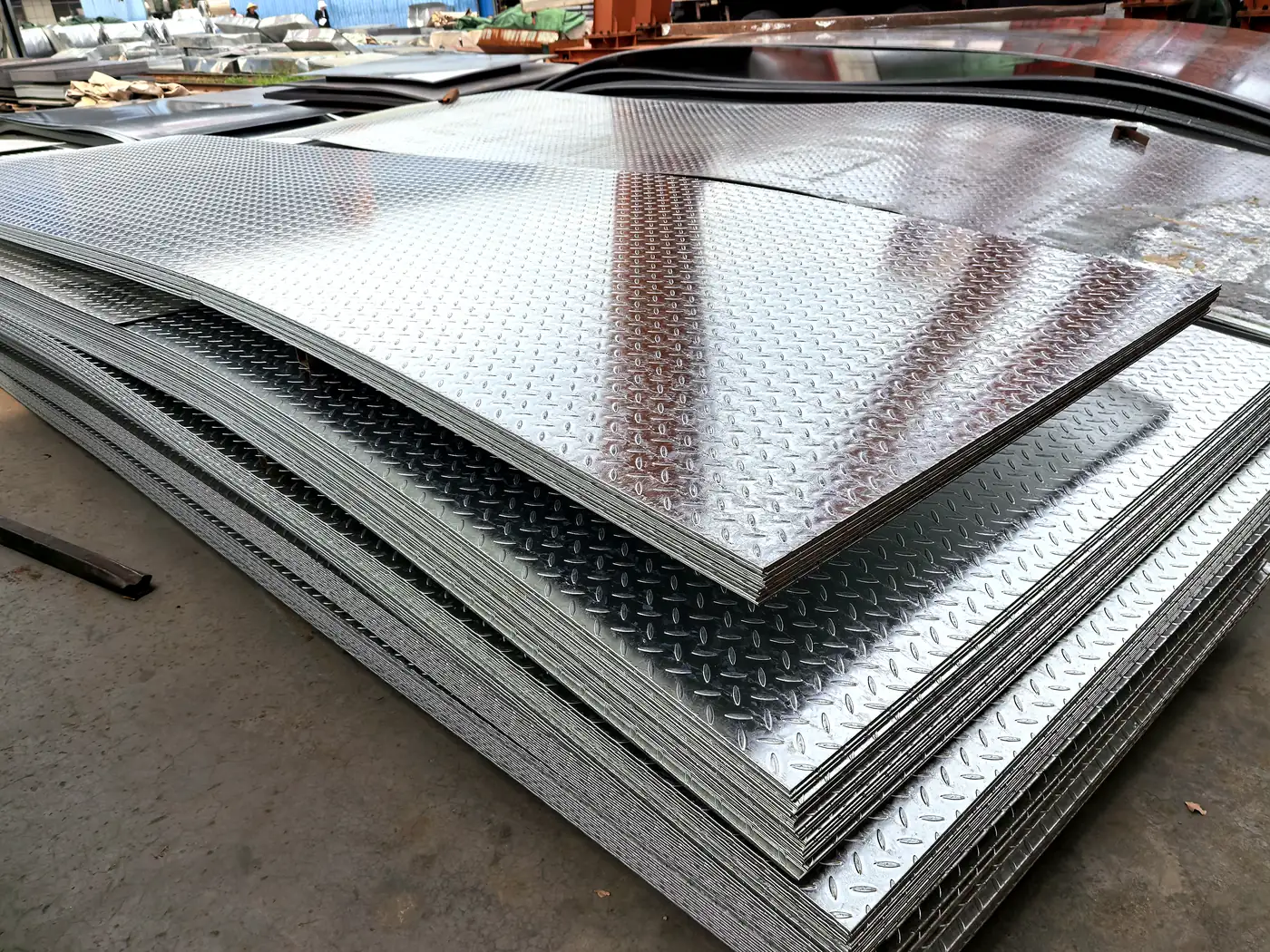
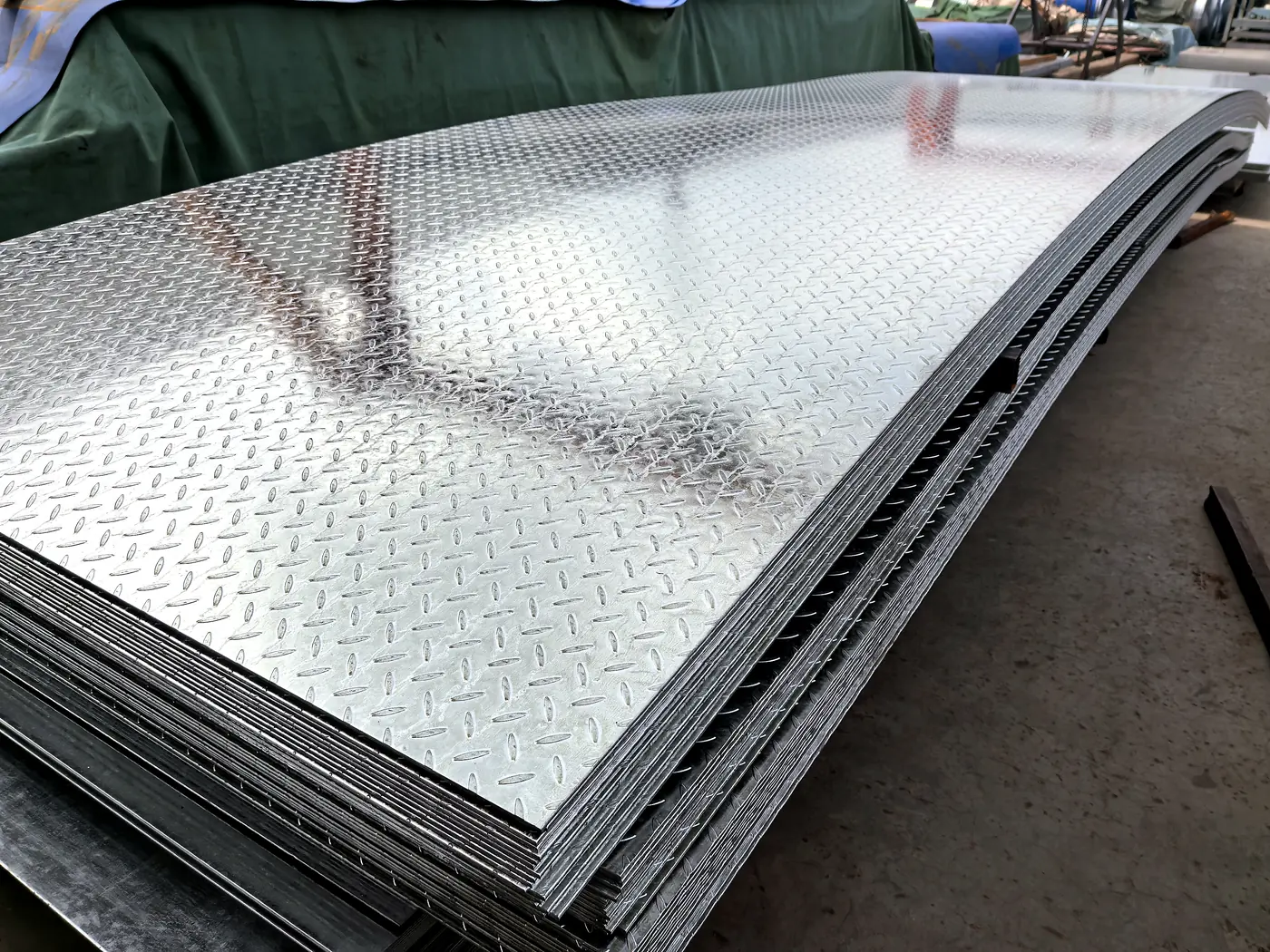
Hot-dip galvanized checkered plate in Q235B base material, base thickness 2.0 mm to 8 mm, with diamond or lentil pattern. The zinc coating protects the pattern, the valleys between the bars and the cut edges, giving slip resistance and corrosion protection together for offshore walkways, industrial platforms and slip-resistant flooring.
Product Overview
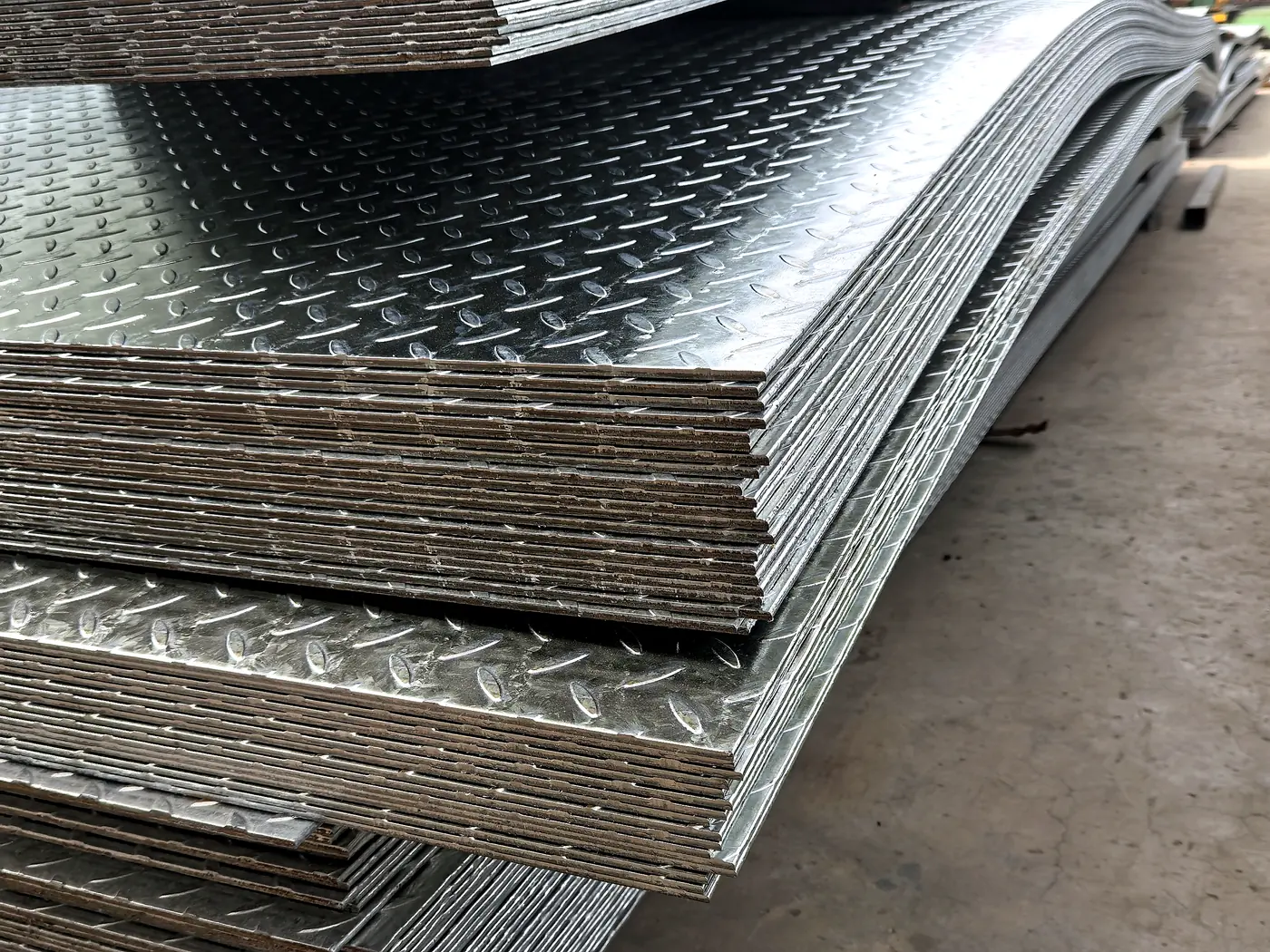
Galvanized checkered plate combines two requirements that appear together on almost every outdoor platform: grip underfoot and resistance to corrosion. The starting material is standard hot-rolled checkered plate in Q235B, with the pattern already rolled into the surface. That plate is then hot-dip galvanized so that a metallurgically bonded zinc coating forms over the whole surface, including the raised bars, the valleys between them and the cut edges of the panel.
The combination matters because the valleys of a checkered pattern are exactly where water collects and where a bare plate will start to corrode. Bare checkered plate on an outdoor platform rusts first between the pattern bars, and painting it does not solve the problem: a paint film fills the pattern and removes most of the grip, then wears away at the highest points where foot traffic is heaviest. Galvanizing protects the plate without filling the pattern, and the sacrificial action of the zinc continues to protect the surface where the coating is scratched or where the panel has been cut.
Service conditions decide the coating weight. Interior and sheltered platforms are adequately served by a light coating, general outdoor exposure calls for a medium coating, and coastal, offshore and industrial atmospheres where salt spray is present should be specified at 275 g/m² or heavier. Because this material is normally cut to size and drilled before galvanizing, we recommend processing the panels first so that the finished part is fully coated, with no bare steel at the edges or around the fixing holes.
Specifications & Size Range
Base thickness and coating combinations. The pattern is diamond or lentil, and the coating weight is nominated against the service environment. Panels cut to size, with holes drilled or punched and edges folded or formed, are processed before galvanizing so the finished part is fully coated.
| Base thickness (mm) | Pattern type | Coating weight (g/m²) | Sheet size (mm) | Typical use |
|---|---|---|---|---|
| 2.0, 2.5, 2.75, 3.0 | Diamond / lentil | 120 / 275 | 1250 × 2400, 1500 × 3000 | Stair treads, access walkways, light platforms, vehicle floors |
| 3.5, 3.75, 4.0, 4.5 | Diamond / lentil | 120 / 275 / 350 | 1250 / 1500 × 6000 | Industrial platforms, walkways, ramps, mezzanine flooring |
| 4.75, 5.0, 5.75, 6.0 | Diamond / lentil | 275 / 350 and heavier | 1500 × 6000, cut to size | Offshore walkways, dock and jetty decking, heavy access ways |
| 7.5, 7.75, 8.0 | Diamond | 275 / 350 and heavier | 1500 × 6000, cut to size | Heavy plant flooring, mining access, machinery platforms |
| Cut, drilled & folded panels | as specified | as specified | to drawing | Ready-to-fit treads, removable platform bays, grating infill panels |
Tolerances
Coating to GB/T 13912, ISO 1461, EN ISO 1461 and ASTM A123, quoted as g/m² total on both surfaces, with about 7 microns of coating thickness per 100 g/m². Coating mass and adhesion are tested per lot and the coating test report travels with the shipment. Base plate thickness follows GB/T 709, with the commercial under-tolerance of about 0.25 mm on the thin and medium gauges stated on the quotation.
Steel Grades & International Equivalents
All grades below are supplied with a mill test certificate. The right-hand column shows the material type and the Chinese standard the grade is produced to; the middle columns give the nearest recognised equivalent in other national standards. Exact equivalence for a specific project should be confirmed on the enquiry.
| GB (China) | ASTM / AISI (US) | EN (Europe) | JIS (Japan) | DIN (Germany) | Type / Standard |
|---|---|---|---|---|---|
| Q235B + hot-dip galvanized | A123 / A153 (ASTM) | EN ISO 1461 | JIS H8641 | DIN 50976 | Hot-dip galvanized structural steel (GB/T 13912) |
| Q235B plate | A36 / A283 Gr.C | S235JR+N (EN 10025-2) | SS400 | St37-2 | Hot-rolled structural plate (GB/T 3274) |
Grade Notes
- Q235B + hot-dip galvanized — Zinc coating of 30–700 g/m² gives 5–30+ years of atmospheric corrosion protection depending on thickness and environment.
- Q235B plate — General structural plate for fabrication, welding and machining. Thickness tolerance to GB/T 709.
Chemical Composition (%, ladle analysis)
Typical specification limits. Actual heat values are reported on the mill test certificate supplied with every shipment.
| Grade | C | Si | Mn | P max | S max | Other elements |
|---|---|---|---|---|---|---|
| Q235B plate | ≤0.20 | ≤0.35 | ≤1.40 | ≤0.045 | ≤0.045 | — |
Mechanical Properties
Minimum values at room temperature unless stated. ReL = yield strength; Rp0.2 = 0.2% proof stress; Rm = tensile strength; A = elongation after fracture.
| Grade | Yield (ReL) | Proof (Rp0.2) | Tensile (Rm) | Elongation A | Impact / others | |
|---|---|---|---|---|---|---|
| Q235B + hot-dip galvanized | — | — | — | — | — | Coating 30–700 g/m² (both sides), made to order Adhesion per GB/T 13912 bend test |
| Q235B plate | ≥235 MPa | — | 370–500 MPa | ≥26% | +20 °C, ≥27 J | — |
Standards & Documents
- GB/T 13912 — hot-dip galvanized coatings on fabricated iron and steel articles
- ISO 1461 / EN ISO 1461 — hot-dip galvanized coatings (international equivalent)
- ASTM A123 — zinc (hot-dip galvanized) coatings on iron and steel products
- GB/T 3277 — hot-rolled checkered steel plate: pattern dimensions and base thickness tolerance
- GB/T 700 — carbon structural steels (Q235B base material); GB/T 709 for base plate dimensions
- Zinc bath to EN 1179 (Zn 99.995 per cent minimum); coating mass test report with every lot
Typical Applications
| Industry / Application | Typical use |
|---|---|
| Offshore & marine walkways | Access walkways, deck routes and platform flooring on marine and offshore installations, where salt spray would destroy a bare or painted surface within a season. |
| Industrial platforms & staging | Plant operating platforms, maintenance access, mezzanine flooring and equipment staging in outdoor or humid environments. |
| Stair treads & egress routes | Outdoor escape stairs, fire stairs, landings and ramps, supplied cut and drilled to the fabrication drawing. |
| Jetties, docks & quayside areas | Deck plates, mooring access routes and quayside walkways exposed to continuous salt spray and abrasion. |
| Water & wastewater plant | Walkways, covers and access flooring around tanks, channels and treatment equipment, where permanent damp makes uncoated steel unsuitable. |
| Cold store & food plant floors | Animal welfare flooring, trolley running surfaces and wet-process access plates. |
| Mining & quarry plant | Access and maintenance flooring on screens, crushers and conveyor structures, where the heavier base gauges resist impact as well as corrosion. |
Common Problems Buyers Face — and How We Prevent Them
These are the issues that most often cause claims on steel imports. Each one is controlled in our process before shipment.
Coating does not reach into the valleys of the pattern
Why it happens: Pattern valleys trap air and dip draining is slower in a checkered surface, so a poorly jigged dip produces thin coverage between the bars where corrosion starts first.
Our control: Panels are jigged with the pattern oriented so the zinc drains freely, and the coating mass is checked on the finished part rather than assumed from the bath. Panels are inspected after dipping, and the coating test report is issued with the shipment.
White rust appearing between the pattern bars in transit
Why it happens: The valleys of the pattern hold moisture and restrict air movement, so wet-storage stain forms quickly when stacked panels are shipped damp or bundled tightly.
Our control: Panels are shipped dry with spacers between bundles so air can circulate, and passivation can be applied where appearance is critical. On long or humid routes VCI paper is added inside the bundle.
Coating damaged at cut edges and drilled holes
Why it happens: Cutting and drilling after galvanizing exposes bare steel, and on a platform the exposed edges are exactly where corrosion begins.
Our control: We cut, punch or drill to your drawing before galvanizing so the finished panel is fully coated. Where site modification is unavoidable, use zinc-rich repair paint on the affected area, and we can supply the correct touch-up material with the order.
Panels warping during the galvanizing dip
Why it happens: The galvanizing thermal cycle releases rolling stress, so thin panels and long narrow treads can bow or twist if they are not jigged and cooled correctly.
Our control: Jigging and dip sequence are planned for slender panels, and straightness is checked after galvanizing. Where a panel is distortion-sensitive, tell us at the enquiry and we will propose a heavier base thickness or a different detail for that item.
Slip resistance assumed from the pattern alone
Why it happens: A galvanized checkered surface left with a heavy oil or grease film will be slippery regardless of the pattern, and the pattern does not compensate for a smooth coating of contamination.
Our control: The material is supplied clean and dry. In service, the correct maintenance is cleaning rather than coating: galvanized checkered plate should be kept free of oil and grease, and it should never be painted, because a paint film fills the pattern and removes the grip.
Our Supply & Manufacturing Advantages
- Grip and corrosion protection together — A galvanized checkered surface stays slip resistant because the coating does not fill the pattern, and it stays protected because the zinc keeps working between the bars.
- Cut and drilled before galvanizing — Treads and platform panels are processed first, so the delivered part is coated at the edges and around every fixing hole with no bare steel.
- Coating matched to the site — Coating weight is nominated against the actual atmosphere, from light interior platforms to 275 g/m² and heavier for coastal and offshore installations.
- No painting and no maintenance cycle — Galvanized plate does not need the repainting cycle that a bare platform requires, which removes the access, surface preparation and disruption cost of maintenance painting.
- Documented coating — Coating mass test report plus an EN 10204 3.1 mill certificate for the base plate with every lot, and third-party inspection on request.
- Export packaging that protects the coating — Panels are bundled with spacers and edge protection, shipped dry, so the coating and the pattern arrive undamaged.
Packaging, Delivery & Payment
- Packing: loose in bulk vessel, or bundled and containerised to your requirement. Galvanized and coated products get VCI paper, waterproof wrapping and edge protection. See our export packaging methods.
- Availability: both stock and custom production. Tell us the specification and we will confirm the route.
- MOQ: no strict minimum — one ton can ship.
- Lead time: stock dispatched to port within 3 days; orders needing export packaging about 1 week; custom production quoted per product.
- Payment: stock — 10% deposit, balance before shipment; custom production — 50% deposit, balance before shipment.
- Documents: EN 10204 3.1 mill test certificate with every shipment; third-party inspection (SGS / BV) on request.
Frequently Asked Questions
What is the difference between plain checkered plate and galvanized checkered plate?
For dry indoor platforms and vehicle floors, plain checkered plate is adequate and cheaper. For anything outdoors, in a wet process area, or within reach of salt spray, galvanized is the correct choice: plain plate rusts first in the valleys of the pattern, and painting fills the pattern and removes most of the grip. Galvanizing costs more per ton but removes the entire repainting cycle.
What coating weight should I specify for a coastal platform?
For a coastal, offshore or salt-spray environment specify 275 g/m² or heavier, which is roughly 19 microns of coating per face. For general inland outdoor exposure 120 to 275 g/m² is normal, and for sheltered or interior platforms 80 to 120 g/m² is adequate. The figure quoted is the total on both surfaces. Tell us the location and we will nominate the coating weight.
Does galvanizing remove the slip resistance of the pattern?
No. The zinc coating is only tens of microns thick and follows the surface, so the raised bars of the pattern remain fully formed. What does remove slip resistance is painting, because a paint film bridges the valleys between the bars and creates a smooth surface. That is the main reason to galvanize rather than paint an anti-slip plate.
Is galvanized checkered plate compliant with ASTM A123?
Yes. The coating is produced and tested to meet ASTM A123 as well as GB/T 13912 and ISO 1461. If your specification references ASTM A123, state it on the enquiry and the coating inspection will be carried out and reported against that standard.
What is the base thickness tolerance on galvanized checkered plate?
The base plate follows the normal commercial tolerance: a nominal 3 mm checkered plate measures about 2.75 mm and a nominal 6 mm plate about 5.75 mm, roughly 0.25 mm under nominal on the thin and medium gauges, with a wider band on the thicker grades. Full-thickness base plate is available on request. The zinc coating is additional to the base thickness.
Can the panels be cut and drilled to my drawing before galvanizing?
Yes, and we recommend it strongly for this product, because cutting or drilling after galvanizing leaves bare steel at the edge or around the hole, exactly where corrosion begins. Send the cutting drawing with the walking direction marked, and the panels will be cut, drilled, folded where required and then galvanized as finished parts.
How long will galvanized checkered plate last outdoors?
Service life depends almost entirely on coating weight and atmosphere. A light coating in a dry inland environment will give many years of service, while a 275 g/m² coating or heavier is used for coastal and industrial atmospheres where a maintenance-free life measured in decades is expected. The zinc coating protects by sacrificial action, so it continues to protect the steel at scratches and cut edges.
What is the difference between galvanized checkered plate and checkered plate with a painted finish?
A painted finish is a barrier film: once it is scratched, corrosion starts at the scratch, and the paint bridges the pattern and reduces grip. Galvanizing forms a metallurgically bonded zinc coating that protects the steel sacrificially, including at scratches and cut edges, and it does not fill the pattern. For anti-slip flooring exposed to weather, galvanizing is the more durable specification.
What is the minimum order quantity and the lead time?
There is no strict minimum and one ton can ship. Galvanized material in common base thicknesses reaches the port in about one week, because the base plate is cut and drilled before dipping. Non-standard thicknesses, coating weights and cut patterns are quoted per item.
Request a Quotation Export Packaging