
Stainless Steel Sheet & Plate (304, 316L), 2B / BA / No.4 / Hairline / Mirror
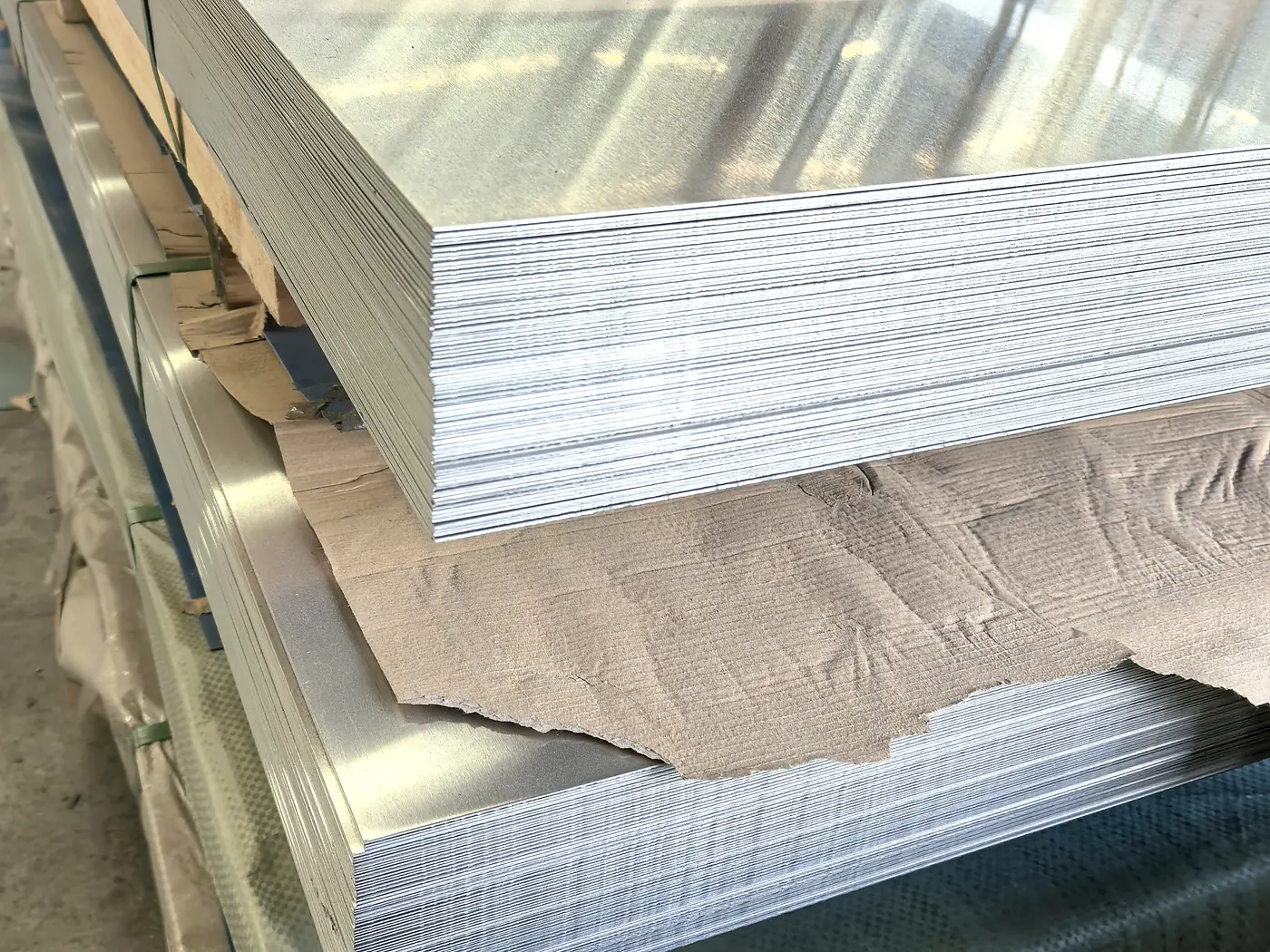
Stainless steel sheet and plate in 304 and 316L, from 0.3 mm to 60 mm, in 2B, BA, No.4, hairline and mirror finishes. Widths 1000 mm to 1500 mm with sheet lengths 2000 mm to 6000 mm, supplied cut to size, with film protection and mill test certificate showing full chemical analysis.
Product Overview
Stainless steel sheet is chosen when corrosion resistance and appearance both matter, or when the service involves chlorides, acids, food contact or high temperature. Grade 304, the 18 per cent chromium 8 per cent nickel austenitic grade, covers normal corrosive environments and is the general-purpose choice for kitchen equipment, food plant, architectural trim and general fabrication. Grade 316L adds 2 to 3 per cent molybdenum with a controlled low carbon content, which markedly improves resistance to chlorides and acids and makes it the correct choice for marine atmosphere, chemical plant and salt-bearing food production.
Thickness spans 0.3 mm to 60 mm. Material up to about 6 mm is normally supplied as cold-rolled sheet in coil or cut lengths, and above that as hot-rolled plate, which is supplied pickled or with a mill finish according to the specification. Surface finish is usually what the customer actually sees, so it is stated explicitly on the order: 2B is the standard cold-rolled annealed and pickled finish with a matte appearance; BA is bright annealed and is close to a mirror; No.4 and hairline are polished finishes with a directional grain, No.4 being the coarser of the two; and mirror finish gives a fully reflective architectural surface.
Because grade and finish are both visible and both easy to misrepresent, this is a product where documentation matters. Every shipment carries a mill test certificate with the full chemical analysis and mechanical properties, and where a project calls for independent verification, third-party inspection and spectroscopic grade identification can be arranged before loading. A protective film is applied to polished surfaces so the finish survives handling and sea transit.
Specifications & Size Range
Thickness, width and finish combinations. Sheet from 0.3 mm to 6 mm is cold-rolled and is held in the common appliance and architectural widths, in coils or cut lengths of 2000 mm to 6000 mm. Plate above 6 mm is hot-rolled. Polished finishes are made to order and the film protection and finish direction are agreed on the enquiry.
| Thickness range | Common thicknesses (mm) | Width (mm) | Standard finish | Typical use |
|---|---|---|---|---|
| Thin sheet | 0.3, 0.4, 0.5, 0.6, 0.8 | 1000 / 1219 / 1250 | 2B / BA | Appliance panels, kitchen equipment, trim, signage |
| General sheet | 1.0, 1.2, 1.5, 2.0, 2.5 | 1000 / 1219 / 1250 / 1500 | 2B / BA / No.4 / hairline | Food plant, worktops, tanks, architectural cladding |
| Plate, thin | 3.0, 4.0, 5.0, 6.0 | 1250 / 1500 / 2000 | No.1 pickled / No.4 / hairline | Tank shells, process equipment, structural trim |
| Plate, medium | 8, 10, 12, 14, 16, 20 | 1500 / 2000 / 2500 | No.1 pickled | Pressure equipment, chemical plant, marine structures |
| Plate, heavy | 25, 30, 40, 50, 60 | 1500 / 2000 / 2500 | No.1 pickled | Heavy process and marine fabrications, machined parts |
Tolerances
Sheet thickness and flatness follow GB/T 3280 for cold-rolled stainless sheet and GB/T 4237 for hot-rolled stainless plate, with thickness tolerance tightening as the gauge reduces. Polished finishes are supplied to the agreed finish standard and grain direction, and finish quality is inspected before film is applied. Chemical composition and mechanical properties are certified by the mill, and independent grade verification can be arranged on request.
Steel Grades & International Equivalents
All grades below are supplied with a mill test certificate. The right-hand column shows the material type and the Chinese standard the grade is produced to; the middle columns give the nearest recognised equivalent in other national standards. Exact equivalence for a specific project should be confirmed on the enquiry.
| GB (China) | ASTM / AISI (US) | EN (Europe) | JIS (Japan) | DIN (Germany) | Type / Standard |
|---|---|---|---|---|---|
| 06Cr19Ni10 (304) | A240 TP304 / A276 304 | 1.4301 / X5CrNi18-10 | SUS304 (JIS G4304) | 1.4301 | Austenitic stainless steel (GB/T 3280 / GB/T 4237) |
| 022Cr17Ni12Mo2 (316L) | A240 TP316L | 1.4404 / X2CrNiMo17-12-2 | SUS316L (JIS G4304) | 1.4404 | Austenitic stainless steel (Mo-bearing) (GB/T 3280 / GB/T 4237) |
Grade Notes
- 06Cr19Ni10 (304) — General-purpose austenitic stainless steel: corrosion resistant, formable and weldable. Non-magnetic in annealed condition.
- 022Cr17Ni12Mo2 (316L) — Mo-bearing stainless steel with superior resistance to chlorides and acids. Preferred for marine, chemical and food-grade equipment.
Chemical Composition (%, ladle analysis)
Typical specification limits. Actual heat values are reported on the mill test certificate supplied with every shipment.
| Grade | C | Si | Mn | P max | S max | Other elements |
|---|---|---|---|---|---|---|
| 06Cr19Ni10 (304) | ≤0.07 | ≤0.75 | ≤2.00 | ≤0.045 | ≤0.030 | Cr 18.0–20.0 Ni 8.0–10.5 |
| 022Cr17Ni12Mo2 (316L) | ≤0.030 | ≤0.75 | ≤2.00 | ≤0.045 | ≤0.030 | Cr 16.0–18.0 Ni 10.0–14.0 Mo 2.00–3.00 |
Mechanical Properties
Minimum values at room temperature unless stated. ReL = yield strength; Rp0.2 = 0.2% proof stress; Rm = tensile strength; A = elongation after fracture.
| Grade | Yield (ReL) | Proof (Rp0.2) | Tensile (Rm) | Elongation A | Impact / others | |
|---|---|---|---|---|---|---|
| 06Cr19Ni10 (304) | — | ≥205 MPa | ≥515 MPa | ≥40% | — | — |
| 022Cr17Ni12Mo2 (316L) | — | ≥170 MPa | ≥485 MPa | ≥40% | — | — |
Standards & Documents
- GB/T 3280 — cold-rolled stainless steel sheet and strip (304 / 316L, dimensions and properties)
- GB/T 4237 — hot-rolled stainless steel sheet and plate (plate grades and delivery conditions)
- ASTM A240 — chromium and chromium-nickel stainless steel plate, sheet and strip for pressure vessels and general applications
- EN 10088 / EN 1.4301 and 1.4404, and JIS G4304 SUS304 / SUS316L grade equivalents
- Chemical composition: 304 to 06Cr19Ni10 (18-20 per cent Cr, 8-10.5 per cent Ni); 316L to 022Cr17Ni12Mo2 (Mo 2-3 per cent, C 0.03 per cent maximum)
- EN 10204 3.1 mill test certificate with full chemical analysis; spectroscopic grade verification and third-party inspection on request
Typical Applications
| Industry / Application | Typical use |
|---|---|
| Food & beverage processing | Work surfaces, tables, mixers and filling equipment, conveyor frames, storage and process tanks and pipework, where 304 satisfies normal hygienic requirements and 316L is used for salt-bearing or acidic products. |
| Chemical & pharmaceutical plant | Reactor and vessel shells, heat exchanger plate, columns, process pipework supports and clean-room equipment, where 316L is normally specified for its resistance to chlorides and acids. |
| Marine & offshore | Deck fittings, handrails, ladder and platform components, bollards and trim, and seawater-exposed equipment, where the molybdenum in 316L resists chloride attack. |
| Architecture & building | Cladding and façade panels, lift car interiors, column and beam cladding, stair and balustrade trim, signage and decorative screens, in a finish matched to the design intent. |
| Commercial kitchen equipment | Cooking and preparation surfaces, sinks and drainers, hoods, shelving and trolleys, where the material must be cleanable, corrosion resistant and hard wearing. |
| Water & sanitary installations | Drinking water tanks and pipework, water treatment plant components, pool plant equipment and sanitary fittings, where 304 is normally adequate and 316L suits aggressive or high-chloride water. |
| General engineering & instrument housings | Instrument and control cases, machine guards, brackets and components where cleanliness, corrosion resistance or a specific surface appearance is required. |
Common Problems Buyers Face — and How We Prevent Them
These are the issues that most often cause claims on steel imports. Each one is controlled in our process before shipment.
Surface rust appearing on stainless steel after installation
Why it happens: Stainless steel resists corrosion through a passive chromium-oxide film, and that film is disrupted by contamination — carbon steel dust from grinding, swarf from a nearby process or chloride deposits. The steel then rusts at spots where the film has been broken.
Our control: Sheet is supplied with film protection and shipped clean and dry. On site, fabricate stainless with dedicated tools, avoid carbon steel contamination, and passivate or clean after fabrication. Where chlorides are present in service, specify 316L rather than 304.
The grade delivered is not the grade ordered
Why it happens: 304 and 316L look, weigh and finish identically, and the difference only shows up in service or in a spectroscopic check, so substitution is a real risk in this product line.
Our control: Every shipment carries a mill test certificate with full chemical analysis showing chromium, nickel and molybdenum content. Where the project requires it, independent spectroscopic grade verification and third-party inspection can be arranged before loading, and heat numbers are recorded through packing.
The polished surface is scratched or damaged on arrival
Why it happens: Polished and mirror surfaces are soft in appearance terms and show every scuff, and they are easily damaged by unprotected stacking, handling or transit.
Our control: Polished sheet is supplied with a protective film and interleaved with spacers during packing. The film is applied at the mill side of the process and should be removed promptly after installation, since leaving it in place for months under sunlight can leave adhesive residue.
Stress-corrosion cracking in a chloride environment
Why it happens: Austenitic stainless steels are susceptible to stress-corrosion cracking where chlorides, tensile stress and moderately elevated temperature exist together, which is a common combination in chemical and coastal process plant.
Our control: Where the service temperature is elevated and chlorides are present, specify 316L and design out residual tensile stress from forming and welding. Send us the service conditions — medium, chloride level and temperature — and we will confirm whether an austenitic grade is suitable.
Parts arriving with the wrong finish or the wrong grain direction
Why it happens: Finish is specified loosely as polished or brushed, and the drawing does not state the grain direction, so the delivered material looks different from the sample when it is installed.
Our control: The finish is named on the order: 2B, BA, No.4, hairline or mirror, together with the grain direction relative to the part. Where the appearance is critical, we supply a physical sample of the finish for approval before the production order is placed.
Our Supply & Manufacturing Advantages
- Two grades covering most services — 304 for general corrosive environments and 316L for chlorides, acids and marine exposure, with the molybdenum and carbon content certified on the mill certificate.
- Finish specified by name — 2B, BA, No.4, hairline and mirror finishes, with grain direction agreed at the enquiry and film protected for transit, so the installed appearance matches the approved sample.
- Sheet and plate from one supplier — Cold-rolled sheet from 0.3 mm and hot-rolled plate to 60 mm, so a project does not combine two suppliers and two sets of certificates.
- Documentation that prevents dispute — Full chemical analysis on the mill test certificate, with spectroscopic grade verification and third-party inspection available before loading.
- Cut-to-size supply — Sheet and plate cut to your blank size, which removes offcut waste and shearing from your own process and preserves the finish during handling.
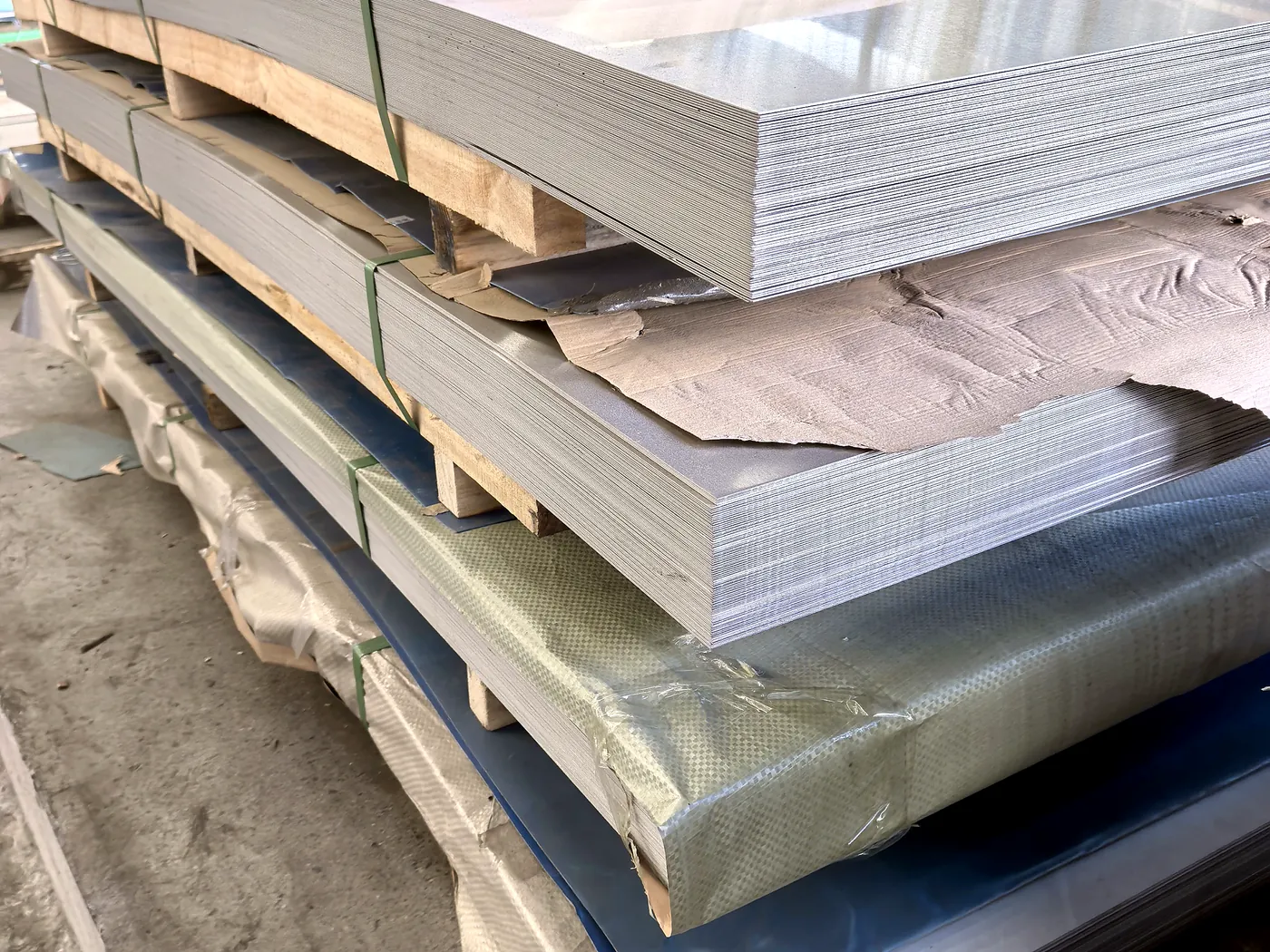
- Export packaging for a soft surface — Film protection, interleaved stacking and edge protection, shipped dry, so the finished surface arrives without the scuffs that a plain sheet bundle would collect.
Packaging, Delivery & Payment
- Packing: loose in bulk vessel, or bundled and containerised to your requirement. Galvanized and coated products get VCI paper, waterproof wrapping and edge protection. See our export packaging methods.
- Availability: both stock and custom production. Tell us the specification and we will confirm the route.
- MOQ: no strict minimum — one ton can ship.
- Lead time: stock dispatched to port within 3 days; orders needing export packaging about 1 week; custom production quoted per product.
- Payment: stock — 10% deposit, balance before shipment; custom production — 50% deposit, balance before shipment.
- Documents: EN 10204 3.1 mill test certificate with every shipment; third-party inspection (SGS / BV) on request.
Frequently Asked Questions
Should I use 304 or 316L stainless steel?
304 is the general-purpose austenitic grade and is correct for most indoor, food and architectural applications where chlorides are not concentrated. 316L contains 2 to 3 per cent molybdenum and a maximum of 0.03 per cent carbon, which improves resistance to chlorides and acids, so it is the right choice for marine atmosphere, salt-bearing food production, chemical plant and elevated-temperature chloride service. If you tell us the medium, the chloride level and the temperature, we will nominate the grade.
What is the difference between 2B and BA finish?
2B is the standard cold-rolled, annealed and pickled finish. It is smooth and matte and takes further polishing, and it is the usual finish for industrial and food plant work. BA is bright annealed, produced in a controlled atmosphere so no pickling is needed, and it is close to a mirror and is used where appearance matters without the cost of a full polish.
What is the difference between No.4 and hairline finish?
Both are polished finishes with a directional grain, and the difference is the coarseness of that grain. No.4 is the coarser, more visible brushed grain usually seen on commercial kitchen equipment and lift interiors. Hairline is a finer, smoother, longer grain often specified for architectural cladding and trim, where a subtle surface is wanted. Grain direction is stated on the order because it changes the look of the installed panel.
Is 304 stainless steel equivalent to ASTM A240 Type 304?
Yes. Chinese 304 corresponds to 06Cr19Ni10 to GB/T 3280 and to ASTM A240 Type 304 and EN 1.4301, and 316L corresponds to 022Cr17Ni12Mo2, ASTM A240 Type 316L and EN 1.4404. The chemistry and mechanical properties are equivalent, and the mill certificate states the Chinese designation with the corresponding international grade.
Will stainless steel rust?
Stainless steel resists corrosion through a passive chromium-oxide surface film, not because it cannot corrode. If the film is disrupted by carbon steel contamination, chlorides or poor cleaning, localised rust can appear, particularly on 304 in a coastal or chloride-bearing environment. Keeping the surface clean, fabricating with dedicated tools and choosing 316L where chlorides are present prevents the problem in almost all cases.
Can stainless steel sheet be welded and formed?
Yes. Both 304 and 316L are readily welded by TIG or MIG and are formed and bent without difficulty, though they work-harden faster than carbon steel, so tighter bend radii and higher forming forces are needed. The low carbon content of 316L is specifically there to reduce the risk of sensitisation at weld zones in corrosive service.
Who supplies stainless steel sheet from China for export?
We do. Stainless sheet and plate in 304 and 316L are produced by major Chinese mills and shipped with an EN 10204 3.1 mill test certificate showing full chemical analysis. Tell us the grade, thickness, finish, size and quantity, and we will confirm availability. Trial quantities from one ton are accepted.
Do you have a minimum order quantity and what is the lead time?
There is no strict minimum order quantity and one ton can ship. Common sizes reach the port in about 3 days; orders requiring a polished finish, film protection, cut-to-size blanks or third-party verification take about one week. Non-standard finishes and sizes are quoted per item.
What documents are supplied with a stainless steel shipment?
An EN 10204 3.1 mill test certificate with heat number, full chemical analysis including chromium, nickel and molybdenum, and mechanical properties, plus the commercial invoice, packing list and certificate of origin. Spectroscopic grade verification and third-party inspection by SGS or BV can be arranged before loading.
Request a Quotation Export Packaging